Zhao Xiaoxuan, Jiang Yuepeng, Xi Hongyan, Chen Lu, Feng Xiaoling
Department of Heilongjiang University of Chinese Medicine, Harbin 150040, China.
Department of Zhejiang Chinese Medical University, Hangzhou 310053, China.
Geburtshilfe Frauenheilkd. 2020 Feb;80(2):161-171. doi: 10.1055/a-1081-2036. Epub 2020 Feb 21.
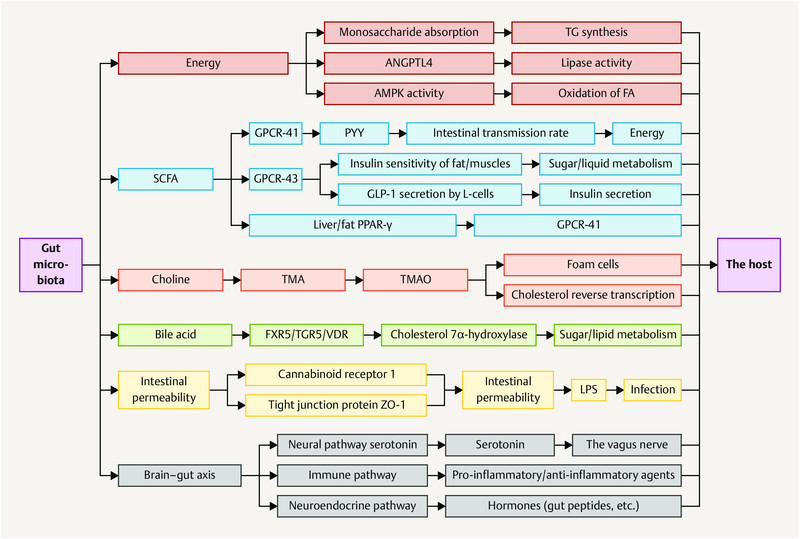
Polycystic ovary syndrome (PCOS) is an endocrine and metabolic syndrome (MS) with a complex etiology, and its pathogenesis is not yet clear. In recent years, the correlation between gut microbiota (GM) and metabolic disease has become a hot topic in research, leading to a number of new ideas about the etiology and pathological mechanisms of PCOS. The literature shows that GM can cause insulin resistance, hyperandrogenism, chronic inflammation and metabolic syndrome (obesity, diabetes) and may contribute to the development of PCOS by influencing energy absorption, the pathways of short chain fatty acids (SCFA), lipopolysaccharides, choline and bile acids, intestinal permeability and the brain-gut axis. As part of the treatment of PCOS, fecal microbiota transplantation, supplementation with prebiotics and traditional Chinese medicine can be used to regulate GM and treat disorders. This article reviews possible mechanisms and treatment options for PCOS, based on methods which target the GM, and offers new ideas for the treatment of PCOS.
多囊卵巢综合征(PCOS)是一种病因复杂的内分泌和代谢综合征(MS),其发病机制尚不清楚。近年来,肠道微生物群(GM)与代谢性疾病之间的相关性已成为研究热点,催生出一些关于PCOS病因和病理机制的新观点。文献表明,GM可导致胰岛素抵抗、高雄激素血症、慢性炎症和代谢综合征(肥胖、糖尿病),并可能通过影响能量吸收、短链脂肪酸(SCFA)、脂多糖、胆碱和胆汁酸的代谢途径、肠道通透性及脑-肠轴,促进PCOS的发展。作为PCOS治疗的一部分,可采用粪便微生物群移植、补充益生元和中药来调节GM并治疗相关病症。本文基于针对GM的方法,综述了PCOS可能的机制和治疗选择,为PCOS的治疗提供新思路。