Yeh Chao Hsing, Caswell Keenan, Pandiri Sonaali, Sair Haris, Lukkahatai Nada, Campbell Claudia M, Stearns Vered, Van de Castle Barbara, Perrin Nancy, Smith Thomas J, Saligan Leorey N
Johns Hopkins University School of Nursing, Baltimore, Maryland.
Department of Radiology, Johns Hopkins University School of Medicine, Baltimore, Maryland.
Glob Adv Health Med. 2020 Feb 13;9:2164956120906092. doi: 10.1177/2164956120906092. eCollection 2020.
The objective of this study was to investigate the dynamic brain activity following auricular point acupressure (APA) in chemotherapy-induced neuropathy (CIN).
Participants received 4 weeks of APA in an open-pilot trial with repeated observation. Along with the clinical self-reported CIN outcomes, objective outcomes were measured over the course of the treatment by physiological changes in pain sensory thresholds from quantitative sensory testing (QST) and repeated functional magnetic resonance imaging scans.
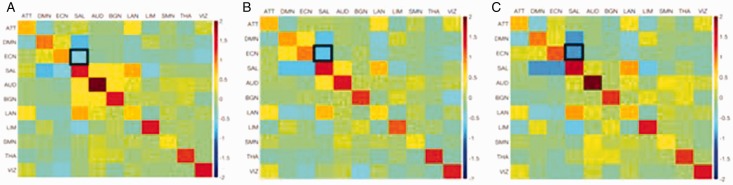
After 4 weeks of APA, participants had reported clinically significant improvements (ie, ≥30%) in a reduction of CIN symptoms (including pain, numbness, tingling, and stiffness) in lower extremity stiffness (32%), reduced foot sensitivity (13%), and higher pain threshold (13%). Across the 11 intrinsic brain networks examined, there was a trend toward significance of the connectivity of the basal ganglia network (BGN) to the salience network (SAL), which was decreased pre-APA versus immediate-APA (effect size [ES] = 1.04, = .07). The BGN also demonstrated decreased connectivity with the language network pre-APA versus delayed imaging post-APA (ES = -0.92, = .07). Furthermore, there was increased executive control network (ECN) and SAL within-network connectivity comparing pre-APA to delayed imaging post-APA, trending toward significance (ES = 0.41, = .09 and ES = 0.17, = .09, respectively).
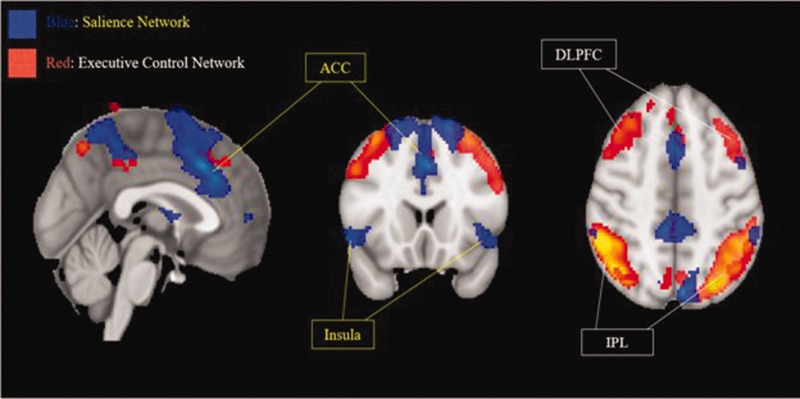
The changes in connectivity and activity within or between the ECN, SAL, and BGN from pre- to post-APA suggest ongoing alterations in brain functional connectivity following APA, particularly in the insula, anterior cingulate, and dorsolateral prefrontal cortices, which play significant roles in pain, memory, and cognitive function.
本研究的目的是调查化疗引起的神经病变(CIN)患者接受耳穴按压(APA)后的大脑动态活动。
在一项开放试点试验中,参与者接受了4周的APA治疗,并进行了重复观察。除了临床自我报告的CIN结果外,在治疗过程中还通过定量感觉测试(QST)中疼痛感觉阈值的生理变化以及重复的功能磁共振成像扫描来测量客观结果。
经过4周的APA治疗后,参与者报告CIN症状(包括疼痛、麻木、刺痛和僵硬)有临床显著改善(即≥30%),下肢僵硬减轻(32%),足部敏感性降低(13%),疼痛阈值提高(13%)。在所检查的11个内在脑网络中,基底神经节网络(BGN)与突显网络(SAL)的连接性有显著趋势,与APA前相比,APA即刻时连接性降低(效应大小[ES]=1.04,P=0.07)。与APA前相比,APA后延迟成像时,BGN与语言网络的连接性也降低(ES=-0.92,P=0.07)。此外,与APA前相比,APA后延迟成像时,执行控制网络(ECN)和SAL的网络内连接性增加,有显著趋势(ES分别为0.41,P=0.09和ES=0.17,P=0.09)。
从APA前到APA后,ECN、SAL和BGN内部或之间的连接性和活动变化表明,APA后大脑功能连接持续改变,特别是在岛叶、前扣带回和背外侧前额叶皮质,这些区域在疼痛、记忆和认知功能中起重要作用。