Division of Epidemiology, School of Public Health, University of California, Berkeley, US.
Division of Environmental Health Sciences, School of Public Health, University of California, Berkeley, US.
Ann Glob Health. 2020 Feb 21;86(1):17. doi: 10.5334/aogh.2470.
Heavy load carrying has been associated with musculoskeletal discomfort (MSD) and disability. However, there is a lack of research investigating this association in resource-constrained settings where heavy load carrying by women is common.
We assessed the impact of heavy load carrying on musculoskeletal pain and disability among women in Shinyanga Region, Tanzania, in an exploratory cross-sectional study.
Eligible participants were a convenience sample of women, at least 18 years of age, who passed a study recruitment site carrying a load. We collected information on load-carrying practices, including frequency and time spent carrying water, wood, agricultural products, coal, sand, or rocks, and measured the weight of the load carried at the time. Outcomes included self-reported MSDs, defined as experiencing pain lasting >3 days in the neck, head, back, knees, feet and/or ankles within the last 1 year, and related disability. Using multivariable logistic regression we assessed for associations between load carrying exposures and MSDs and disability.
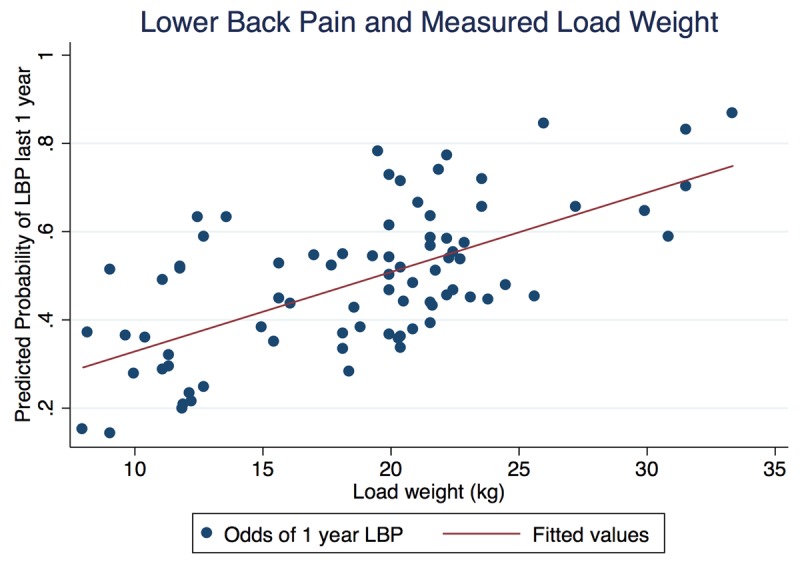
Results showed a high prevalence of MSDs across the body regions assessed and evidence to suggest a relationship of back pain and related disability with several measures of load-carrying, including duration, frequency, and weight. Multivariable analyses revealed associations of increased load carrying exposures with low back pain (LBP) and related disability, including statistically significant increases in odds of LBP with increasing weight, total duration of load carrying/week and cumulative loads/week.
Findings indicate a substantial burden of MSDs and disability in this population of women who carry heavy loads daily. The extent of discomfort and disability increased with increasing exposure to various load-carrying measures, especially for LBP. Larger epidemiologic studies that definitively assess relationships of load carrying with MSDs and disability are warranted.
重负荷搬运与肌肉骨骼不适(MSD)和残疾有关。然而,在资源有限的环境中,女性普遍进行重负荷搬运,针对这种关联的研究却很少。
我们在坦桑尼亚欣延加地区进行了一项探索性横断面研究,评估了重负荷搬运对女性肌肉骨骼疼痛和残疾的影响。
合格的参与者是在研究招募点通过携带负荷的便利样本,年龄至少 18 岁。我们收集了有关负荷搬运实践的信息,包括携带水、木材、农产品、煤、沙或岩石的频率和时间,以及当时携带的负荷重量。结果包括自我报告的 MSD,定义为在过去 1 年内颈部、头部、背部、膝盖、脚和/或脚踝持续疼痛>3 天,以及相关残疾。我们使用多变量逻辑回归评估了负荷搬运暴露与 MSD 和残疾之间的关联。
结果显示,身体各个部位的 MSD 患病率很高,并且有证据表明背部疼痛和相关残疾与几种负荷搬运措施有关,包括持续时间、频率和重量。多变量分析显示,增加负荷搬运暴露与下背部疼痛(LBP)和相关残疾有关,包括随着负荷重量、每周总搬运时间和每周总负荷的增加,LBP 的几率显著增加。
研究结果表明,在这个每天搬运重物的女性人群中,MSD 和残疾的负担很大。不适感和残疾的程度随着对各种负荷搬运措施的暴露程度增加而增加,特别是 LBP。需要进行更大规模的流行病学研究,以明确评估负荷搬运与 MSD 和残疾之间的关系。