Uppala Sravani, Parihar Anuj Singh, Modipalle Varsha, Manual Litto, Oommen Vinni Mary, Karadiguddi Pallavi, Gupta Parkhi
Department of Conservative Dentistry and Endodontics, Drs. Sudha and Nageswara Rao Siddhartha Institute of Dental Sciences, Chinaoutpalli, Andhra Pradesh, India.
Department of Periodontics, People's Dental Academy, Bhopal, Madhya Pradesh, India.
J Family Med Prim Care. 2020 Jan 28;9(1):229-234. doi: 10.4103/jfmpc.jfmpc_707_19. eCollection 2020 Jan.
Bone loss around dental implants is generally measured by monitoring changes in marginal bone level using radiographs. After the first year of implantation, an implant should have <0.2 mm annual loss of marginal bone level to satisfy the criteria of success. However, the success rate of dental implants depends on the amount of the crestal bone around the implants. The main aim of this study was to evaluate and compare the crestal bone loss around implants placed with particulate β-Tricalcium Phosphate Bone Graft and platelet concentrates.
50 individuals received hundred dental implants. Each individual received one dental implant in the edentulous site filled with β-Tricalcium Phosphate Bone Graft along (β-TCP) with Platelet- Rich Plasma (PRP) (Group A) and another in edentulous site filled only with β-Tricalcium Phosphate Bone Graft (Group B) in the posterior edentulous region. All the 100 implants were prosthetically loaded after a healing period of three months. Crestal bone loss was measured on mesial, distal, buccal and lingual side of each implant using periapical radiographs 3 months, 6 months and 9 months after implant placement.
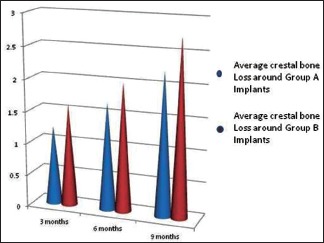
The average crestal bone loss 9 months after the implants placement in Group A and Group B was 2.75 mm and 2.23 mm respectively, the value being statistically significant ( < 0.05). In both Group A and Group B, the average crestal bone loss was maximum on the lingual side followed by buccal, distal and mesial sides.
β-TCP is a promising biomaterial for clinical situations requiring bone augmentation. However, the addition of PRP results in decreased bone loss around the dental implants.
牙种植体周围的骨量丢失通常通过使用X线片监测边缘骨水平的变化来测量。植入后的第一年,种植体边缘骨水平的年丢失量应小于0.2mm才能满足成功标准。然而,牙种植体的成功率取决于种植体周围牙槽嵴骨的量。本研究的主要目的是评估和比较使用颗粒状β-磷酸三钙骨移植材料和浓缩血小板植入种植体周围的牙槽嵴骨丢失情况。
50名个体接受了100颗牙种植体。每个个体在无牙区植入一颗种植体,其中一个无牙区填充β-磷酸三钙骨移植材料(β-TCP)并联合富血小板血浆(PRP)(A组),另一个无牙区仅填充β-磷酸三钙骨移植材料(B组),均位于后牙无牙区。所有100颗种植体在三个月的愈合期后进行修复加载。在种植体植入后3个月、6个月和9个月,使用根尖片在每个种植体的近中、远中、颊侧和舌侧测量牙槽嵴骨丢失情况。
种植体植入9个月后,A组和B组的平均牙槽嵴骨丢失量分别为2.75mm和2.23mm,差异具有统计学意义(<0.05)。在A组和B组中,平均牙槽嵴骨丢失量在舌侧最大,其次是颊侧、远中侧和近中侧。
β-TCP是一种在需要骨增量的临床情况下很有前景的生物材料。然而,添加PRP可减少牙种植体周围的骨丢失。