School of Environmental and Rural Science, University of New England, Armidale, 2351 NSW, Australia.
Baiada Poultry Pty Limited, Pendle Hill, 2145 NSW, Australia.
Poult Sci. 2020 Mar;99(3):1551-1563. doi: 10.1016/j.psj.2019.12.005. Epub 2020 Jan 30.
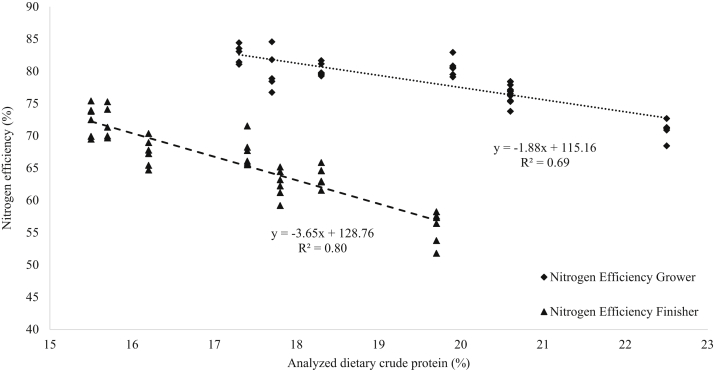
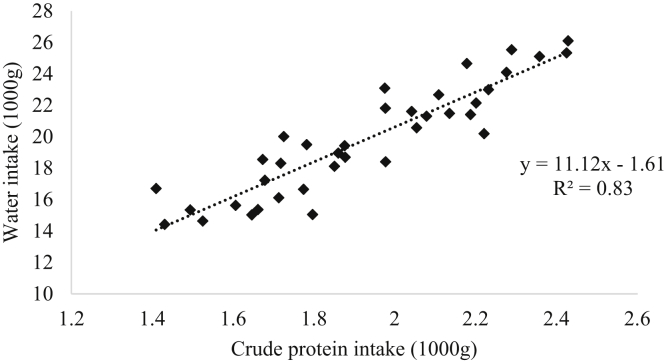
Reducing dietary CP can reduce N pollution. Much research has been reported in corn-based diets; however, the amino acid (AA) profiles of wheat-based diets differ. Poor performance as a result of reduced protein (RP) has been overcome in corn-based diets with essential AA and glycine (Gly) supplementation. The current study examined RP levels and Gly in wheat-based diets. An industry standard protein (SP) diet plus 3 RP diets with and without Gly supplementation, to match the SP treatment at 0.713 and 0.648% digestible Gly for the grower and finisher periods respectively, were fed to male broilers from day 10 of age. Grower CP included 22.5, 20.6, 18.3, and 17.7% (days 10-21) and finisher CP included 19.7, 17.8, 16.2, and 15.5% (days 21-35). Performance, meat yield, N efficiency, water intake, and apparent ileal digestibility of N and AA were measured. No difference in body weight gain (BWG), feed intake, or feed conversion ratio (FCR) were observed at 20% CP compared to the SP treatment. However, further reducing protein reduced BWG (P < 0.001), feed intake (P < 0.001), and increased FCR (P < 0.001). Supplementation of 0.713% Gly in the grower period increased BWG (P < 0.001) and reduced FCR (P < 0.001). Relative meat yield was not affected by dietary protein, however reducing CP increased relative fat pad weight (P < 0.001). Nitrogen efficiency increased with decreased CP in both grower (R = 0.69) and finisher (R = 0.80) treatments. Water intake decreased (R = 0.83) with decreasing CP intake. Apparent ileal digestibility of AA and N were higher in RP diets (P < 0.05). The benefits of reduced water intake and increased N efficiency and the disadvantages of poor performance and increased body fat in RP corn-based diets have been identified in RP wheat-based diets. Furthermore, at 18.5% CP the supplementation of crystalline AA and Gly can maintain BWG and FCR observed in SP diets.
降低日粮 CP 可以减少 N 污染。大量研究已经报道了在玉米基础日粮中;然而,小麦基础日粮的氨基酸(AA)谱不同。通过在玉米基础日粮中添加必需 AA 和甘氨酸(Gly)来克服由于蛋白质(RP)减少而导致的生长性能下降。本研究检查了小麦基础日粮中的 RP 水平和 Gly。从 10 日龄起,给雄性肉鸡饲喂工业标准蛋白(SP)日粮加 3 种 RP 日粮,其中 2 种添加 Gly 补充剂,以分别在生长期和育肥期与 SP 处理相匹配,达到 0.713%和 0.648%可消化 Gly。生长期 CP 分别为 22.5%、20.6%、18.3%和 17.7%(10-21 日龄),育肥期 CP 分别为 19.7%、17.8%、16.2%和 15.5%(21-35 日龄)。测量了生长性能、肉产量、氮效率、水摄入量和 AA 的表观回肠消化率。与 SP 处理相比,20% CP 组的体重增重(BWG)、饲料摄入量或饲料转化率(FCR)无差异。然而,进一步降低蛋白质会降低 BWG(P<0.001)、饲料摄入量(P<0.001)和增加 FCR(P<0.001)。在生长期添加 0.713%的 Gly 可增加 BWG(P<0.001)和降低 FCR(P<0.001)。日粮蛋白质对相对肉产量没有影响,但降低 CP 会增加相对脂肪垫重量(P<0.001)。氮效率随着生长期(R=0.69)和育肥期(R=0.80)处理 CP 的降低而增加。随着 CP 摄入量的减少,水摄入量减少(R=0.83)。AA 和 N 的回肠表观消化率在 RP 日粮中较高(P<0.05)。在 RP 玉米基础日粮中已经确定了减少水摄入、提高氮效率的好处,以及 RP 小麦基础日粮中生长性能下降和体脂增加的缺点。此外,在 CP 为 18.5%时,添加结晶 AA 和 Gly 可以维持 SP 日粮中观察到的 BWG 和 FCR。