Department of Epidemiology and Biostatistics, and Ministry of Education Key Laboratory of Environment and Health, and State Key Laboratory of Environmental Health (Incubating), School of Public Health, Tongji Medical College, Huazhong University of Science and Technology, Wuhan, Hubei Province, China.
Department of Psychological Medicine, Yong Loo Lin School of Medicine, National University of Singapore, Singapore.
Am J Obstet Gynecol. 2020 Sep;223(3):410.e1-410.e23. doi: 10.1016/j.ajog.2020.02.032. Epub 2020 Feb 26.
Epidemiologic studies suggest that declining estrogen levels in menopause may play an important role in the pathogenesis of dementia and contribute to increased risk of cognitive impairment in women. Most previous studies have been conducted in Western populations to investigate the relationship of the length of reproductive periods and use of hormone-replacement therapy with risk of cognitive function and dementia, but the findings are inconclusive. Relevant evidence among Asian populations is limited.
To evaluate the association between reproductive and hormonal factors and the risk of cognitive impairment in Chinese women with natural menopause.
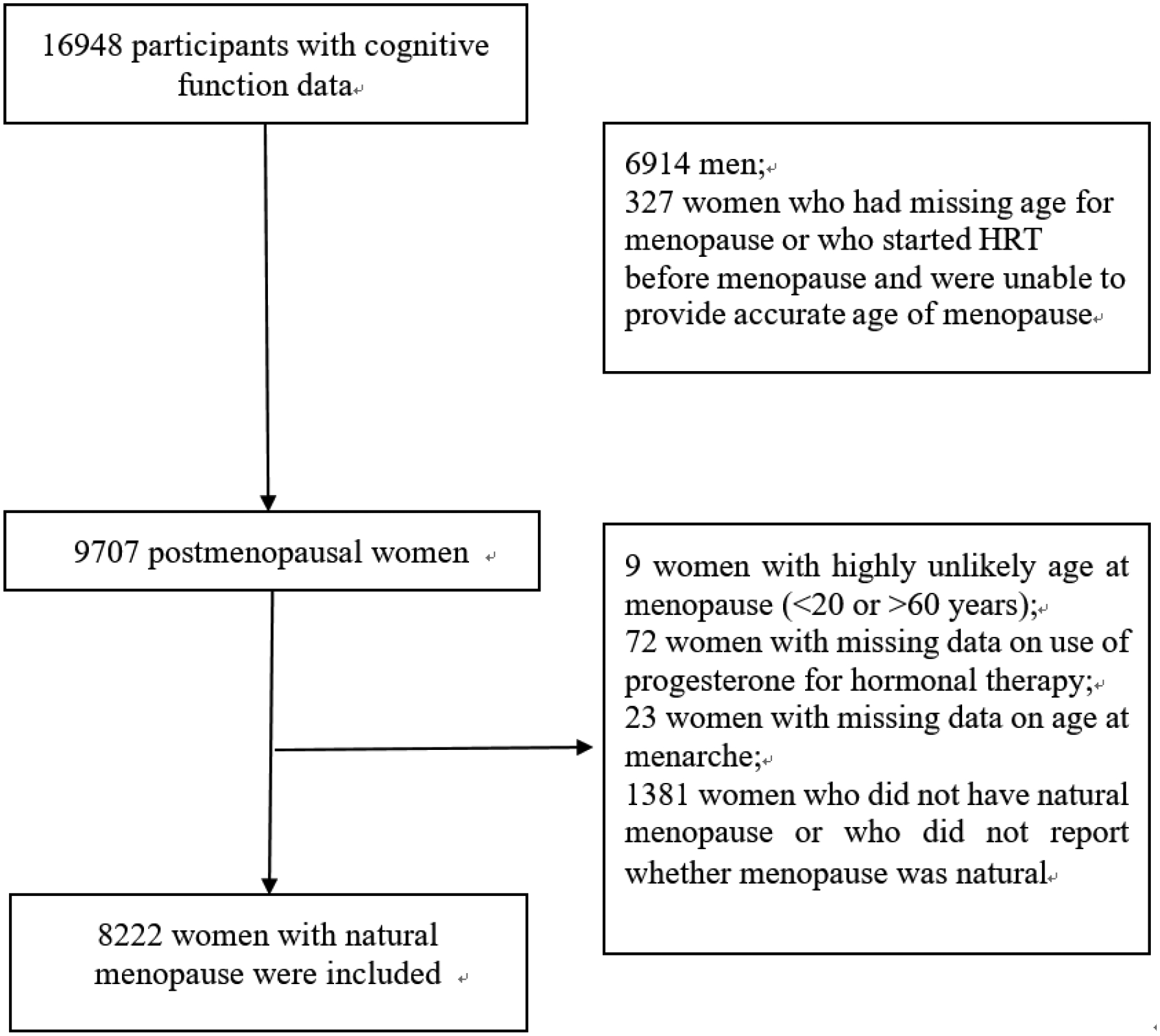
The Singapore Chinese Health Study is a population-based study that recruited participants aged 45-74 years between 1993 and 1998, and the current study included 8222 women from this cohort who had natural menopause, complete data on reproductive factors and hormonal therapies at baseline (1993-1998), follow-up 1 (1999-2004) and follow-up 2 interviews (2006-2010), and cognitive function evaluated at ages 61-96 years using the Singapore Modified Mini-Mental State Examination during the follow-up 3 visits (2014-2016). Multivariable logistic regression models were used to estimate odds ratios and 95% confidence intervals for the risk of cognitive impairment.
Compared with women with menopause at 50-54 years of age, the odds ratios (95% confidence interval) were 1.67 (1.32-2.11), 1.24 (1.08-1.44), and 1.06 (0.87- 1.29) for women who experienced menopause before 45 years, at 45-49 years of age, and after 54 years, respectively. Compared with women with 35-39 reproductive years from menarche to menopause, the odds ratios (95% confidence interval) were 1.28 (1.11-1.48) for women with <35 reproductive years. Furthermore, compared with women who had 1-2 children, the odds ratios (95% confidence interval) were 1.27 (1.04-1.55) for women who had more than 5 children, and the risk increased significantly by 5% per child birth (odds ratio, 1.05; 95% confidence interval, 1.01-1.09). Compared with those who had never used oral contraceptives, women with short-term use (≤5 years) of oral contraceptives had 26% lower odds of having cognitive impairment (odds ratio, 0.74; 95% confidence interval, 0.63-0.87), whereas the association was not statistically significant for those used for more than 5 years (odds ratio, 0.87; 95% confidence interval, 0.68-1.13). Women who used hormone-replacement therapy had a 39% lower odd of getting cognitive impairment compared with nonusers (odds ratio, 0.61; 95% confidence interval, 0.46-0.80).
Our data suggest that shorter reproductive years and greater parity were associated with a greater risk of cognitive impairment in late life, whereas the use of oral contraceptives and hormone-replacement therapy was associated with decreased risk. As the population ages, understanding how these factors affect late-life cognitive function in women may help health professionals develop preventive measures targeting lifetime estrogen exposure from endogenous or exogenous sources.
流行病学研究表明,绝经后雌激素水平下降可能在痴呆症的发病机制中起重要作用,并增加女性认知障碍的风险。大多数先前的研究都是在西方人群中进行的,旨在研究生育期长度和激素替代疗法的使用与认知功能和痴呆症风险之间的关系,但结果尚无定论。亚洲人群的相关证据有限。
评估生育和激素因素与中国自然绝经女性认知障碍风险之间的关系。
新加坡华人健康研究是一项基于人群的研究,于 1993 年至 1998 年期间招募了 45-74 岁的参与者,本研究纳入了该队列中的 8222 名自然绝经的女性,她们在基线(1993-1998 年)、随访 1(1999-2004 年)和随访 2 访谈(2006-2010 年)时具有完整的生育因素和激素治疗数据,并且在随访 3 期间(2014-2016 年)使用新加坡改良简易精神状态检查评估了 61-96 岁的认知功能。使用多变量逻辑回归模型来估计认知障碍风险的优势比(95%置信区间)。
与 50-54 岁绝经的女性相比,45 岁以下、45-49 岁和 54 岁以上绝经的女性的优势比(95%置信区间)分别为 1.67(1.32-2.11)、1.24(1.08-1.44)和 1.06(0.87-1.29)。与从初潮到绝经的生育期为 35-39 年的女性相比,生育期<35 年的女性的优势比(95%置信区间)为 1.28(1.11-1.48)。此外,与生育 1-2 个孩子的女性相比,生育超过 5 个孩子的女性的优势比(95%置信区间)为 1.27(1.04-1.55),并且每生育一个孩子风险增加 5%(优势比,1.05;95%置信区间,1.01-1.09)。与从未使用过口服避孕药的女性相比,短期(≤5 年)使用口服避孕药的女性认知障碍的几率降低 26%(优势比,0.74;95%置信区间,0.63-0.87),而使用时间超过 5 年的女性的关联则不具有统计学意义(优势比,0.87;95%置信区间,0.68-1.13)。与非使用者相比,使用激素替代疗法的女性认知障碍的几率降低 39%(优势比,0.61;95%置信区间,0.46-0.80)。
我们的数据表明,生育年限较短和生育次数较多与晚年认知障碍的风险增加有关,而使用口服避孕药和激素替代疗法与降低风险有关。随着人口老龄化,了解这些因素如何影响女性晚年的认知功能,可能有助于健康专业人员制定针对内源性或外源性雌激素暴露的预防措施。