Mondino Marine, Ghumman Sukhmanjit, Gane Claire, Renauld Emmanuelle, Whittingstall Kevin, Fecteau Shirley
Department of Psychiatry and Neurosciences, Medical School, Université Laval, CERVO Brain Research Center, Centre Intégré Universitaire en Santé et Services Sociaux de la Capitale-Nationale, Quebec City, QC, Canada.
Department of Radiology, Faculty of Medicine and Health Science, University of Sherbrooke, Sherbrooke, QC, Canada.
Front Hum Neurosci. 2020 Feb 5;13:474. doi: 10.3389/fnhum.2019.00474. eCollection 2019.
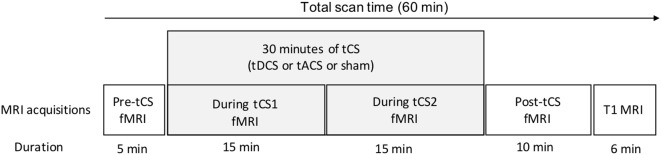
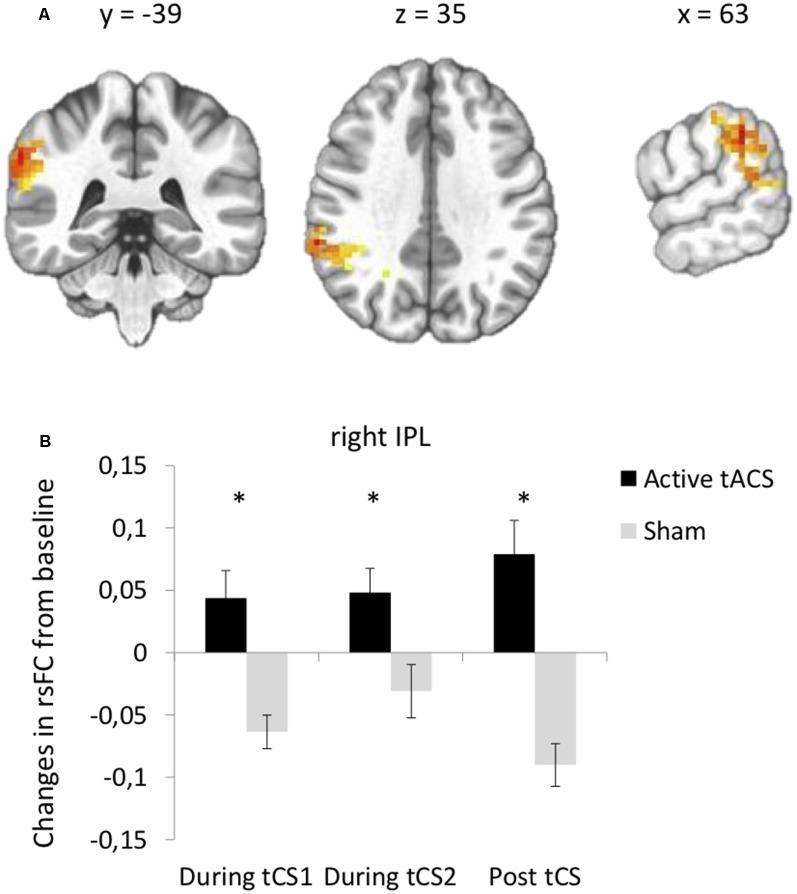
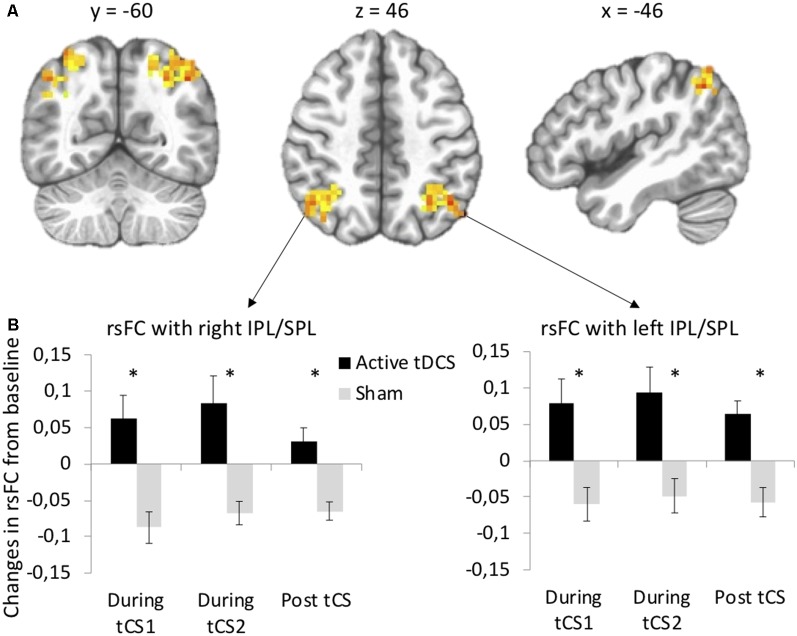
: Transcranial stimulation with direct (tDCS) and alternating current (tACS) has increasingly gained interest in various fields, from cognitive neuroscience to clinical investigations. Transcranial current stimulation used alone may modulate brain activity that consequently influences behaviors, without providing information on potentially induced brain activity changes. The combination of transcranial current stimulation and functional magnetic resonance imaging (fMRI) may help to address this. This exploratory study investigated instantaneous and subsequent effects of tDCS and tACS on resting-state functional connectivity (rsFC) in healthy adults. : We conducted a randomized crossover study with 15 healthy subjects receiving three stimulation conditions (tDCS, tACS, and sham) on separate days. Stimulation was applied over the left and right dorsolateral prefrontal cortex (DLPFC) for 30 min (1 mA). rsFC of the targeted prefrontal areas was assessed before, during, and after stimulation using multiband fMRI and using left and right DLPFC as seeds. : Both tDCS and tACS increased rsFC during and after the stimulation period, as compared to sham. tDCS-induced changes were observed between the left DLPFC and bilateral parietal regions at the junction of the superior parietal and the inferior parietal lobules. tACS-induced changes were observed between the left DLPFC and the right inferior parietal lobule. : Overall, these results suggest that a single session with a low dose, 1 mA, of tDCS or tACS can cause changes in fronto-parietal connectivity that occur rapidly, that is, within the first 15 min. Although exploratory, this work contributes to the discussion of the potential of transcranial current stimulation to modulate resting-state networks and the interest of combining transcranial current stimulation with neuroimaging to identify these changes.
经颅直流电刺激(tDCS)和经颅交流电刺激(tACS)在从认知神经科学到临床研究的各个领域越来越受到关注。单独使用经颅电流刺激可能会调节大脑活动,进而影响行为,但无法提供关于潜在诱发的大脑活动变化的信息。经颅电流刺激与功能磁共振成像(fMRI)相结合可能有助于解决这一问题。这项探索性研究调查了tDCS和tACS对健康成年人静息态功能连接(rsFC)的即时和后续影响。
我们进行了一项随机交叉研究,15名健康受试者在不同日期接受三种刺激条件(tDCS、tACS和假刺激)。刺激施加于左右背外侧前额叶皮层(DLPFC),持续30分钟(1毫安)。在刺激前、刺激期间和刺激后,使用多波段fMRI并以左右DLPFC为种子,评估目标前额叶区域的rsFC。
与假刺激相比,tDCS和tACS在刺激期间及刺激后均增加了rsFC。在左DLPFC与顶叶上小叶和顶叶下小叶交界处的双侧顶叶区域之间观察到tDCS诱导的变化。在左DLPFC与右侧顶叶下小叶之间观察到tACS诱导的变化。
总体而言,这些结果表明,单次低剂量(1毫安)的tDCS或tACS可导致额顶叶连接迅速发生变化,即在最初15分钟内。尽管是探索性的,但这项工作有助于讨论经颅电流刺激调节静息态网络的潜力,以及将经颅电流刺激与神经成像相结合以识别这些变化的意义。