Sumner Maxwell D, Beard Samuel, Pryor Elizabeth K, Das Indrajit, McCully Kevin K
Non-Invasive Exercise Muscle Physiology Lab, Department of Kinesiology, University of Georgia, Athens, GA, United States.
Front Physiol. 2020 Feb 14;11:111. doi: 10.3389/fphys.2020.00111. eCollection 2020.
Near-infrared spectroscopy (NIRS) has been used to measure muscle mitochondrial capacity (mVOmax) as the recovery rate constant of muscle metabolism after exercise. The current method requires as many as 50 short ischemic occlusions to generate two recovery rate constants.
To determine the validity and repeatability of using a 6-occlusion protocol versus one with 22 occlusions to measure muscle mitochondrial capacity. The order effect of performing multiple Mito6 test was also evaluated.
In two independent data sets (bicep = 7, forearm A = 23), recovery curves were analyzed independently using both the 6 and 22 occlusion methods. A third data set (forearm B = 16) was generated on the forearm muscles of healthy subjects using four 6-occlusion tests performed in succession. Recovery rate constants were generated using a MATLAB routine.
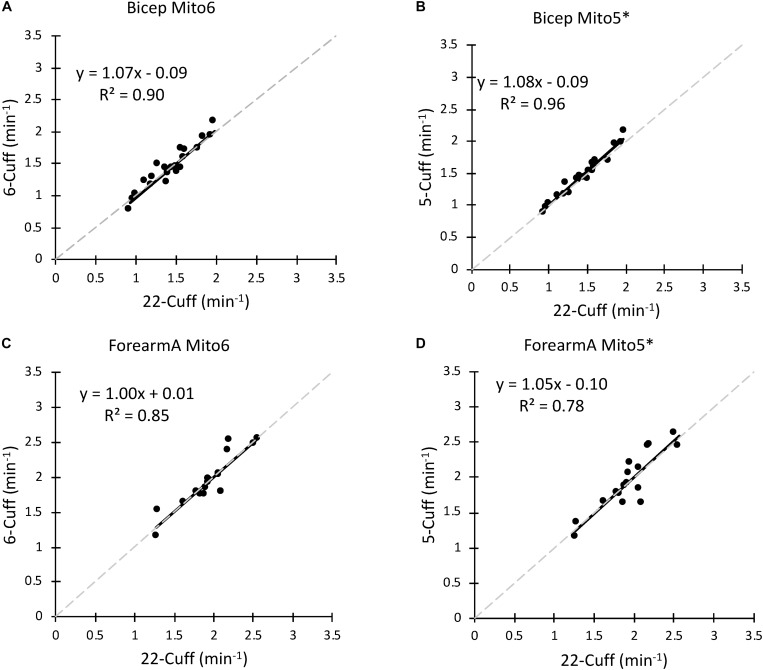
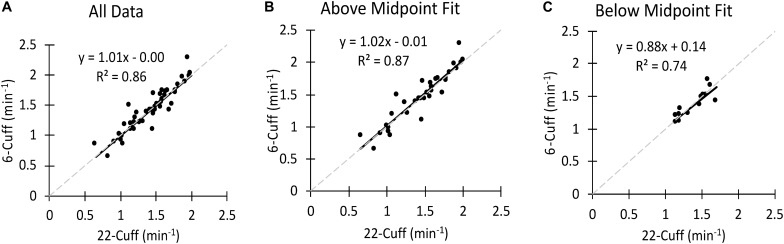
When calculated from the same data set, the recovery rate constants were not significantly different between the 22 occlusion and 6 occlusion methods for the bicep (1.43 ± 0.33 min, 1.43 ± 0.35 min, = 0.81) and the forearm A (1.97 ± 0.40 min, 1.97 ± 0.43 min, = 0.90). Equivalence testing showed that the mean difference was not different than zero and the 90% confidence intervals were within 5% of the average rate constant. This was true for the Mito6 and the Mito5 approaches. Bland-Altman analysis showed a slope of 0.21 min and an r of 0.045 for the bicep dataset and a slope of -0.01 min and an of 0.045 for the forearm A dataset. When performing the four 6-occlusion tests; recovery rate constants showed no order effects (1.50 ± 0.51 min, 1.42 ± 0.54 min, 1.26 ± 0.41 min, 1.29 ± 0.47 min, > 0.05).
The Mito6 analysis is a valid and repeatable approach to measure mitochondrial capacity. The Mito6 protocol used fewer ischemic occlusion periods and multiple tests could be performed in succession in less time, increasing the practicality of the NIRS mitochondrial capacity test. There were no order effects for the rate constants of four repeated 6-occlusion tests of mitochondrial capacity, supporting the use of multiple tests to improve accuracy.
近红外光谱(NIRS)已被用于测量肌肉线粒体容量(mVOmax),即运动后肌肉代谢的恢复速率常数。目前的方法需要多达50次短暂缺血性阻断来生成两个恢复速率常数。
确定使用6次阻断方案与22次阻断方案测量肌肉线粒体容量的有效性和可重复性。还评估了进行多次Mito6测试的顺序效应。
在两个独立的数据集中(肱二头肌=7例,前臂A=23例),分别使用6次阻断法和22次阻断法独立分析恢复曲线。在健康受试者的前臂肌肉上生成第三个数据集(前臂B=16例),连续进行4次6次阻断测试。使用MATLAB程序生成恢复速率常数。
从同一数据集中计算时,肱二头肌(1.43±0.33分钟,1.43±0.35分钟,P=0.81)和前臂A(1.97±0.40分钟,1.97±0.43分钟,P=0.90)的22次阻断法和6次阻断法之间的恢复速率常数无显著差异。等效性检验表明,平均差异不显著不同于零,90%置信区间在平均速率常数的5%以内。Mito6和Mito5方法均如此。Bland-Altman分析显示,肱二头肌数据集的斜率为0.21分钟,r为0.045;前臂A数据集的斜率为-0.01分钟,r为0.045。进行4次6次阻断测试时,恢复速率常数未显示顺序效应(1.50±0.51分钟,1.42±0.54分钟,1.26±0.41分钟,1.29±0.47分钟,P>0.05)。
Mito6分析是一种测量线粒体容量的有效且可重复的方法。Mito6方案使用的缺血性阻断期较少,且可以在更短的时间内连续进行多次测试,提高了NIRS线粒体容量测试的实用性。线粒体容量的4次重复6次阻断测试的速率常数没有顺序效应,支持使用多次测试来提高准确性。