Jones Emily J, Booth Catherine, Fonseca Sonia, Parker Aimee, Cross Kathryn, Miquel-Clopés Ariadna, Hautefort Isabelle, Mayer Ulrike, Wileman Tom, Stentz Régis, Carding Simon R
Gut Microbes and Health Research Programme, Quadram Institute Bioscience, Norwich, United Kingdom.
Core Science Resources, Quadram Institute Bioscience, Norwich, United Kingdom.
Front Microbiol. 2020 Feb 6;11:57. doi: 10.3389/fmicb.2020.00057. eCollection 2020.
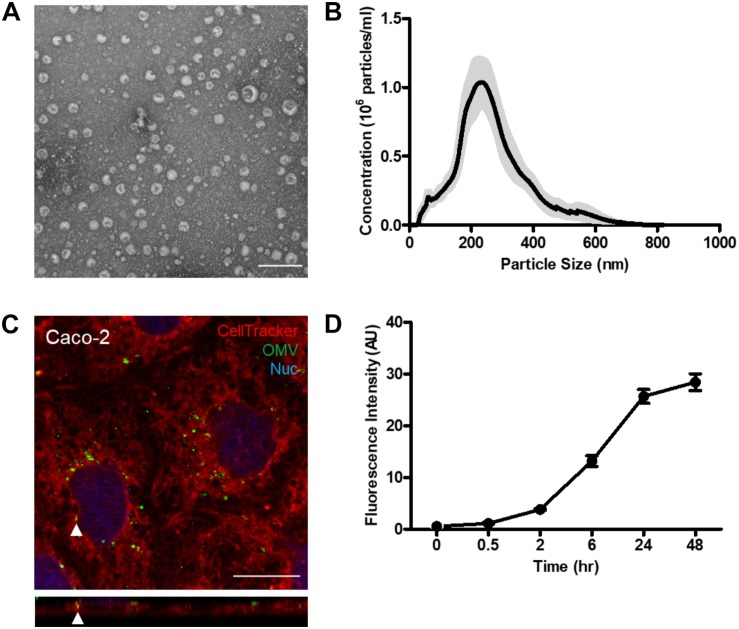
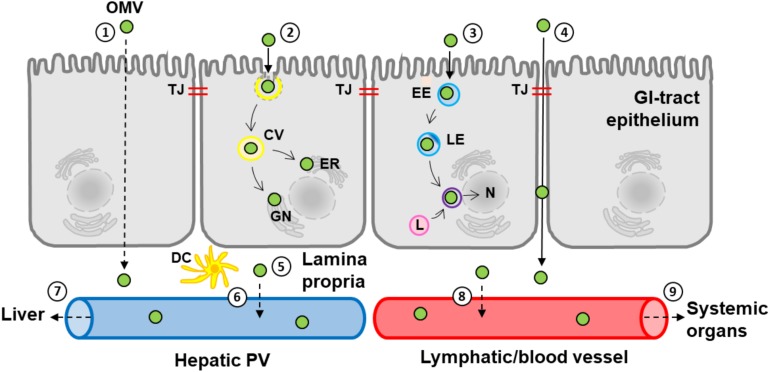
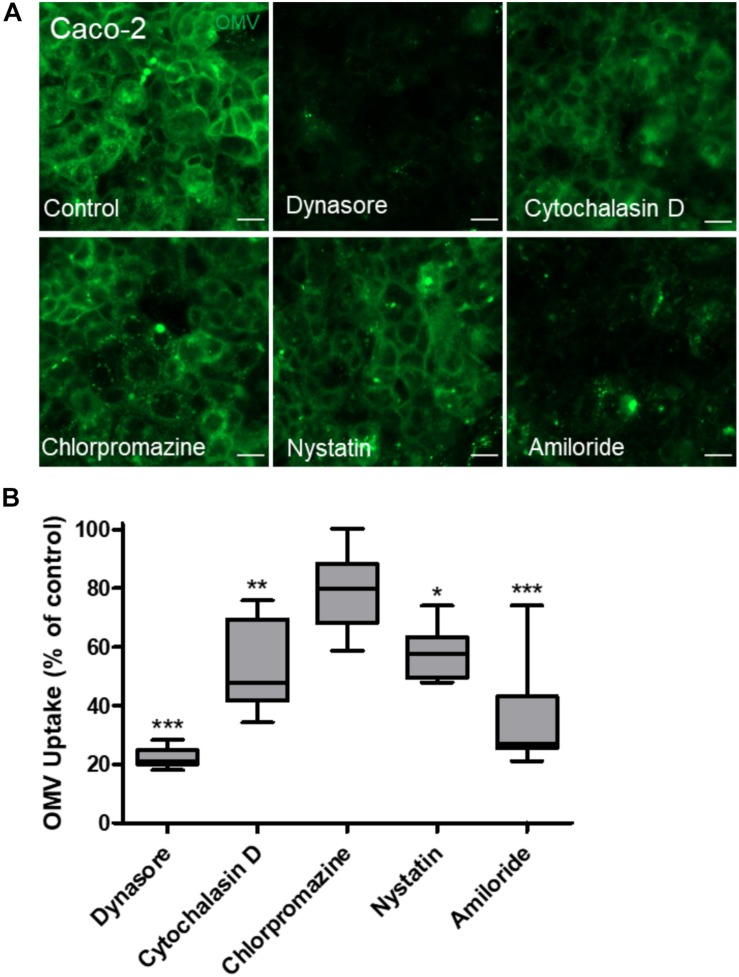
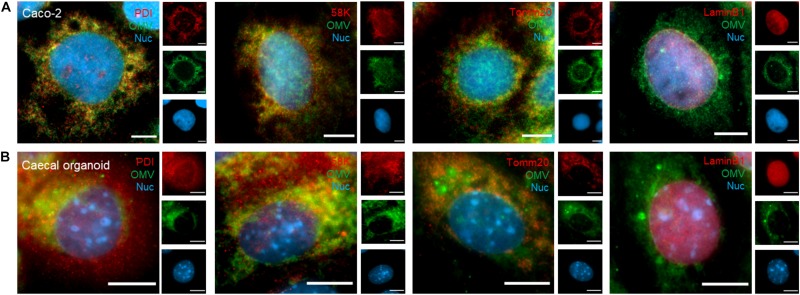
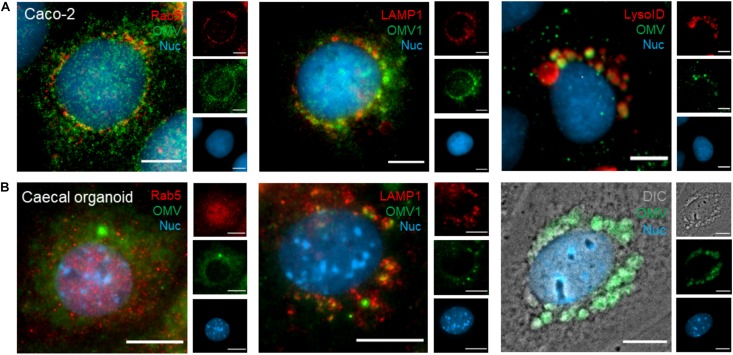
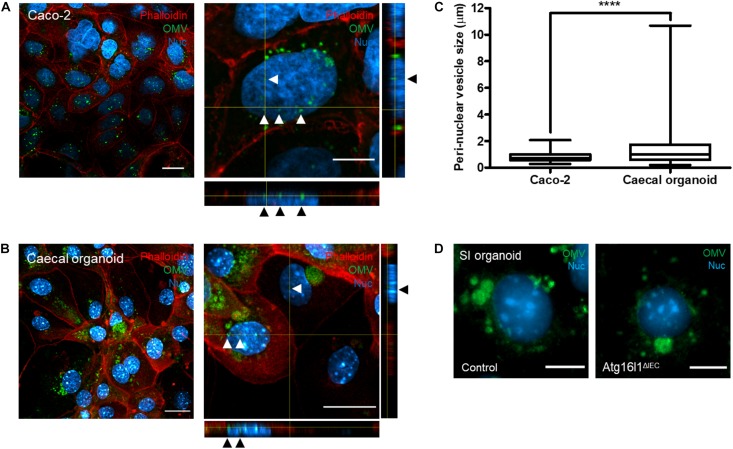
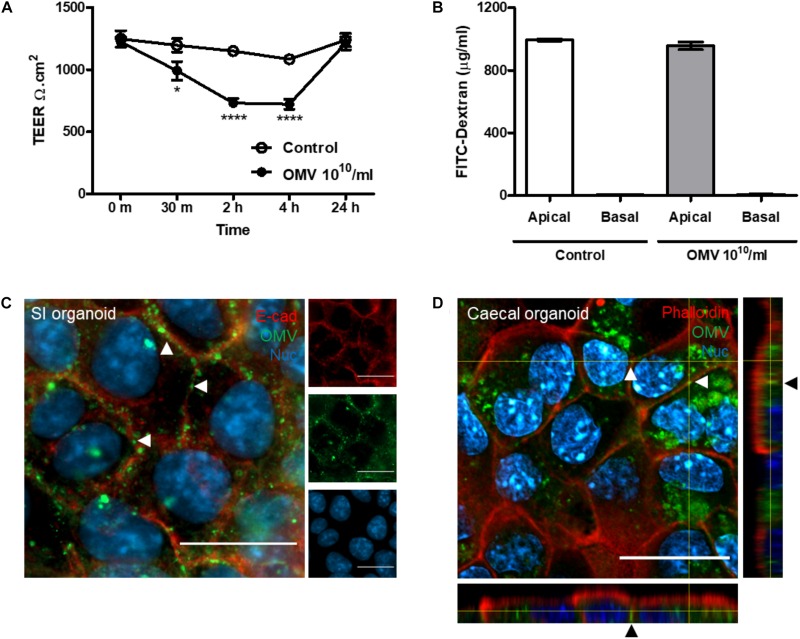
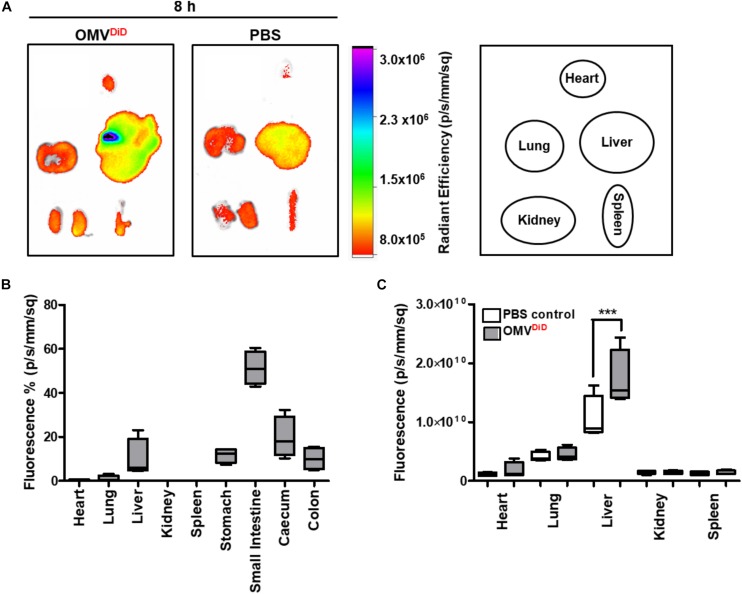
Gram-negative bacteria ubiquitously produce and release nano-size, non-replicative outer membrane vesicles (OMVs). In the gastrointestinal (GI-) tract, OMVs generated by members of the intestinal microbiota are believed to contribute to maintaining the intestinal microbial ecosystem and mediating bacteria-host interactions, including the delivery of bacterial effector molecules to host cells to modulate their physiology. Bacterial OMVs have also been found in the bloodstream although their origin and fate are unclear. Here we have investigated the interactions between OMVs produced by the major human gut commensal bacterium, (Bt), with cells of the GI-tract. Using a combination of culture systems including intestinal epithelial organoids and imaging we show that intestinal epithelial cells principally acquire Bt OMVs via dynamin-dependent endocytosis followed by intracellular trafficking to LAMP-1 expressing endo-lysosomal vesicles and co-localization with the perinuclear membrane. We observed that Bt OMVs can also transmigrate through epithelial cells via a paracellular route with imaging demonstrating that within hours of oral administration Bt OMVs can be detected in systemic tissues and in particular, the liver. Our findings raise the intriguing possibility that OMVs may act as a long-distance microbiota-host communication system.
革兰氏阴性菌普遍会产生并释放纳米级、无复制能力的外膜囊泡(OMV)。在胃肠道中,肠道微生物群成员产生的OMV被认为有助于维持肠道微生物生态系统并介导细菌与宿主的相互作用,包括将细菌效应分子传递给宿主细胞以调节其生理功能。血液中也发现了细菌OMV,但其来源和归宿尚不清楚。在这里,我们研究了主要的人体肠道共生细菌——嗜黏蛋白阿克曼氏菌(Akkermansia muciniphila,简称Bt)产生的OMV与胃肠道细胞之间的相互作用。我们使用包括肠道上皮类器官在内的多种培养系统,并结合成像技术,结果表明肠道上皮细胞主要通过依赖发动蛋白的内吞作用摄取Bt OMV,随后在细胞内运输至表达溶酶体相关膜蛋白1(LAMP-1)的内溶酶体囊泡,并与核周膜共定位。我们观察到,Bt OMV也可以通过细胞旁途径穿过上皮细胞,成像显示口服给药数小时后,Bt OMV可以在全身组织中被检测到,尤其是在肝脏中。我们的研究结果提出了一个有趣的可能性,即OMV可能作为一种长距离的微生物群-宿主通讯系统。