KCL Breast Cancer Now Research Unit, Guys Cancer Centre, King's College London, London, United Kingdom.
Centre for Immunobiology and Regenerative Medicine, Barts and The London School of Medicine and Dentistry, Queen Mary University of London, London, United Kingdom.
Front Immunol. 2020 Feb 4;10:3111. doi: 10.3389/fimmu.2019.03111. eCollection 2019.
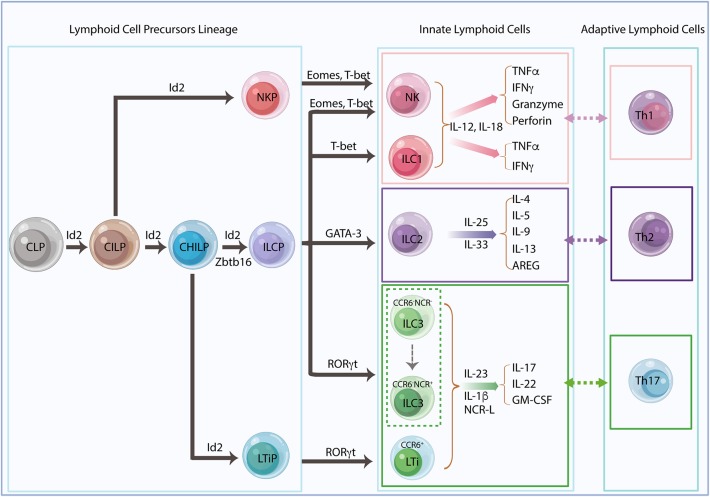
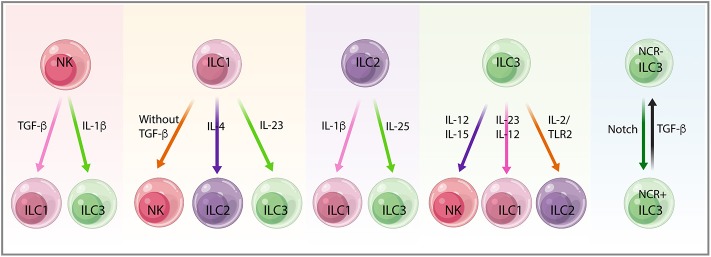
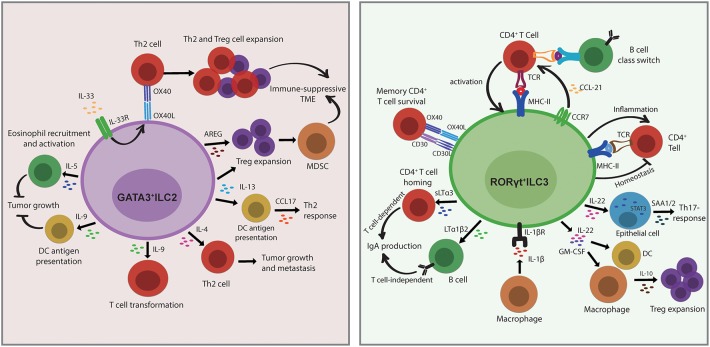
Innate lymphoid cells (ILCs) are largely tissue resident and respond rapidly toward the environmental signals from surrounding tissues and other immune cells. The pleiotropic function of ILCs in diverse contexts underpins its importance in the innate arm of immune system in human health and disease. ILCs derive from common lymphoid progenitors but lack adaptive antigen receptors and functionally act as the innate counterpart to T-cell subsets. The classification of different subtypes is based on their distinct transcription factor requirement for development as well as signature cytokines that they produce. The discovery and subsequent characterization of ILCs over the past decade have mainly focused on the regulation of inflammation, tissue remodeling, and homeostasis, whereas the understanding of the multiple roles and mechanisms of ILCs in cancer is still limited. Emerging evidence of the potent immunomodulatory properties of ILCs in early host defense signifies a major advance in the use of ILCs as promising targets in cancer immunotherapy. In this review, we will decipher the non-exclusive roles of ILCs associated with both protumor and antitumor activities. We will also dissect the heterogeneity, plasticity, genetic evidence, and dysregulation in different cancer contexts, providing a comprehensive understanding of the complexity and diversity. These will have implications for the therapeutic targeting in cancer.
先天淋巴细胞 (ILC) 主要驻留在组织中,并对周围组织和其他免疫细胞的环境信号迅速作出反应。ILC 在多种情况下的多功能性是其在人类健康和疾病中的先天免疫系统中的重要基础。ILC 来源于共同淋巴祖细胞,但缺乏适应性抗原受体,并且在功能上作为 T 细胞亚群的先天对应物发挥作用。不同亚型的分类基于其发育所需的不同转录因子要求以及它们产生的特征细胞因子。在过去十年中,对 ILC 的发现和随后的表征主要集中在炎症、组织重塑和稳态的调节上,而对 ILC 在癌症中的多种作用和机制的理解仍然有限。ILC 在早期宿主防御中具有强大的免疫调节特性的新证据标志着将 ILC 作为癌症免疫治疗有前途的靶标的使用取得了重大进展。在这篇综述中,我们将阐明与促肿瘤和抗肿瘤活性相关的 ILC 的非排他性作用。我们还将剖析不同癌症环境中的异质性、可塑性、遗传证据和失调,提供对复杂性和多样性的全面理解。这将对癌症的治疗靶向产生影响。