Campbell Emma L, Byrne Andrew W, Menzies Fraser D, McBride Kathryn R, McCormick Carl M, Scantlebury Michael, Reid Neil
School of Biological Sciences Queen's University Belfast Belfast UK.
Veterinary Sciences Division Agri-Food and Biosciences Institute (AFBI) Belfast UK.
Ecol Evol. 2019 Jul 9;9(15):8479-8489. doi: 10.1002/ece3.5282. eCollection 2019 Aug.
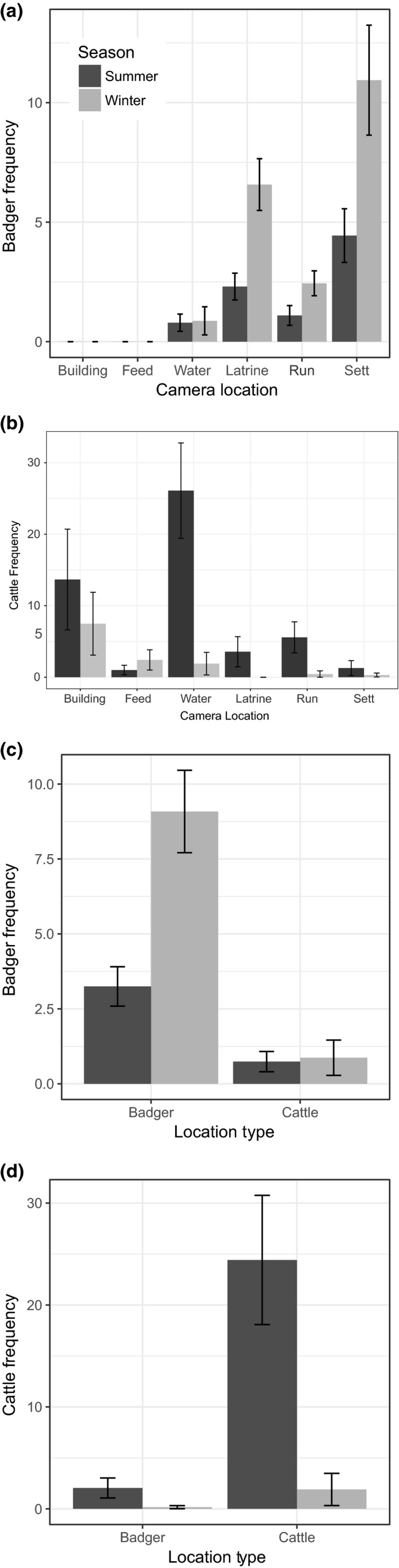
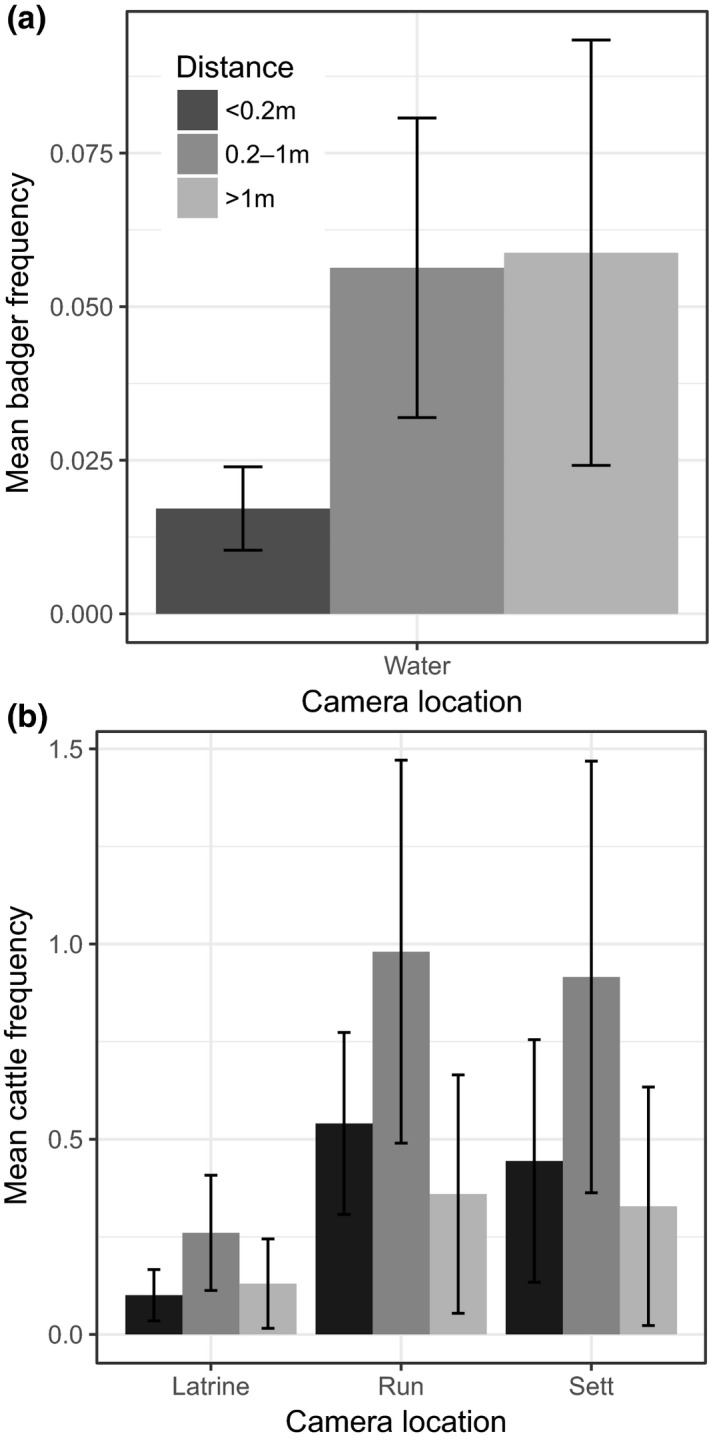
In Great Britain and Ireland, badgers () are a wildlife reservoir of and implicated in bovine tuberculosis transmission to domestic cattle. The route of disease transmission is unknown with direct, so-called "nose-to-nose," contact between hosts being extremely rare. Camera traps were deployed for 64,464 hr on 34 farms to quantify cattle and badger visitation rates in space and time at six farm locations. Badger presence never coincided with cattle presence at the same time, with badger and cattle detection at the same location but at different times being negatively correlated. Badgers were never recorded within farmyards during the present study. Badgers utilized cattle water troughs in fields, but detections were infrequent (equivalent to one badger observed drinking every 87 days). Cattle presence at badger-associated locations, for example, setts and latrines, were three times more frequent than badger presence at cattle-associated locations, for example, water troughs. Preventing cattle access to badger setts and latrines and restricting badger access to cattle water troughs may potentially reduce interspecific bTB transmission through reduced indirect contact.
在大不列颠及爱尔兰,獾是牛结核病的野生动物宿主,并且被认为与牛结核病传播到家畜有关。疾病传播途径尚不清楚,宿主之间直接的所谓“鼻对鼻”接触极为罕见。在34个农场部署了64464小时的相机陷阱,以量化六个农场地点牛和獾在空间和时间上的到访率。獾的出现从未与牛同时出现,在同一地点但不同时间检测到獾和牛呈负相关。在本研究中,从未在农场院子里记录到獾。獾会在田间使用牛的水槽,但检测到的情况很少见(相当于每87天观察到一只獾饮水)。牛出现在与獾相关的地点,例如洞穴和粪便处,比獾出现在与牛相关的地点,例如水槽处的频率高三倍。防止牛进入獾的洞穴和粪便处,并限制獾进入牛的水槽,可能会通过减少间接接触来潜在地减少种间牛结核病传播。