Kuncorojakti Suryo, Srisuwatanasagul Sayamon, Kradangnga Krishaporn, Sawangmake Chenphop
Veterinary Stem Cell and Bioengineering Innovation Center (VSCBIC), Veterinary Pharmacology and Stem Cell Research Laboratory, Faculty of Veterinary Science, Chulalongkorn University, Bangkok, Thailand.
Department of Veterinary Anatomy, Faculty of Veterinary Medicine, Universitas Airlangga, Surabaya, Indonesia.
Front Vet Sci. 2020 Feb 12;7:4. doi: 10.3389/fvets.2020.00004. eCollection 2020.
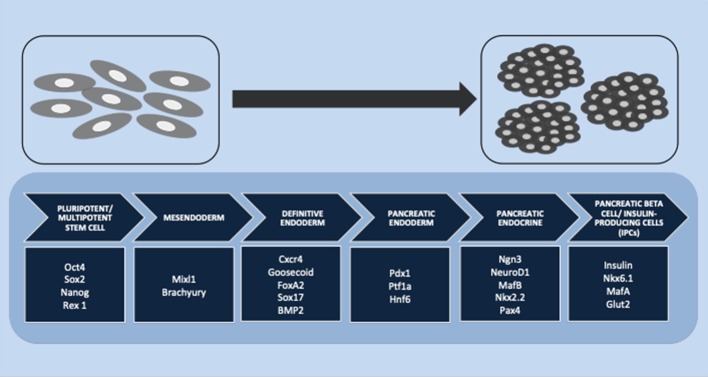
Diabetes mellitus (DM) remains a global concern in both human and veterinary medicine. Type I DM requires prolonged and consistent exogenous insulin administration to address hyperglycemia, which can increase the risk of diabetes complications such as retinopathy, nephropathy, neuropathy, and heart disorders. Cell-based therapies have been successful in human medicine using the Edmonton protocol. These therapies help maintain the production of endogenous insulin and stabilize blood glucose levels and may possibly be adapted to veterinary clinical practice. The limited number of cadaveric pancreas donors and the long-term use of immunosuppressive agents are the main obstacles for this protocol. Over the past decade, the development of potential therapies for DM has mainly focused on the generation of effective insulin-producing cells (IPCs) from various sources of stem cells that can be transplanted into the body. Another successful application of stem cells in type I DM therapies is transplanting generated IPCs. Encapsulation can be an alternative strategy to protect IPCs from rejection by the body due to their immunoisolation properties. This review summarizes current concepts of IPCs and encapsulation technology for veterinary clinical application and proposes a potential stem-cell-based platform for veterinary diabetic regenerative therapy.
糖尿病(DM)在人类医学和兽医学领域仍然是一个全球性问题。I型糖尿病需要长期持续给予外源性胰岛素来控制高血糖,这会增加糖尿病并发症的风险,如视网膜病变、肾病、神经病变和心脏疾病。在人类医学中,基于细胞的疗法采用埃德蒙顿方案已取得成功。这些疗法有助于维持内源性胰岛素的分泌,稳定血糖水平,并且有可能应用于兽医临床实践。尸体胰腺供体数量有限以及长期使用免疫抑制剂是该方案的主要障碍。在过去十年中,糖尿病潜在疗法的发展主要集中在从各种干细胞来源生成有效的胰岛素产生细胞(IPC),并将其移植到体内。干细胞在I型糖尿病治疗中的另一个成功应用是移植生成的IPC。由于其免疫隔离特性,封装可以作为一种保护IPC不被机体排斥的替代策略。本文综述了用于兽医临床应用的IPC和封装技术的当前概念,并提出了一个潜在的基于干细胞的兽医糖尿病再生治疗平台。