Department of Systems and Computer Engineering, Carleton University, Ottawa, ON, Canada, K1S 5B6.
Children's Hospital of Eastern Ontario, Ottawa, ON, Canada, K1H 8L1.
Sci Rep. 2020 Mar 3;10(1):3962. doi: 10.1038/s41598-020-60898-3.
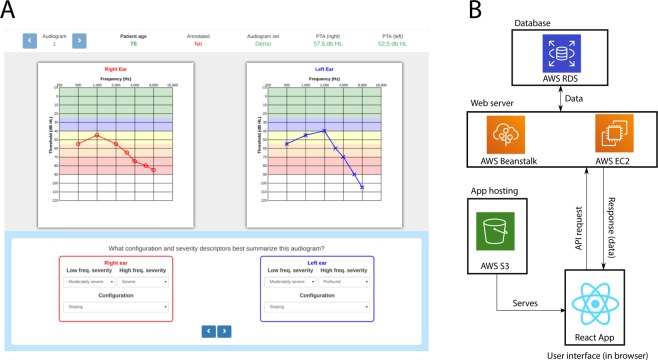
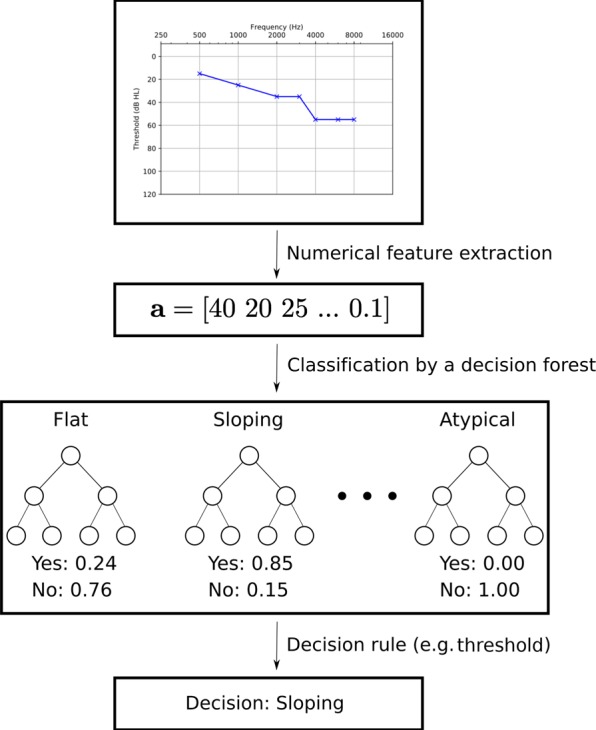
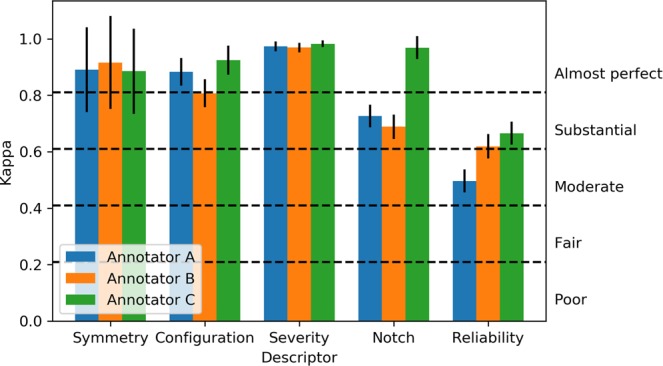
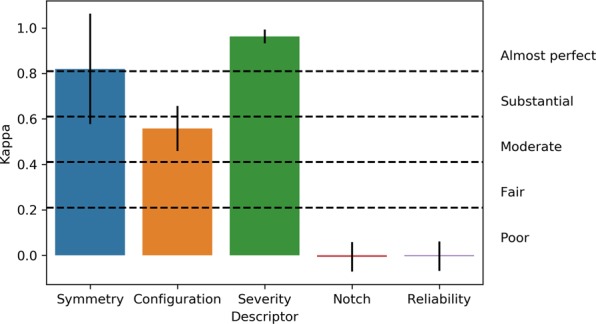
Recent mobile and automated audiometry technologies have allowed for the democratization of hearing healthcare and enables non-experts to deliver hearing tests. The problem remains that a large number of such users are not trained to interpret audiograms. In this work, we outline the development of a data-driven audiogram classification system designed specifically for the purpose of concisely describing audiograms. More specifically, we present how a training dataset was assembled and the development of the classification system leveraging supervised learning techniques. We show that three practicing audiologists had high intra- and inter-rater agreement over audiogram classification tasks pertaining to audiogram configuration, symmetry and severity. The system proposed here achieves a performance comparable to the state of the art, but is significantly more flexible. Altogether, this work lays a solid foundation for future work aiming to apply machine learning techniques to audiology for audiogram interpretation.
最近的移动和自动化听力技术使得听力保健民主化,使非专业人员也能够进行听力测试。但问题仍然是,大量这样的用户没有接受过解释听力图的培训。在这项工作中,我们概述了一个数据驱动的听力图分类系统的开发,该系统专门用于简洁地描述听力图。更具体地说,我们展示了如何组装训练数据集以及利用监督学习技术开发分类系统。我们表明,三位有经验的听力学家在与听力图配置、对称性和严重程度有关的听力图分类任务上具有较高的组内和组间评分者一致性。这里提出的系统实现了与现有技术相当的性能,但具有更高的灵活性。总的来说,这项工作为未来将机器学习技术应用于听力图解释的听力学研究奠定了坚实的基础。