Department of Orthopaedic Surgery, Gifu University Graduate School of Medicine, Gifu, 501-1194, Japan.
Laboratory of Stem Cell Oncology, Department of Life Science Frontiers, Center for iPS Cell Research and Application (CiRA), Kyoto University, Kyoto, 606-8507, Japan.
Sci Rep. 2020 Mar 4;10(1):3992. doi: 10.1038/s41598-020-61063-6.
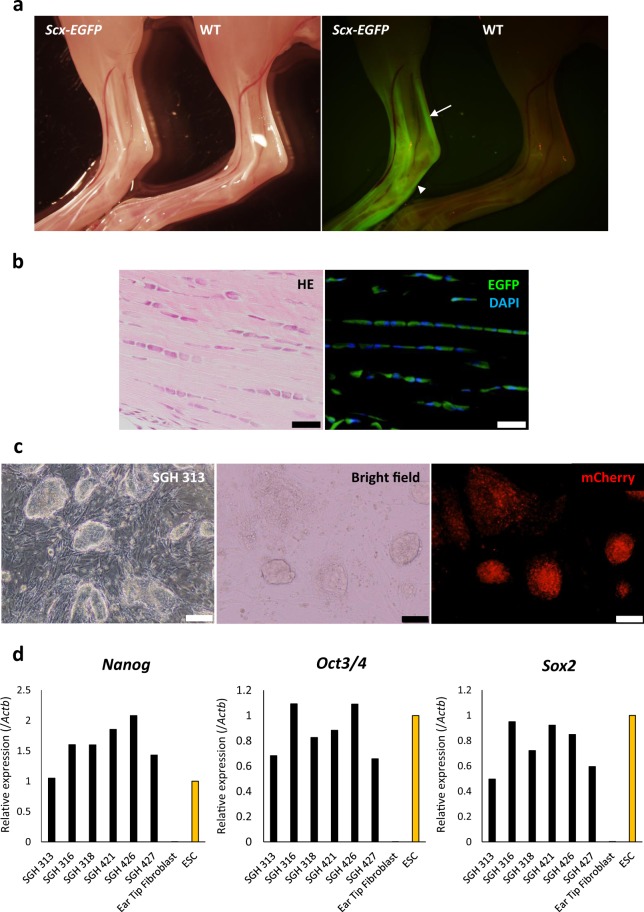
Tendons are dense fibrous structures that attach muscles to bones. Healing of tendon injuries is a clinical challenge owing to poor regenerative potential and scarring. Here, we created reporter mice that express EGFP, driven by the promoter of the tendon-specific Scleraxis (Scx) transcription-factor gene; we then generated induced pluripotent stem cells (iPSCs) from these mice. Utilising these fluorescently labelled iPSCs, we developed a tenogenic differentiation protocol. The iPSC-derived EGFP-positive cells exhibited elevated expression of tendon-specific genes, including Scx, Mohawk, Tenomodulin, and Fibromodulin, indicating that they have tenocyte-like properties. Finally, we demonstrated that these cells promoted tendon regeneration in mice after transplantation into injured tendons reducing scar formation via paracrine effect. Our data demonstrate that the tenogenic differentiation protocol successfully provided functional cells from iPSCs. We propose that pluripotent stem cell-based therapy using this protocol will provide an effective therapeutic approach for tendon injuries.
肌腱是将肌肉连接到骨骼的致密纤维结构。由于再生潜力差和形成瘢痕,肌腱损伤的愈合是临床面临的挑战。在这里,我们创建了一种报告小鼠,其表达 EGFP,由肌腱特异性 Scleraxis (Scx) 转录因子基因的启动子驱动;然后,我们从这些小鼠中生成诱导多能干细胞 (iPSC)。利用这些荧光标记的 iPSC,我们开发了一种肌腱分化方案。iPSC 衍生的 EGFP 阳性细胞表现出肌腱特异性基因的高表达,包括 Scx、Mohawk、Tenomodulin 和 Fibromodulin,表明它们具有肌腱细胞样特性。最后,我们证明这些细胞在移植到受伤的肌腱后通过旁分泌作用促进了小鼠的肌腱再生,减少了瘢痕形成。我们的数据表明,该肌腱分化方案成功地从 iPSC 中提供了功能细胞。我们提出,使用该方案的基于多能干细胞的治疗将为肌腱损伤提供一种有效的治疗方法。