School of International Development and Global Studies, University of Ottawa, Ottawa, Ontario, Canada.
The George Institute for Global Health, The University of Oxford, Oxford, United Kingdom.
BMJ Glob Health. 2020 Jan 23;5(1):e002042. doi: 10.1136/bmjgh-2019-002042. eCollection 2020.
There is mixed evidence and lack of consensus on the impact of economic development on stunting, and likewise there is a dearth of empirical studies on this relationship in the case of sub-Saharan Africa. Thus, this paper examines whether economic growth is associated with childhood stunting in low-income and middle-income sub-Saharan African countries.
We analysed data from 89 Demographic and Health Surveys conducted between 1987 and 2016 available as of October 2018 using multivariable multilevel logistic regression models to show the association between gross domestic product (GDP) per capita and stunting. We adjusted the models for child's age, survey year, child's sex, birth order and country random effect, and presented adjusted and unadjusted ORs.
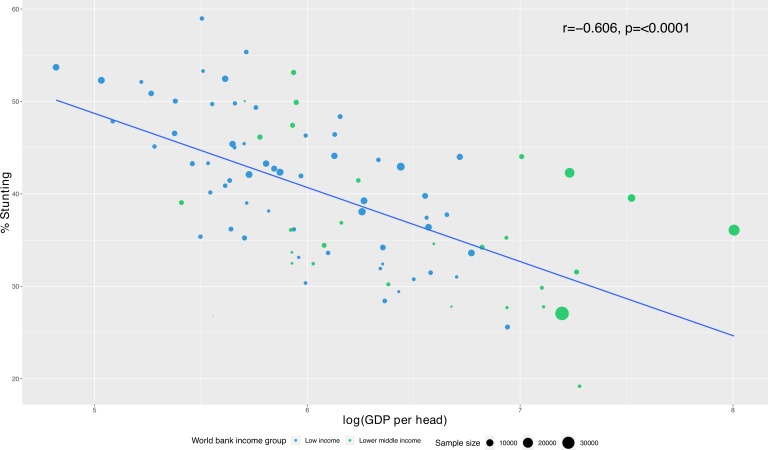
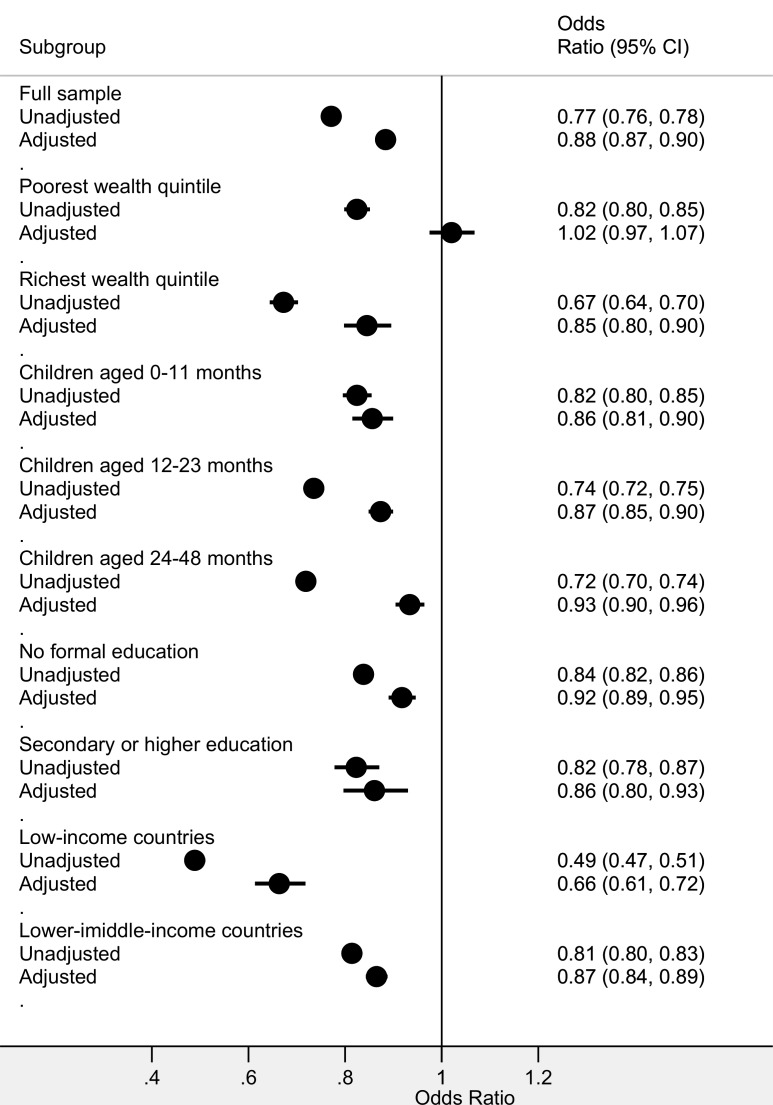
We included data from 490 526 children. We found that the prevalence of stunting decreased with increasing GDP per capita (correlation coefficient=-0.606, p<0.0001). In the unadjusted model for full sample, for every US$1000 increase in GDP per capita, the odds of stunting decreased by 23% (OR=0.77, 95% CI 0.76 to 0.78). The magnitude of the association between GDP per capita and stunting was stronger among children in the richest quintile. After adjustment was made, the association was not significant among children from the poorest quintile. However, the magnitude of the association was more pronounced among children from low-income countries, such that, in the model adjusted for child's age, survey year, child's sex, birth order and country random effect, the association between GDP per capita and stunting remained statistically significant; for every US$1000 increase in GDP per capita, the odds of stunting decreased by 12% (OR=0.88, 95% CI 0.87 to 0.90).
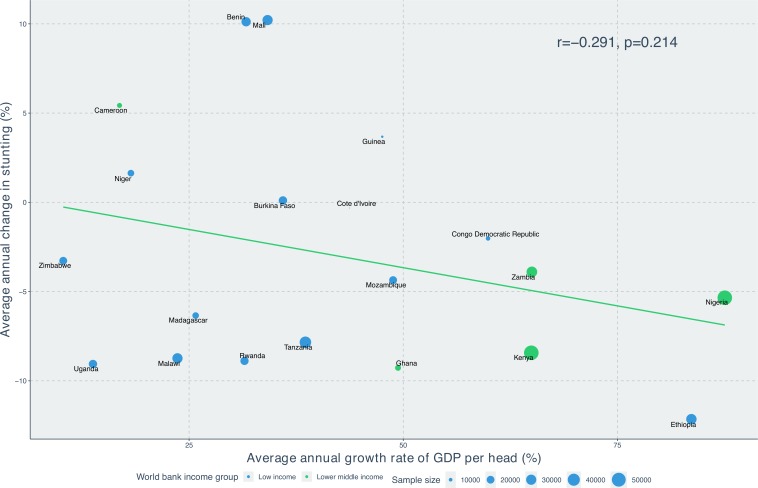
There was no significant association between economic growth and child nutritional status. The prevalence of stunting decreased with increasing GDP per capita. This was more pronounced among children from the richest quintile. The magnitude of the association was higher among children from low-income countries, suggesting that households in the poorest quintile were typically the least likely to benefit from economic gains. The findings could serve as a building block needed to modify current policy as per child nutrition-related programmes in Africa.
关于经济发展对发育迟缓的影响,现有证据相互矛盾且缺乏共识,同样,在撒哈拉以南非洲地区,关于这一关系的实证研究也很少。因此,本文研究了在低收入和中等收入的撒哈拉以南非洲国家中,经济增长是否与儿童发育迟缓有关。
我们分析了截至 2018 年 10 月可获得的 1987 年至 2016 年期间进行的 89 次人口与健康调查的数据,使用多变量多层逻辑回归模型来显示人均国内生产总值(GDP)与发育迟缓之间的关系。我们调整了模型,纳入了儿童年龄、调查年份、儿童性别、出生顺序和国家随机效应,并呈现了调整和未调整的比值比(OR)。
我们纳入了 490526 名儿童的数据。我们发现,随着人均 GDP 的增加,发育迟缓的患病率下降(相关系数=-0.606,p<0.0001)。在全样本的未调整模型中,人均 GDP 每增加 1000 美元,发育迟缓的几率就会降低 23%(OR=0.77,95%CI 0.76 至 0.78)。在最富裕的五分之一儿童中,人均 GDP 与发育迟缓之间的关联程度更强。调整后,最贫穷的五分之一儿童的关联不显著。然而,在来自低收入国家的儿童中,这种关联更加明显,以至于在调整了儿童年龄、调查年份、儿童性别、出生顺序和国家随机效应的模型中,人均 GDP 与发育迟缓之间的关联仍然具有统计学意义;人均 GDP 每增加 1000 美元,发育迟缓的几率就会降低 12%(OR=0.88,95%CI 0.87 至 0.90)。
经济增长与儿童营养状况之间没有显著关联。发育迟缓的患病率随着人均 GDP 的增加而下降。在最富裕的五分之一儿童中,这种情况更为明显。在来自低收入国家的儿童中,这种关联更为强烈,这表明最贫穷的五分之一家庭最不可能从经济增长中受益。这些发现可以为修改非洲与儿童营养相关方案的现行政策提供必要的基础。