Department of Humanities, Social and Political Sciences, Eidgenössische Technische Hochschule Zürich, Zürich, Switzerland.
Department of Economics and Centre for Modern Indian Studies, University of Göttingen, Göttingen, Germany.
JAMA Netw Open. 2023 Nov 1;6(11):e2342654. doi: 10.1001/jamanetworkopen.2023.42654.
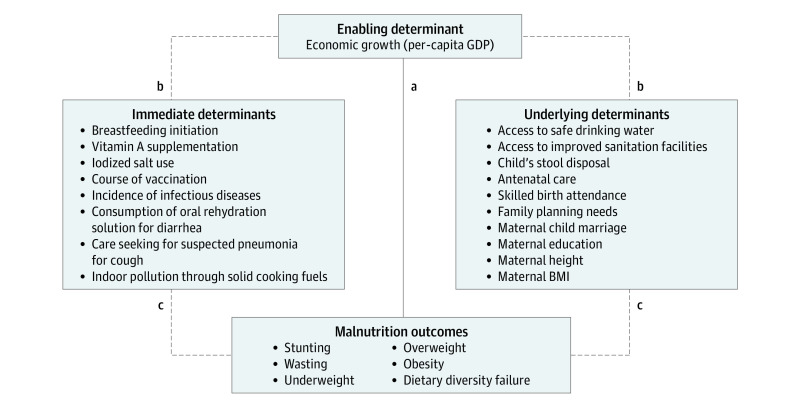
Economic growth may reduce childhood malnutrition through improvements of several contributing factors, but the empirical evidence is mixed. Identifying the most important factors that contribute to child malnutrition and their associations with economic growth can inform decision-making about targeted investments to improve children's health.
To assess the associations between economic growth and malnutrition, contributing factors and malnutrition, and economic growth and contributing factors of malnutrition in low- and middle-income countries (LMICs).
DESIGN, SETTING, AND PARTICIPANTS: This cross-sectional study used data from 239 Demographic and Health Surveys from January 1, 1990, to December 31, 2021. Observations included 1 138 568 children aged 0 to 35 months with valid anthropometric measures and information on contributing factors of malnutrition from 58 LMICs. Data were analyzed from May 20, 2022, to February 16, 2023.
National per-capita gross domestic product (GDP) was used as a proxy for economic growth.
Six measures of childhood malnutrition were constructed: stunting (height-for-age z score <-2), underweight (weight-for-age z score <-2), wasting (weight-for-height z score <-2), overweight (weight-for-height z score >2), obesity (weight-for-height z score >3), and dietary diversity failure (consumption of less than 5 of 8 different food groups in the past 24 hours). Eighteen contributing factors of malnutrition were constructed, of which 10 were underlying determinants (eg, access to improved sanitation) and 8 were immediate determinants (eg, breastfeeding initiation).
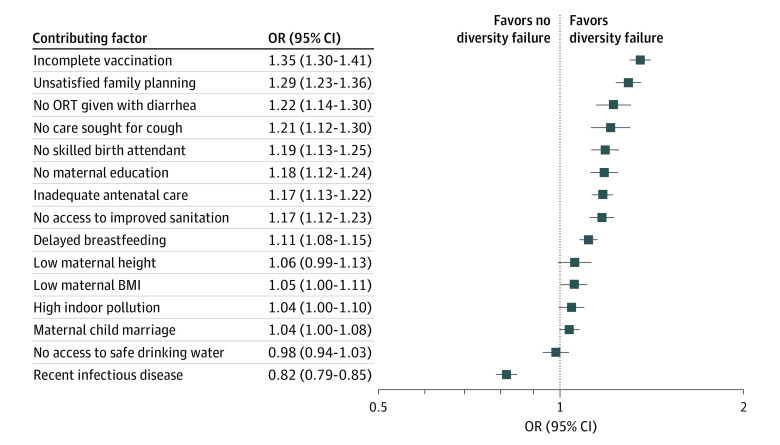
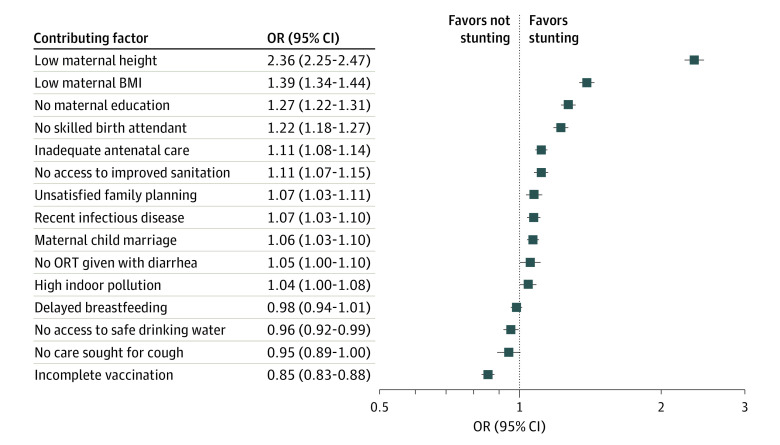
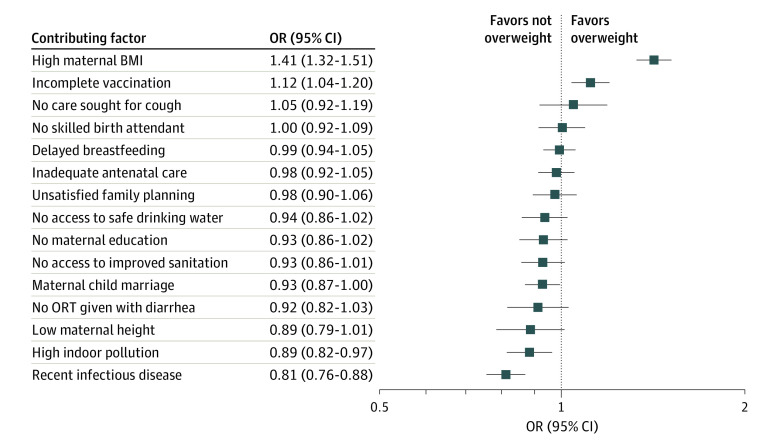
A total of 1 138 568 children (mean [SD] age, 17.14 [10.26] months; 579 589 [50.9%] boys and 558 979 [49.1%] girls) were included in the analysis. Of these, 27.3% (95% CI, 27.2%-27.4%) had stunting; 25.7% (95% CI, 25.6%-25.8%), underweight; 11.2% (95% CI, 11.1%-11.2%), wasting; 3.8% (95% CI, 3.7%-3.8%), overweight; 1.1% (95% CI, 1.1%-1.1%), obesity; and 79.8% (95% CI, 79.7%-79.9%), dietary diversity failure. Per-capita GDP was weakly associated with childhood malnutrition. The odds ratios associated with a 5% increase in per-capita GDP were 0.99 (95% CI, 0.99-1.00) for stunting, 1.01 (95% CI, 1.00-1.01) for wasting, 1.00 (95% CI, 1.00-1.00) for underweight, 0.98 (95% CI, 0.98-0.98) for overweight, 0.98 (95% CI, 0.97-0.98) for obesity, and 1.03 (95% CI, 1.01-1.04) for dietary diversity failure. Although strong associations were found between many contributing factors and most outcomes for malnutrition, associations identified between per-capita GDP and these contributing factors themselves were ambiguous.
In this multicountry cross-sectional study, economic growth was weakly associated with childhood malnutrition and several contributing factors. To reduce child malnutrition, economic growth may need to be accompanied by more targeted investments to improve contributing factors that are strongly associated with child malnutrition, such as maternal health and education.
重要性:经济增长可能通过改善几个促成因素来减少儿童营养不良,但实证证据参差不齐。确定导致儿童营养不良的最重要因素及其与经济增长的关联,可以为有针对性地投资改善儿童健康提供决策依据。
目的:评估经济增长与营养不良、促成因素与营养不良以及中低收入国家(LMIC)中经济增长与营养不良促成因素之间的关联。
设计、地点和参与者:本横断面研究使用了 1990 年 1 月 1 日至 2021 年 12 月 31 日期间来自 239 项人口与健康调查的数据。观察对象包括来自 58 个 LMIC 的 581588 名 0 至 35 个月大的儿童,他们的身高、体重和其他信息均可用,可用于评估营养状况。数据分析于 2022 年 5 月 20 日至 2023 年 2 月 16 日进行。
暴露:人均国内生产总值(GDP)被用作经济增长的代理指标。
主要结果和措施:构建了 6 种儿童营养不良衡量指标:发育迟缓(身高年龄 Z 分数<-2)、消瘦(体重年龄 Z 分数<-2)、消瘦(体重身高 Z 分数<-2)、超重(体重身高 Z 分数>2)、肥胖(体重身高 Z 分数>3)和饮食多样性失败(过去 24 小时内摄入不到 8 种不同食物组中的 5 种)。构建了 18 种营养不良促成因素,其中 10 种是潜在决定因素(如获得改善的卫生设施),8 种是直接决定因素(如母乳喂养开始时间)。
结果:共纳入 1138568 名儿童(平均[SD]年龄,17.14[10.26]个月;579589 名[50.9%]男孩和 558979 名[49.1%]女孩)进行分析。其中,27.3%(95%CI,27.2%-27.4%)发育迟缓;25.7%(95%CI,25.6%-25.8%),消瘦;11.2%(95%CI,11.1%-11.2%),消瘦;3.8%(95%CI,3.7%-3.8%),超重;1.1%(95%CI,1.1%-1.1%),肥胖;79.8%(95%CI,79.7%-79.9%),饮食多样性失败。人均 GDP 与儿童营养不良呈弱相关。与人均 GDP 增加 5%相关的比值比为 0.99(95%CI,0.99-1.00),与发育迟缓相关;1.01(95%CI,1.00-1.01),与消瘦相关;1.00(95%CI,1.00-1.00),与消瘦相关;0.98(95%CI,0.98-0.98),与超重相关;0.98(95%CI,0.97-0.98),与肥胖相关;1.03(95%CI,1.01-1.04),与饮食多样性失败相关。虽然许多促成因素与大多数营养不良结果之间存在很强的关联,但人均 GDP 与这些促成因素之间的关联并不明确。
结论:在这项多国家横断面研究中,经济增长与儿童营养不良和几个促成因素之间存在弱相关。为了减少儿童营养不良,经济增长可能需要伴随着更多有针对性的投资,以改善与儿童营养不良密切相关的促成因素,如母婴健康和教育。