Institute of Psychology & Leiden Institute for Brain and Cognition, Leiden University, Wassenaarseweg 52, 2333AK, Leiden, the Netherlands.
Princeton Neuroscience Institute, Princeton University, Princeton, NJ, USA.
Cogn Affect Behav Neurosci. 2020 Jun;20(3):521-535. doi: 10.3758/s13415-020-00783-8.
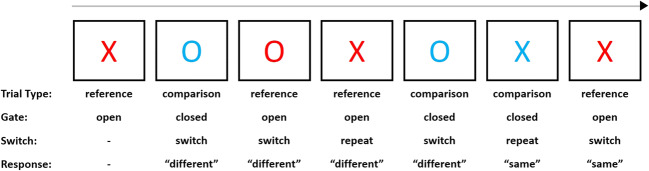
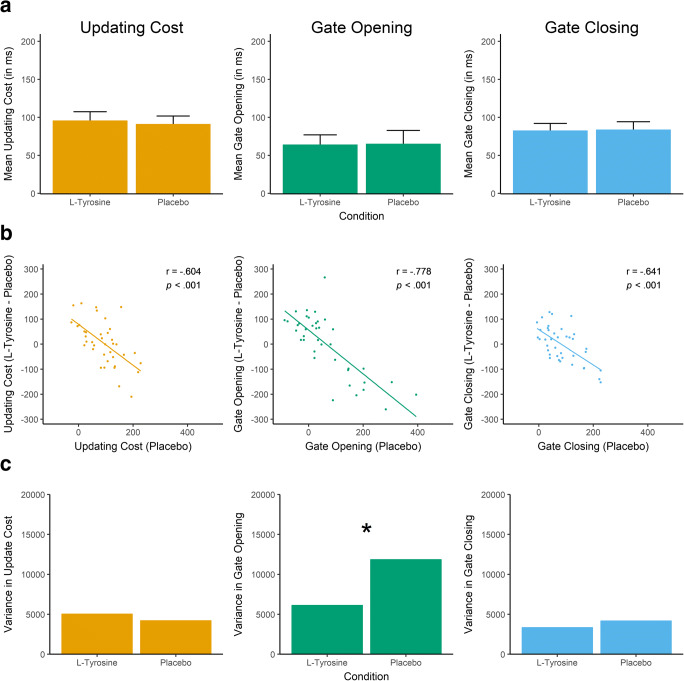
Adaptive goal-directed behavior requires a dynamic balance between maintenance and updating within working memory (WM). This balance is controlled by an input-gating mechanism implemented by dopamine in the basal ganglia. Given that dopaminergic manipulations can modulate performance on WM-related tasks, it is important to gain mechanistic insight into whether such manipulations differentially affect updating (i.e., encoding and removal) and the closely-related gate opening/closing processes that respectively enable/prevent updating. To clarify this issue, 2.0 g of dopamine's precursor L-tyrosine was administered to healthy young adults (N = 45) in a double-blind, placebo-controlled, within-subjects study. WM processes were empirically distinguished using the reference-back paradigm, which isolates performance related to updating, gate opening, and gate closing. L-tyrosine had a selective, baseline-dependent effect only on gate opening, which was evidenced by markedly reduced variance across subjects in gate opening performance in the L-tyrosine compared with the placebo condition, whereas the whole-sample average performance did not differ between conditions. This indicates a pattern of results whereby low-performing subjects improved, whereas high-performing subjects were impaired on L-tyrosine. Importantly, this inverted U-shaped pattern was not explained by regression to the mean. These results are consistent with an inverted-U relationship between dopamine and WM, and they indicate that updating and gating are differentially affected by a dopaminergic manipulation. This highlights the importance of distinguishing these processes when studying WM, for example, in the context of WM deficits in disorders with a dopaminergic pathophysiology.
自适应目标导向行为需要在工作记忆 (WM) 中维持和更新之间实现动态平衡。这种平衡由基底神经节中的多巴胺实现的输入门控机制控制。鉴于多巴胺能操纵可以调节与 WM 相关任务的表现,因此重要的是要深入了解这种操纵是否会对更新(即编码和删除)以及密切相关的门控开启/关闭过程产生不同的影响,这些过程分别使能/防止更新。为了澄清这个问题,在一项双盲、安慰剂对照、个体内研究中,给健康的年轻成年人(N=45)服用 2.0 克多巴胺前体 L-酪氨酸。使用参考回溯范式从经验上区分 WM 过程,该范式分离与更新、门控开启和门控关闭相关的表现。L-酪氨酸对门控开启具有选择性、依赖基线的影响,这表现在与安慰剂相比,L-酪氨酸条件下门控开启表现的受试者间变异性明显降低,而整个样本的平均表现则没有差异。这表明了一种结果模式,即低表现者在 L-酪氨酸上得到了改善,而高表现者则受到了损害。重要的是,这种倒 U 型模式不能用回归平均值来解释。这些结果与多巴胺和 WM 之间的倒 U 关系一致,并且表明更新和门控受到多巴胺能操纵的不同影响。这强调了在研究 WM 时区分这些过程的重要性,例如在具有多巴胺病理生理学的疾病中 WM 缺陷的情况下。