Vitalant Research Institute, San Francisco, CA, United States of America.
UCSF Dept. of Laboratory Medicine, University of California-San Francisco, San Francisco, CA, United States of America.
PLoS One. 2020 Mar 5;15(3):e0229993. doi: 10.1371/journal.pone.0229993. eCollection 2020.
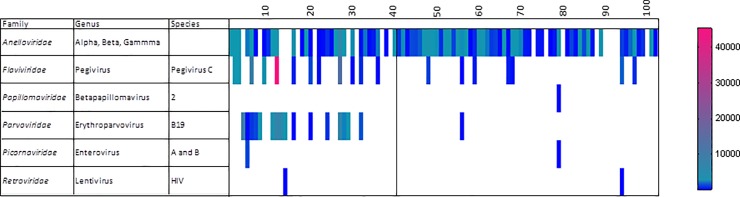
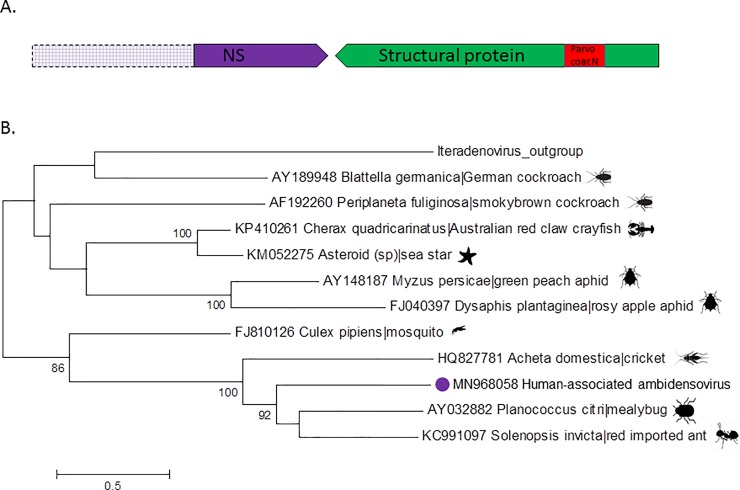
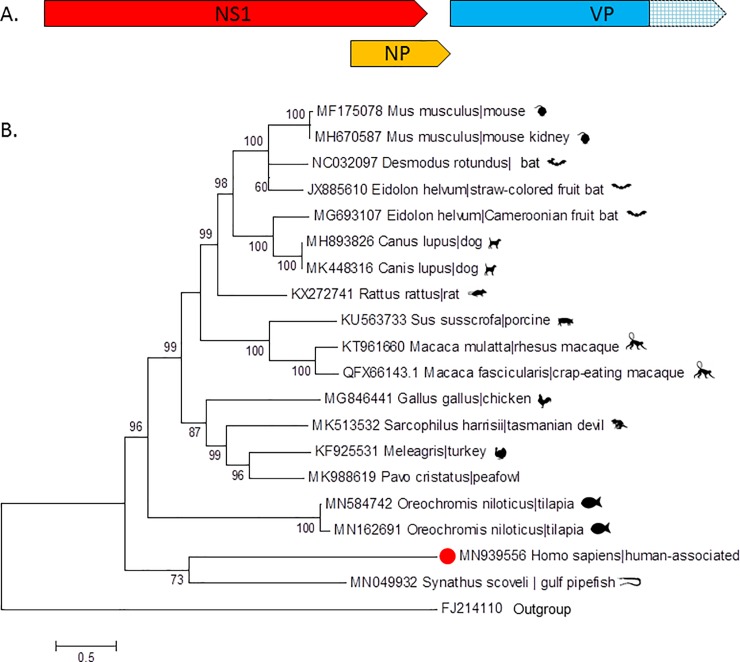
Plasma from patients with dengue-like symptoms was collected in 2013 to 2016 from the Brazilian states of Tocantins and Amapa. 781 samples testing negative for IgM against Dengue, Zika, and Chikungunya viruses and for flaviviruses, alphaviruses and enteroviruses RNA using RT-PCRs were analyzed using viral metagenomics. Viral particles-associated nucleic acids were enriched, randomly amplified, and deep sequenced in 102 mini-pools generating over 2 billion reads. Sequence data was analyzed for the presence of known and novel eukaryotic viral reads. Anelloviruses were detected in 80%, human pegivirus 1 in 19%, and parvovirus B19 in 17% of plasma pools. HIV and enteroviruses were detected in two pools each. Previously uncharacterized viral genomes were also identified, and their presence in single plasma samples confirmed by PCR. Chapparvovirus and ambidensovirus genomes, both in the Parvoviridae family, were partially characterized showing 33% and 34% identity in their NS1 sequences to their closest relative. Molecular surveillance using pre-existing plasma from febrile patients provides a readily scalable approach for the detection of novel, potentially emerging, viruses.
从 2013 年至 2016 年,在巴西的托坎廷斯州和阿马帕州收集了有登革热样症状的患者的血浆。使用 RT-PCR 对 781 份样本进行了检测,这些样本均针对登革热、寨卡和基孔肯雅热病毒、黄病毒、甲病毒和肠道病毒 RNA 的 IgM 呈阴性反应,分析了这些样本的病毒宏基因组学。对病毒粒子相关的核酸进行了富集、随机扩增和深度测序,共生成了超过 20 亿个读长的 102 个迷你池。对序列数据进行了分析,以确定是否存在已知和新型真核病毒序列。在 80%的血浆池、19%的人庚型肝炎病毒 1 和 17%的细小病毒 B19 中检测到微小病毒。每个池都检测到了 HIV 和肠道病毒。还鉴定了以前未表征的病毒基因组,并通过 PCR 对单个血浆样本中这些病毒的存在进行了确认。部分表征了 parvoviridae 科中的 Chapparvovirus 和 ambidensovirus 基因组,其 NS1 序列与亲缘关系最近的病毒的同源性分别为 33%和 34%。使用现有发热患者的血浆进行分子监测,为检测新型、潜在出现的病毒提供了一种易于扩展的方法。