Key Laboratory of Systems Biology, CAS Center for Excellence in Molecular Cell Science, Shanghai Institute of Biochemistry and Cell Biology, Shanghai Institutes for Biological Sciences, Chinese Academy of Sciences, University of Chinese Academy of Sciences, Shanghai, 200031, China.
Shanghai Research Center for Brain Science and Brain-Inspired Intelligence, Shanghai, 201210, China.
BMC Genomics. 2020 Mar 5;21(Suppl 1):74. doi: 10.1186/s12864-020-6465-8.
Postpartum developmental delay has been proposed as an important phenotype of human evolution which contributes to many human-specific features including the increase in brain size and the advanced human-specific cognitive traits. However, the biological processes and molecular functions underlying early brain development still remain poorly understood, especially in human and primates.
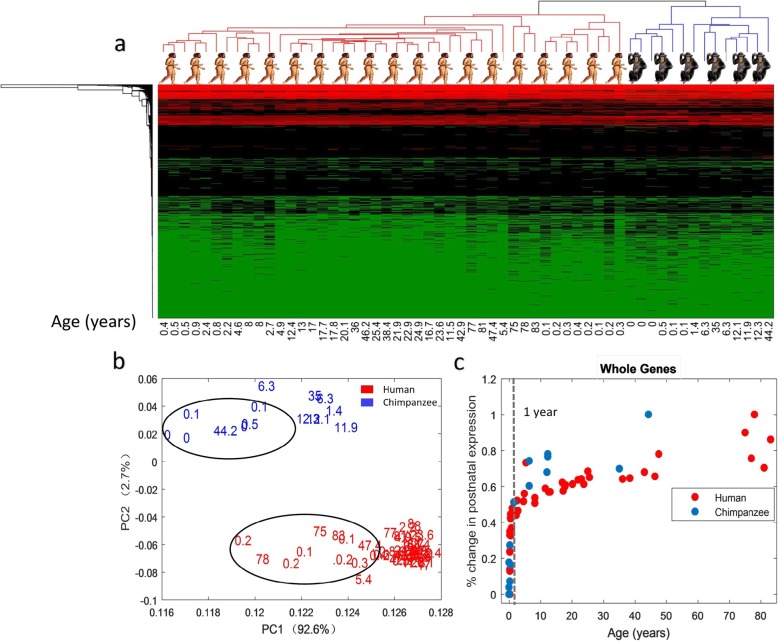
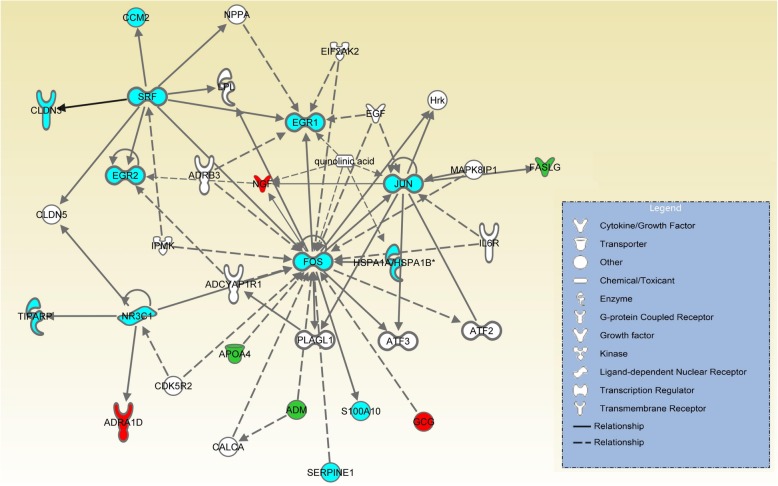
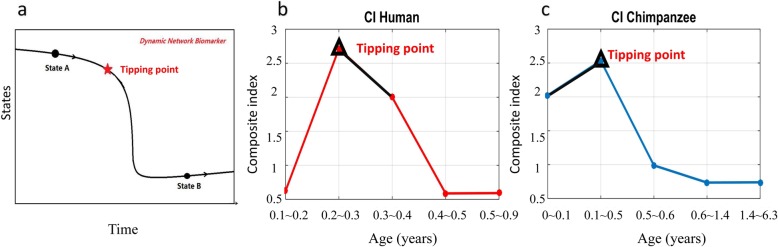
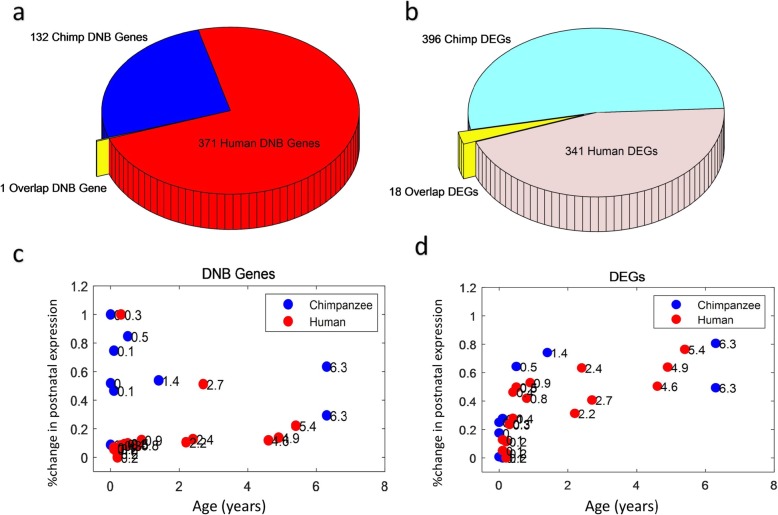
In this paper, we comparatively and extensively studied dorsolarteral prefrontal cortex expression data in human and chimpanzee to investigate the critical processes or biological events during early brain development at a molecular level. By using the dynamic network biomarker (DNB) model, we found that there are tipping points around 3 months and 1 month, which are crucial periods in infant human and chimpanzee brain development, respectively. In particular, we shown that the human postnatal development and the corresponding expression changes are delayed 3 times relative to chimpanzee, and we also revealed that many common biological processes are highly involved in those critical periods for both human and chimpanzee, e.g., physiological system development functions, nervous system development, organismal development and tissue morphology. These findings support that the maximal rates of brain growth will be in those two critical periods for respective human and primates. In addition, different from chimpanzee, our analytic results also showed that human can further develop a number of advanced behavior functions around this tipping point (around 3 months), such as the ability of learning and memory.
This work not only provides biological insights into primate brain development at a molecular level but also opens a new way to study the criticality of nonlinear biological processes based on the observed omics data.
产后发育迟缓被认为是人类进化的一个重要表型,它有助于许多人类特有的特征,包括大脑尺寸的增加和先进的人类特有的认知特征。然而,早期大脑发育的生物学过程和分子功能仍然知之甚少,特别是在人类和灵长类动物中。
在本文中,我们比较和广泛地研究了人类和黑猩猩的背外侧前额叶皮质表达数据,以在分子水平上研究早期大脑发育过程中的关键过程或生物学事件。通过使用动态网络生物标志物(DNB)模型,我们发现人类和黑猩猩大脑发育的关键时期分别在 3 个月和 1 个月左右存在转折点。特别是,我们表明人类的产后发育和相应的表达变化相对于黑猩猩延迟了 3 倍,我们还揭示了许多常见的生物学过程高度参与了人类和黑猩猩的这两个关键时期,例如生理系统发育功能、神经系统发育、机体发育和组织形态。这些发现支持人类和灵长类动物的大脑生长最快速度将在这两个关键时期。此外,与黑猩猩不同的是,我们的分析结果还表明,人类可以在这个转折点(大约 3 个月)周围进一步发展出一些高级行为功能,例如学习和记忆能力。
这项工作不仅为灵长类动物大脑发育提供了分子水平上的生物学见解,还为基于观察到的组学数据研究非线性生物学过程的关键特性开辟了新途径。