Gebauer Sarah, Schootman Mario, Xian Hong, Xaverius Pamela
Saint Louis University-School of Medicine, 1402 S Grand Blvd, St. Louis, MO 63104, United States.
Saint Louis University College for Public Health and Social Justice, 3545 Lafayette Ave, St. Louis, MO 63103, United States.
Prev Med Rep. 2020 Feb 11;18:101063. doi: 10.1016/j.pmedr.2020.101063. eCollection 2020 Jun.
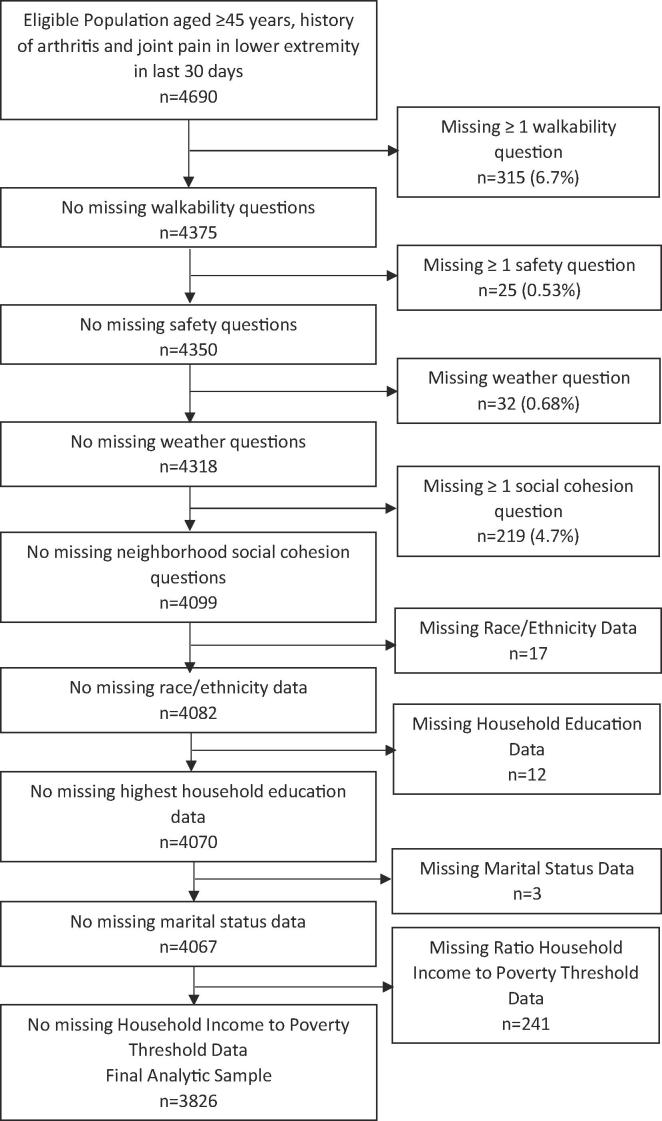
Arthritis is a leading cause of disability in the United States, with the most efficacious treatments being physical activity (PA). Arthritis patients are less likely to meet PA recommendations and the neighborhood environment may play a role. This study examines the effect of neighborhood walkability and social cohesion on PA among arthritis patients in a sample of US adults. This cross-sectional study used 2015 National Health Interview Survey data. Eligible participants were age ≥45 years, had arthritis, recent leg-joint pain and complete data. Walkability was based on 6 questions regarding amenities and destinations that promote walking. Social cohesion was based on 4 validated questions. Meeting PA was defined as 150 min/week. Chi-squared testing and logistic regression determined associations between neighborhood environment and PA, including interaction between social cohesion and walkability. The final unweighted sample included 3,826 participants with mean age 64.6 years (SE = 0.26), 61.8% female and 78.1% non-Hispanic White. In adjusted, weighted analysis, not, slightly, and moderately-walkable neighborhoods all had lower odds of meeting PA recommendations verses highly-walkable neighborhood (OR = 0.61[95% CI 0.41-0.92], OR = 0.65[95% CI 0.50-0.85], OR = 0.75[95% CI 0.59-0.97], respectively). Social cohesion was independently associated with decreased odds of meeting PA guidelines (p = 0.003). No interaction with walkability was found (p = 0.405). Less than a highly-walkable neighborhood and lower social cohesion were independently associated with decreased odds of meeting PA recommendations among adults with arthritis and recent joint pain. Since walking is one of the most effective treatments for arthritis, clinicians should be sensitive to barriers patients may perceive to walking.
关节炎是美国导致残疾的主要原因之一,最有效的治疗方法是体育活动(PA)。关节炎患者不太可能达到PA建议的标准,而社区环境可能起到一定作用。本研究在美国成年人样本中,考察社区步行便利性和社会凝聚力对关节炎患者PA的影响。这项横断面研究使用了2015年全国健康访谈调查数据。符合条件的参与者年龄≥45岁,患有关节炎,近期有腿部关节疼痛且数据完整。步行便利性基于6个关于促进步行的便利设施和目的地的问题。社会凝聚力基于4个经过验证的问题。达到PA标准定义为每周150分钟。卡方检验和逻辑回归确定了社区环境与PA之间的关联,包括社会凝聚力和步行便利性之间的相互作用。最终未加权样本包括3826名参与者,平均年龄64.6岁(标准误=0.26),61.8%为女性,78.1%为非西班牙裔白人。在调整后的加权分析中,与步行便利性高的社区相比,步行便利性低、一般和中等的社区达到PA建议标准的几率都较低(OR分别为0.61[95%CI 0.41 - 0.92]、0.65[95%CI 0.50 - 0.85]、0.75[95%CI 0.59 - 0.97])。社会凝聚力与达到PA指南标准的几率降低独立相关(p = 0.003)。未发现与步行便利性的相互作用(p = 0.405)。对于患有关节炎和近期关节疼痛的成年人,社区步行便利性低和社会凝聚力低与达到PA建议标准的几率降低独立相关。由于步行是治疗关节炎最有效的方法之一,临床医生应注意患者可能察觉到的步行障碍。