Liu Heng-Jian, Li Huan-Ting, Lin Yuan, Lu Dong-Lin, Yue Yong, Xiong Jing, Li Cong-Qin, Xu Xiang-Yu, Feng Yu-Gong
Qingdao University, Qingdao, Shandong, China (mainland).
Department of Neurosurgery, Affiliated Hospital of Qingdao University, Qingdao, Shandong, China (mainland).
Med Sci Monit. 2020 Mar 6;26:e920754. doi: 10.12659/MSM.920754.
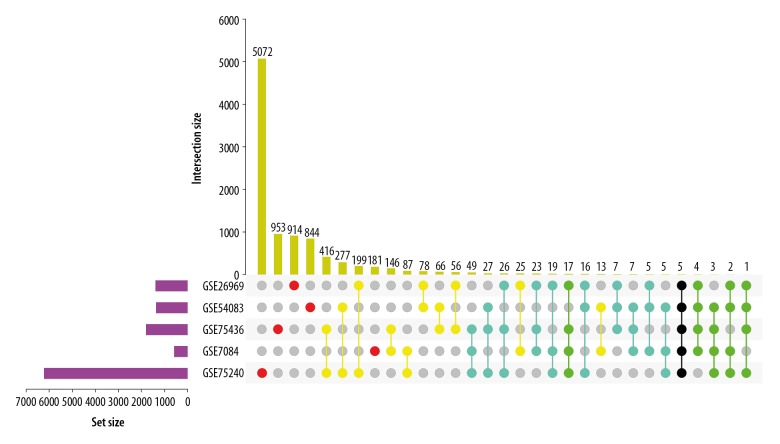
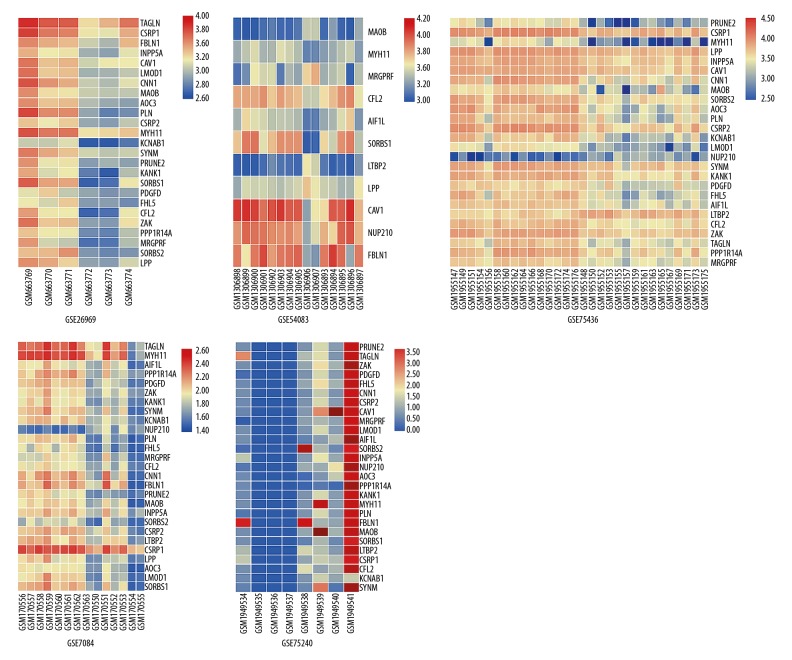
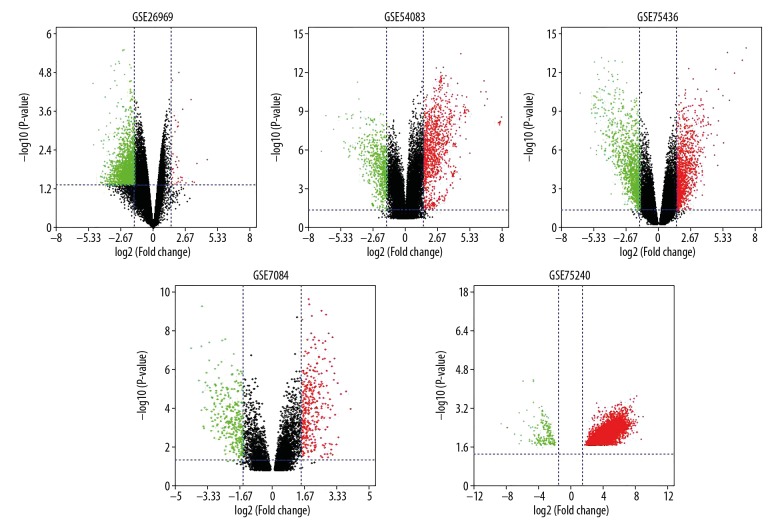
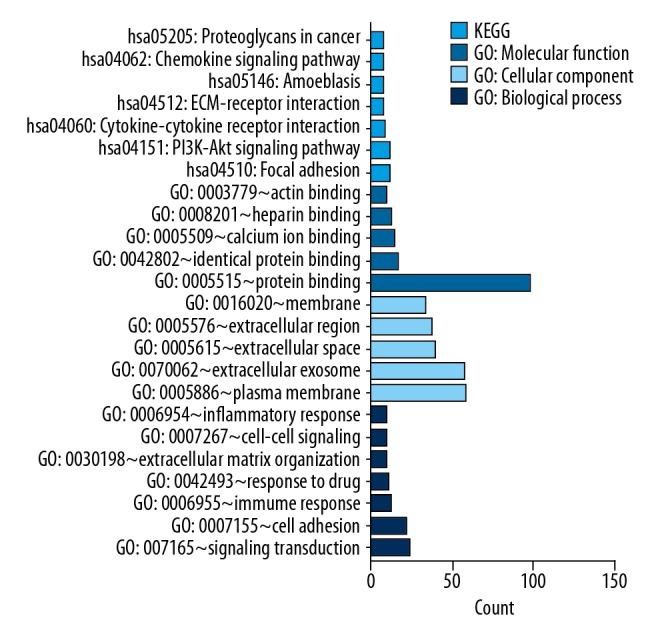
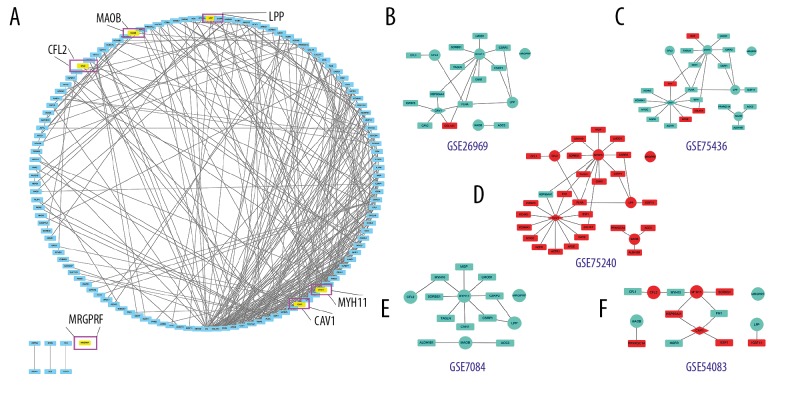
BACKGROUND Rupture of intracranial aneurysms (IA) is associated with high rates of mortality around the world. Use of intestinal probiotics can regulate the pathophysiology of aneurysms, but the details of the mechanism involved have been unclear. MATERIAL AND METHODS The GEO2R analysis website was used to detect the DEGs between IAs, AAAs, samples after supplementation with probiotics, and normal samples. The online tool DAVID provides functional classification and annotation analyses of associated genes, including GO and KEGG pathway. PPI of these DEGs was analyzed based on the STRING database, followed by analysis using Cytoscape software. RESULTS We found 170 intersecting DEGs (contained in GSE75240 and more than 2 of the 4 aneurysms datasets), 5 intersecting DEGs (contained in all datasets) and 1 intersecting DEG (contained in GSE75240 and all IAs datasets). GO analysis results suggested that the DEGs primarily participate in signal transduction, cell adhesion, immune response, response to drug, extracellular matrix organization, cell-cell signaling, and inflammatory response in the BP terms, and the KEGG pathways are mainly enriched in focal adhesion, cytokine-cytokine receptor interaction, ECM-receptor interaction, amoebiasis, chemokine signaling pathway, proteoglycans, and PI3K-Akt signaling pathway in cancer pathways. Through PPI network analysis, we confirmed 2 candidates for further study: CAV1 and MYH11. These downregulated DEGs are associated with the formation of aneurysms, and the change of these DEGs is the opposite in probiotics-treated animals. CONCLUSIONS Our study suggests that MYH11 and CAV1 are potential target genes for prevention of aneurysms. Further experiments are needed to verify these findings.
颅内动脉瘤(IA)破裂在全球范围内与高死亡率相关。肠道益生菌的使用可调节动脉瘤的病理生理过程,但其中涉及的机制细节尚不清楚。
使用GEO2R分析网站检测IA、腹主动脉瘤(AAA)、补充益生菌后的样本与正常样本之间的差异表达基因(DEG)。在线工具DAVID提供相关基因的功能分类和注释分析,包括基因本体论(GO)和京都基因与基因组百科全书(KEGG)通路。基于STRING数据库分析这些DEG的蛋白质-蛋白质相互作用(PPI),随后使用Cytoscape软件进行分析。
我们发现了170个交集DEG(包含在GSE75240和4个动脉瘤数据集中的2个以上)、5个交集DEG(包含在所有数据集中)和1个交集DEG(包含在GSE75240和所有IA数据集中)。GO分析结果表明,DEG在生物学过程(BP)术语中主要参与信号转导、细胞粘附、免疫反应、药物反应、细胞外基质组织、细胞间信号传导和炎症反应,KEGG通路主要富集于癌症通路中的粘着斑、细胞因子-细胞因子受体相互作用、细胞外基质-受体相互作用、阿米巴病、趋化因子信号通路、蛋白聚糖和PI3K-Akt信号通路。通过PPI网络分析,我们确定了2个可供进一步研究的候选基因:小窝蛋白1(CAV1)和肌球蛋白重链11(MYH11)。这些下调的DEG与动脉瘤的形成相关,并且在益生菌处理的动物中这些DEG的变化相反。
我们的研究表明,MYH11和CAV1是预防动脉瘤的潜在靶基因。需要进一步的实验来验证这些发现。