Elena Silantyeva, Dragana Zarkovic, Ramina Soldatskaia, Evgeniia Astafeva, Orazov Mekan
Hospital Lapino (MD Medical Group), Moscow, Russia.
Faculty of Physical Education and Sport, Department of Anatomy and Biomechanics, Charles University, Prague, Czech Republic.
Sex Med. 2020 Jun;8(2):282-289. doi: 10.1016/j.esxm.2020.01.004. Epub 2020 Mar 4.
Impaired coordination, relaxation, and atrophy of pelvic floor muscles (PFMs) may cause various health issues referred to as pelvic floor dysfunction (PFD). In recent years, electromagnetic noninvasive stimulation of the pelvic floor was successfully used to treat PFD symptoms.
This study aims to compare the effectiveness of electrical and magnetic noninvasive stimulation for the treatment of PFD in postpartum women.
2 intervention groups treated with high-intensity focused electromagnetic ([HIFEM]; G1) procedure and electrical stimulation (G2) were established along with the control group (G3). Patients received 10 therapies delivered at the hospital (G1; 2-3 times per week) or self-administered at home (G2; every other day) after initial training. The protocol was identical for both modalities. Functionality of the PFM was examined by surface electromyography measurements (maximal voluntary contraction [MVC]; mean MVC; muscle activity at rest; endurance of contraction) while patient's subjective perception of pelvic floor functionality was assessed by Pelvic Floor Impact Questionnaire-Short Form 7 (PFIQ-7) standardized questionnaire. Changes in electromyography values and PFIQ-7 scores were statistically evaluated from baseline to after all treatments.
The main outcome measure was enhancement of PFM activity.
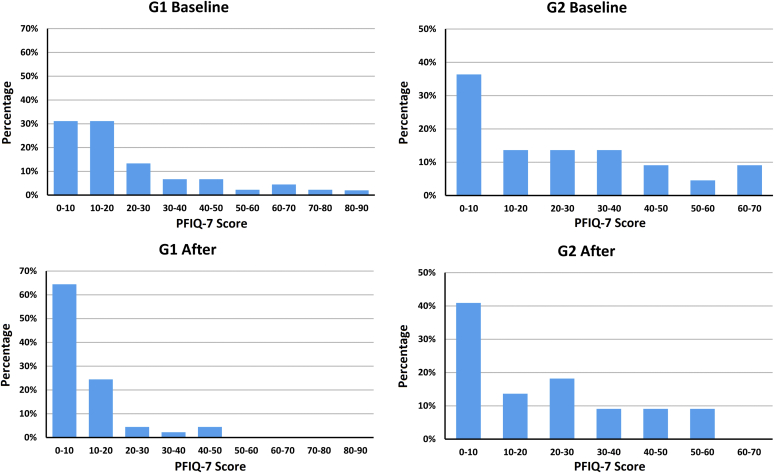
In total, 95 patients (G1 = 50; G2 = 25; G3 = 20) participated in the study. The MVC, mean MVC, and endurance were lowered in symptomatic patients. After the treatments, these parameters significantly increased (P < .001) and moved toward the values of healthy population. Electrogenesis at relaxation revealed divergent tendencies in the G1 and G2 groups. PFIQ-7 scores significantly improved in treated patients (P < .001). In general, superior results were documented in the HIFEM group as it reached improvement of electromyography parameters from 48% to 59% (electrical stimulation from 7% to 36%) and similarly the improvement of PFIQ-7 score by 57% (electrical stimulation by 32%).
This study documented that the HIFEM procedure was significantly more effective than electrical stimulation in treatment of PFD in postpartum women. Both the objective and subjective evaluation indicates more profound effects of magnetic stimulation. Elena S, Dragana Z, Ramina S, et al. Electromyographic Evaluation of the Pelvic Muscles Activity After High-Intensity Focused Electromagnetic Procedure and Electrical Stimulation in Women With Pelvic Floor Dysfunction. Sex Med 2020;8:282-289.
盆底肌肉(PFMs)协调、放松和萎缩功能受损可能会导致各种被称为盆底功能障碍(PFD)的健康问题。近年来,盆底的电磁非侵入性刺激已成功用于治疗PFD症状。
本研究旨在比较电刺激和磁刺激非侵入性治疗产后女性PFD的有效性。
设立了2个干预组,分别采用高强度聚焦电磁([HIFEM];G1)程序和电刺激(G2)进行治疗,并设立了对照组(G3)。患者在接受初始培训后,在医院接受10次治疗(G1;每周2 - 3次)或在家自行治疗(G2;每隔一天一次)。两种治疗方式的方案相同。通过表面肌电图测量(最大自主收缩[MVC];平均MVC;静息时的肌肉活动;收缩耐力)来检查PFM的功能,同时通过盆底影响问卷简表7(PFIQ - 7)标准化问卷评估患者对盆底功能的主观感受。从基线到所有治疗结束后,对肌电图值和PFIQ - 7评分的变化进行统计学评估。
主要观察指标是PFM活动的增强。
共有95名患者(G1 = 50;G2 = 25;G3 = 20)参与了该研究。有症状患者的MVC、平均MVC和耐力降低。治疗后,这些参数显著增加(P <.001),并趋向于健康人群的值。静息时的电发生在G1组和G2组中显示出不同的趋势。治疗患者的PFIQ - 7评分显著改善(P <.001)。总体而言,HIFEM组的结果更优,其肌电图参数改善了48%至59%(电刺激为7%至36%),同样,PFIQ - 7评分改善了57%(电刺激为32%)。
本研究表明,在治疗产后女性PFD方面,HIFEM程序比电刺激显著更有效。客观和主观评估均表明磁刺激的效果更显著。Elena S, Dragana Z, Ramina S等。盆底功能障碍女性高强度聚焦电磁程序和电刺激后盆底肌肉活动的肌电图评估。性医学2020;8:282 - 289。