Department of Kinesiology, Brock University, St. Catharines, Ontario, Canada.
Department of Life Sciences, University of Roehampton, London, United Kingdom.
PLoS One. 2018 Mar 29;13(3):e0195219. doi: 10.1371/journal.pone.0195219. eCollection 2018.
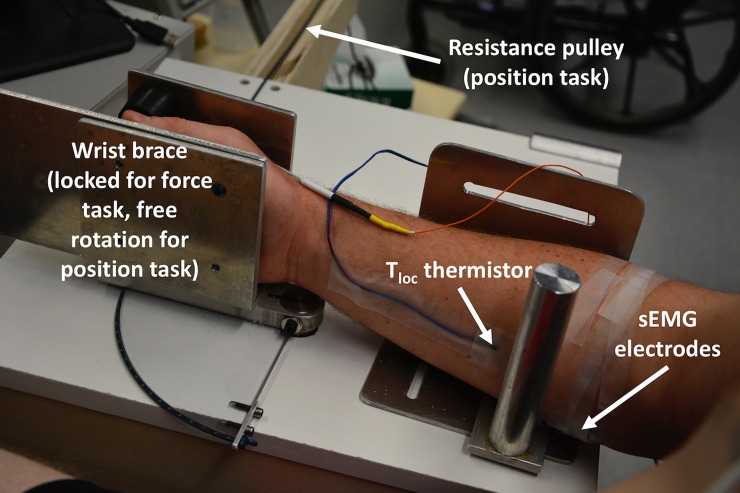
The large body of work demonstrating hyperthermic impairment of neuromuscular function has utilized maximal isometric contractions, but extrapolating these findings to whole-body exercise and submaximal, dynamic contractions may be problematic. We isolated and compared core and skin temperature influences on an isometric force task versus a position task requiring dynamic maintenance of joint angle. Surface electromyography (sEMG) was measured on the flexor carpi radialis at 60% of baseline maximal voluntary contraction while either pushing against a rigid restraint (force task) or while maintaining a constant wrist angle and supporting an equivalent inertial load (position task). Twenty participants performed each task at 0.5°C rectal temperature (Tre) intervals while being passively heated from 37.1±0.3°C to ≥1.5°C Tre and then cooled to 37.8±0.3°C, permitting separate analyses of core versus skin temperature influences. During a 3-s contraction, trend analysis revealed a quadratic trend that peaked during hyperthermia for root-mean-square (RMS) amplitude during the force task. In contrast, RMS amplitude during the position task remained stable with passive heating, then rapidly increased with the initial decrease in skin temperature at the onset of passive cooling (p = 0.010). Combined hot core and hot skin elicited shifts toward higher frequencies in the sEMG signal during the force task (p = 0.003), whereas inconsistent changes in the frequency spectra occurred for the position task. Based on the patterns of RMS amplitude in response to thermal stress, we conclude that core temperature was the primary thermal afferent influencing neuromuscular response during a submaximal force task, with minimal input from skin temperature. However, skin temperature was the primary thermal afferent during a position task with minimal core temperature influence. Therefore, temperature has a task-dependent impact on neuromuscular responses.
大量研究表明,高热会损害神经肌肉功能,这些研究大多采用了最大等长收缩的方法,但将这些发现推断到全身运动和次最大、动态收缩可能存在问题。我们分别比较和隔离了核心温度和皮肤温度对等长力任务和动态维持关节角度的位置任务的影响。表面肌电图(sEMG)在基线最大自主收缩的 60%时测量桡侧腕屈肌,参与者在推刚性约束(力任务)或保持恒定腕角和支撑等效惯性负荷(位置任务)时进行测量。20 名参与者在直肠温度(Tre)间隔 0.5°C 的情况下进行了每项任务,从 37.1±0.3°C 被动加热到≥1.5°C Tre,然后冷却到 37.8±0.3°C,允许对核心温度与皮肤温度的影响进行单独分析。在 3 秒收缩期间,趋势分析显示在力任务中,均方根(RMS)幅度在高温期间呈二次趋势,达到峰值。相比之下,在位置任务中,RMS 幅度在被动加热过程中保持稳定,然后在被动冷却开始时皮肤温度迅速下降时迅速增加(p = 0.010)。在力任务中,热核心和热皮肤联合产生的热量会导致肌电图信号向更高频率移动(p = 0.003),而在位置任务中,频率谱则发生不一致的变化。基于对热应激的 RMS 幅度的反应模式,我们得出结论,在次最大力任务中,核心温度是影响神经肌肉反应的主要热传入,皮肤温度的影响较小。然而,在位置任务中,皮肤温度是主要的热传入,核心温度的影响较小。因此,温度对神经肌肉反应有任务依赖性的影响。