Stanisci Annalucia, Tøndervik Anne, Gaardløs Margrethe, Lervik Anders, Skjåk-Bræk Gudmund, Sletta Håvard, Aachmann Finn L
Department of Biotechnology and Food Science, NTNU Norwegian University of Science and Technology, Norwegian Biopolymer Laboratory (NOBIPOL), Sem Sælands vei 6/8, NO 7491 Trondheim, Norway.
Department of Biotechnology and Nanomedicine, SINTEF Industry, Richard Birkelands veg 3 B, NO 7491 Trondheim, Norway.
ACS Omega. 2020 Feb 24;5(8):4352-4361. doi: 10.1021/acsomega.9b04490. eCollection 2020 Mar 3.
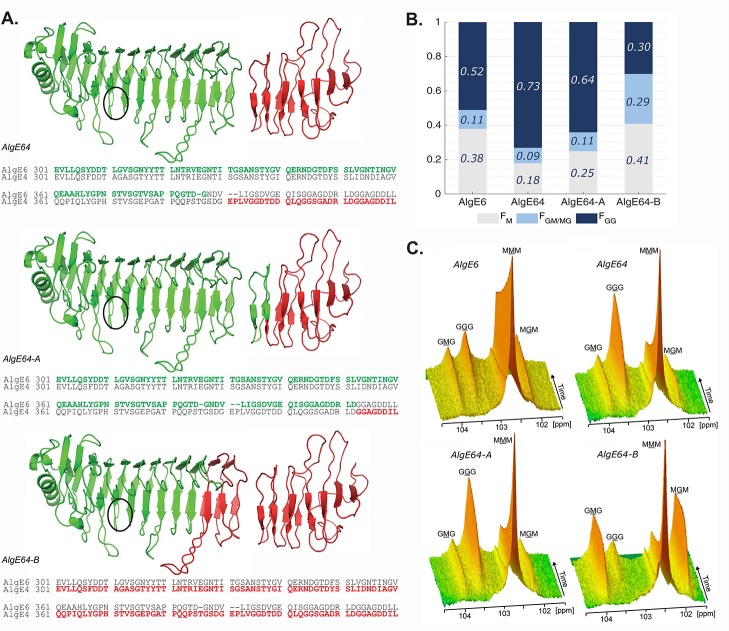
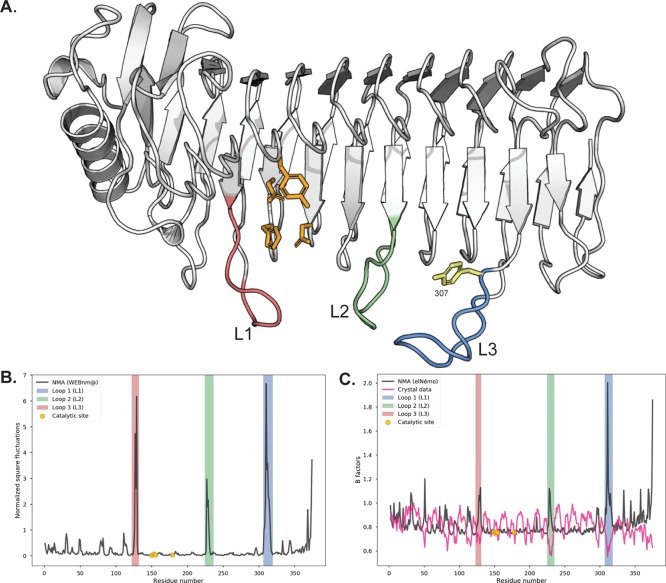
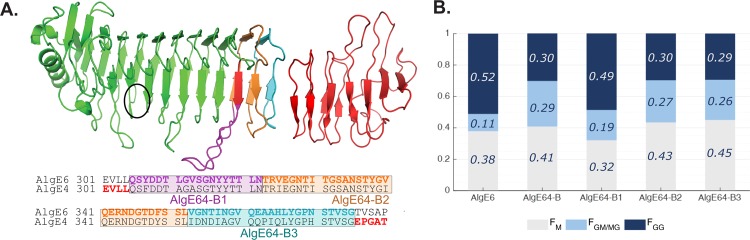
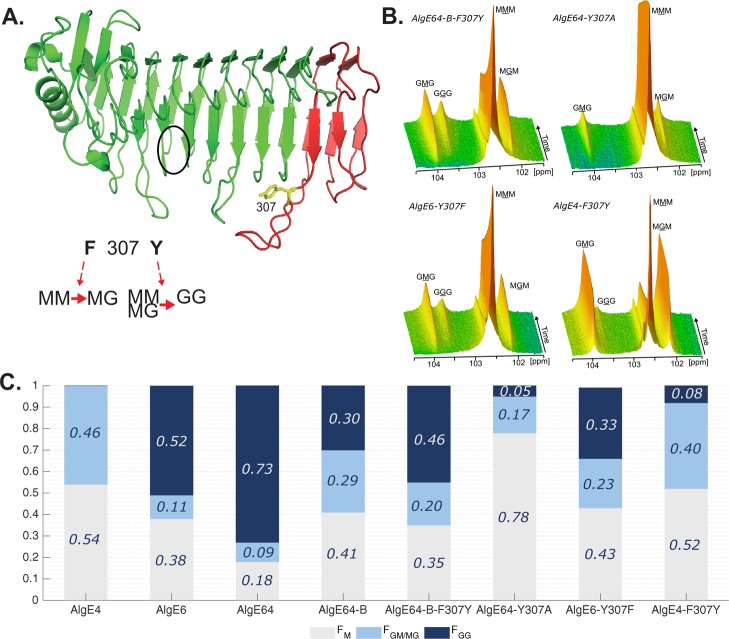
Alginate is a linear copolymer composed of 1→4 linked β-d-mannuronic acid (M) and its epimer α-l-guluronic acid (G). The polysaccharide is first produced as homopolymeric mannuronan and subsequently, at the polymer level, C-5 epimerases convert M residues to G residues. The bacterium encodes a family of seven secreted and calcium ion-dependent mannuronan C-5 epimerases (AlgE1-AlgE7). These epimerases consist of two types of structural modules: the A-modules, which contain the catalytic site, and the R-modules, which influence activity through substrate and calcium binding. In this study, we rationally designed new hybrid mannuronan C-5 epimerases constituting the A-module from AlgE6 and the R-module from AlgE4. This led to a better understanding of the molecular mechanism determining differences in MG- and GG-block-forming properties of the enzymes. A long loop with either tyrosine or phenylalanine extruding from the β-helix of the enzyme proved essential in defining the final alginate block structure, probably by affecting substrate binding. Normal mode analysis of the A-module from AlgE6 supports the results.
藻酸盐是一种线性共聚物,由1→4连接的β-D-甘露糖醛酸(M)及其差向异构体α-L-古洛糖醛酸(G)组成。这种多糖最初以同聚甘露糖醛酸的形式产生,随后在聚合物水平上,C-5差向异构酶将M残基转化为G残基。该细菌编码一个由七种分泌型且依赖钙离子的甘露糖醛酸C-5差向异构酶(AlgE1-AlgE7)组成的家族。这些差向异构酶由两种类型的结构模块组成:包含催化位点的A模块和通过底物及钙离子结合影响活性的R模块。在本研究中,我们合理设计了新的杂合甘露糖醛酸C-5差向异构酶,其A模块来自AlgE6,R模块来自AlgE4。这使我们对决定这些酶形成MG和GG嵌段特性差异的分子机制有了更好的理解。从酶的β-螺旋中伸出的带有酪氨酸或苯丙氨酸的长环,可能通过影响底物结合,在确定最终藻酸盐嵌段结构方面被证明是至关重要的。对AlgE6的A模块进行的正常模式分析支持了该结果。