Germline Stem Cells and Microenvironment Lab, College of Animal Science and Technology, Nanjing Agricultural University, Nanjing, Jiangsu 210095, China.
Germline Stem Cells and Microenvironment Lab, College of Animal Science and Technology, Nanjing Agricultural University, Nanjing, Jiangsu 210095, China. E-mail:
Zool Res. 2020 Mar 18;41(2):203-207. doi: 10.24272/j.issn.2095-8137.2020.024.
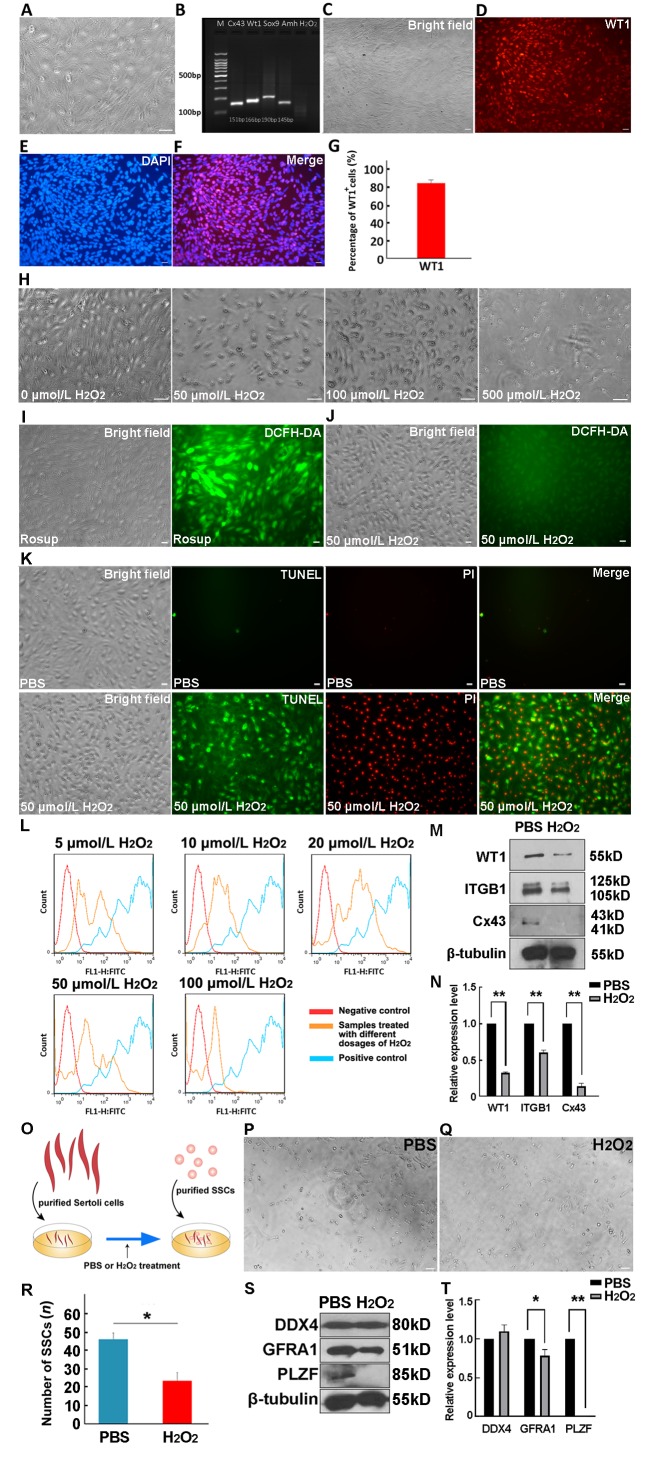
Gap junctions regulate intercellular communication between Sertoli cells and germ cells in male testes and play vital functions in spermatogenesis. Many factors in animal breeding and husbandry can induce oxidative stress, which can impair the testis microenvironment and male animal fertility. However, the underlying mechanisms are largely unknown. Recently, we identified that androgen signals promote the expression of connexin-43 (Cx43), a key component of gap junctions, to regulate spermatogenesis. Thus, we asked whether hyperactive reactive oxygen species (ROS) can impair gap junctions by interfering with Cx43 in porcine testes. Using a porcine Sertoli cell system, we found that hyperactive ROS caused extensive apoptosis in Sertoli cells, remarkable decrease in Cx43 expression, and failed maintenance of co-cultured spermatogonial stem cells (SSCs), indicating that ROS impaired the function of Sertoli cells and promoted loss of SSCs. This observation provides a possible mechanism for the impact of ROS on fertility of male animals.
缝隙连接调节睾丸中支持细胞和生殖细胞之间的细胞间通讯,在精子发生中发挥重要作用。动物繁殖和饲养中的许多因素会引起氧化应激,从而损害睾丸微环境和雄性动物的生育能力。然而,其潜在机制在很大程度上尚不清楚。最近,我们发现雄激素信号促进间隙连接关键组成部分连接蛋白 43(Cx43)的表达,以调节精子发生。因此,我们想知道活性氧(ROS)是否可以通过干扰猪睾丸中的 Cx43 来损害缝隙连接。使用猪支持细胞系统,我们发现过度活跃的 ROS 导致支持细胞广泛凋亡,Cx43 表达显著减少,共培养的精原干细胞(SSCs)无法维持,表明 ROS 损害了支持细胞的功能并促进 SSCs 的丢失。这一观察结果为 ROS 对雄性动物生育能力的影响提供了一种可能的机制。