Department of Biology, University of Washington, Seattle, WA 98195;
Department of Biology, University of Washington, Seattle, WA 98195.
Proc Natl Acad Sci U S A. 2020 Mar 24;117(12):6476-6483. doi: 10.1073/pnas.1916903117. Epub 2020 Mar 9.
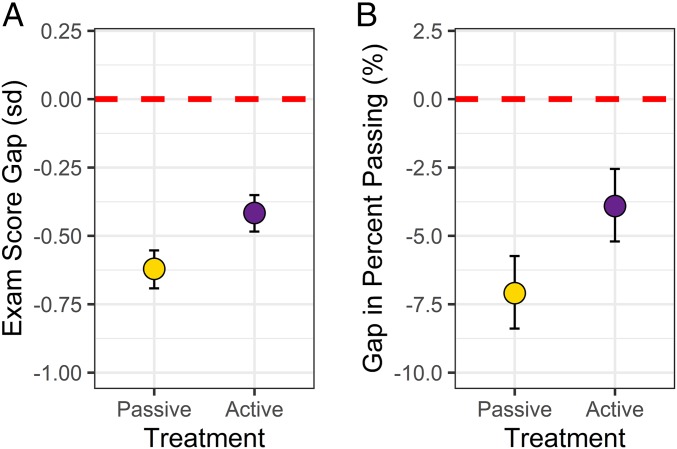
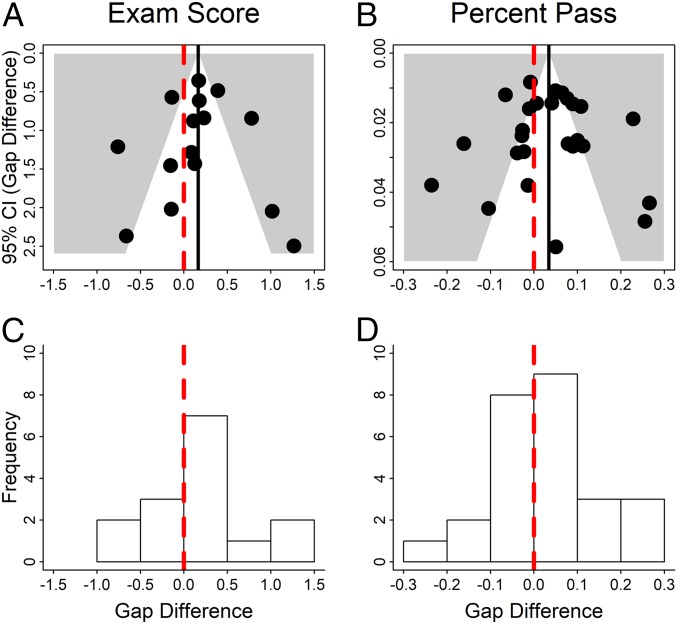
We tested the hypothesis that underrepresented students in active-learning classrooms experience narrower achievement gaps than underrepresented students in traditional lecturing classrooms, averaged across all science, technology, engineering, and mathematics (STEM) fields and courses. We conducted a comprehensive search for both published and unpublished studies that compared the performance of underrepresented students to their overrepresented classmates in active-learning and traditional-lecturing treatments. This search resulted in data on student examination scores from 15 studies (9,238 total students) and data on student failure rates from 26 studies (44,606 total students). Bayesian regression analyses showed that on average, active learning reduced achievement gaps in examination scores by 33% and narrowed gaps in passing rates by 45%. The reported proportion of time that students spend on in-class activities was important, as only classes that implemented high-intensity active learning narrowed achievement gaps. Sensitivity analyses showed that the conclusions are robust to sampling bias and other issues. To explain the extensive variation in efficacy observed among studies, we propose the heads-and-hearts hypothesis, which holds that meaningful reductions in achievement gaps only occur when course designs combine deliberate practice with inclusive teaching. Our results support calls to replace traditional lecturing with evidence-based, active-learning course designs across the STEM disciplines and suggest that innovations in instructional strategies can increase equity in higher education.
我们检验了一个假设,即在所有科学、技术、工程和数学(STEM)领域和课程中,相比于传统讲授型课堂,参与主动学习型课堂的代表性不足的学生的成绩差距更小。我们全面搜索了已发表和未发表的研究,这些研究比较了代表性不足的学生与代表性过高的学生在主动学习和传统讲授型处理中的表现。这项搜索为 15 项研究(共 9238 名学生)的学生考试成绩数据和 26 项研究(共 44606 名学生)的学生不及格率数据提供了依据。贝叶斯回归分析表明,平均而言,主动学习将考试成绩的成绩差距缩小了 33%,将及格率差距缩小了 45%。学生在课堂活动上花费的时间比例很重要,只有实施高强度主动学习的课程才能缩小成绩差距。敏感性分析表明,这些结论不受抽样偏差和其他问题的影响。为了解释研究中观察到的广泛的效果差异,我们提出了“头与心”假说,即只有当课程设计将刻意练习与包容性教学相结合时,成绩差距才会显著缩小。我们的研究结果支持在 STEM 学科中用基于证据的主动学习课程设计取代传统讲授型课程的呼吁,并表明教学策略的创新可以提高高等教育中的公平性。