Baniga Zebedayo, Hounmanou Yaovi M Gildas, Kudirkiene Egle, Kusiluka Lughano J M, Mdegela Robinson H, Dalsgaard Anders
Department of Veterinary Medicine and Public Health, College of Veterinary Medicine and Biomedical Sciences, Sokoine University of Agriculture, Morogoro, Tanzania.
Department of Fisheries Development, National Fish Quality Control Laboratory-Nyegezi, Mwanza, Tanzania.
Front Microbiol. 2020 Feb 21;11:108. doi: 10.3389/fmicb.2020.00108. eCollection 2020.
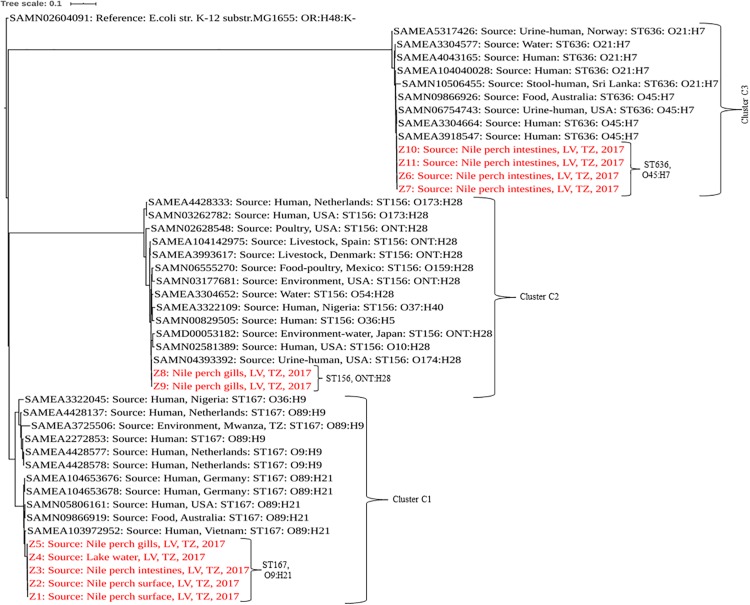
Extended-spectrum β-lactamase (ESBL)-producing bacteria constitute an emerging global health issue with food products being vehicles of transmission and the aquatic environments serving as potential reservoirs. This study aimed to characterize ESBL-producing in Nile perch and water from Lake Victoria in Tanzania. A total of 180 samples of Nile perch and 60 water samples were screened for ESBL-producing on MacConkey agar supplemented with 2 μg/ml of cefotaxime and confirmed by and PCR. Antimicrobial resistance was determined by the disk diffusion method, and the ESBL-producing isolates were whole genome sequencing (WGS). ESBL-producing were detected in eight of the 180 analyzed Nile perch samples, and only one water sample was positive (1.7%, = 60). Isolates were resistant to sulfamethoxazole-trimethoprim (100%), ampicillin/cloxacillin (100%), erythromycin 72.7% (8/11), tetracycline 90.9% (10/11), and nalidixic acid 63.6% (7/11). This mostly corroborates the resistance genes that they carried for sulfonamides (1 and 2), trimethoprim (A and B), aminoglycosides [, A, and B], tetracycline [(B) and (D)], and fluoroquinolones (A4). They harbored plasmid replicon types IncF, IncX, IncQ, and Col and carried and genes generally found on the same contigs as the IncF plasmid replicon. Although epidemiologically unrelated, the strains formed three separate sequence type-phylogroup-serotype-specific clusters: C1, C2, and C3. Cluster C1 included five strains (3 to 13 SNPs) belonging to ST167, phylogroup A, and serotype O9:H21; the two C2 strains (11 SNPs) belong to ST156, phylogroup B1, and serotype ONT:H28; and C3 was made up of four strains (SNPs ranged from 4 to 17) of ST636, phylogroup B2, and serotype O45:H7. The common virulence gene was reported in all strains. In addition, strains in C2 and C3 possessed , A, and E virulence genes, and the gene was found only in C3. The present study reports the occurrence of multidrug-resistant ESBL-producing carrying plasmid-mediated ESBL genes in offshore water and Nile perch in Lake Victoria. Strains formed three clonal clusters of unknown origin. This study reveals that the Lake may serve as reservoir for ESBL-producing bacteria that can be transmitted by fish as a food chain hazard of One-Health concern.
产超广谱β-内酰胺酶(ESBL)细菌已成为一个新出现的全球健康问题,食品是其传播媒介,而水生环境则可能是其潜在储存库。本研究旨在对坦桑尼亚维多利亚湖尼罗尖吻鲈及其水体中产ESBL细菌进行特征分析。共对180份尼罗尖吻鲈样本和60份水样进行检测,以筛选在添加2μg/ml头孢噻肟的麦康凯琼脂上产ESBL的细菌,并通过双纸片协同试验和PCR进行确认。采用纸片扩散法测定抗菌药物敏感性,对产ESBL分离株进行全基因组测序(WGS)。在180份分析的尼罗尖吻鲈样本中,有8份检测出产ESBL细菌,仅1份水样呈阳性(1.7%,n = 60)。分离株对磺胺甲恶唑-甲氧苄啶(100%)、氨苄西林/氯唑西林(100%)、红霉素72.7%(8/11)、四环素90.9%(10/11)和萘啶酸63.6%(7/11)耐药。这与它们携带的磺胺类(sul1和sul2)、甲氧苄啶(dfrA和dfrB)、氨基糖苷类[aac(6’)-Ib、aph(3’)-Ia和ant(3’)-Ia]、四环素[tet(B)和tet(D)]和氟喹诺酮类(qnrA4)耐药基因基本相符。它们携带IncF、IncX、IncQ和Col质粒复制子类型,并携带通常与IncF质粒复制子位于同一重叠群上的blaCTX-M-15和blaTEM-1基因。尽管在流行病学上无关联,但这些菌株形成了三个独立的序列型-系统发育群-血清型特异性簇:C1、C2和C3。C1簇包括5株属于ST167、系统发育群A和血清型O9:H21的菌株(3至13个单核苷酸多态性);2株C2菌株(11个单核苷酸多态性)属于ST156、系统发育群B1和血清型ONT:H28;C3由4株属于ST636、系统发育群B2和血清型O45:H7的菌株组成(单核苷酸多态性范围为4至17)。所有菌株均检测到常见毒力基因ompA。此外,C2和C3簇中的菌株具有fimH、papC和sfaS毒力基因,而sat基因仅在C3簇中发现。本研究报告了维多利亚湖近海水中和尼罗尖吻鲈中携带质粒介导ESBL基因的多重耐药产ESBL细菌的存在。菌株形成了三个来源不明的克隆簇。该研究表明,该湖泊可能是产ESBL细菌的储存库,这些细菌可通过鱼类传播,成为一个涉及“同一健康”的食物链危害。