Falgenhauer Linda, Imirzalioglu Can, Oppong Kwabena, Akenten Charity Wiafe, Hogan Benedikt, Krumkamp Ralf, Poppert Sven, Levermann Vinzent, Schwengers Oliver, Sarpong Nimako, Owusu-Dabo Ellis, May Jürgen, Eibach Daniel
Institute of Medical Microbiology, Justus Liebig University Giessen, Giessen, Germany.
German Center for Infection Research, Partner Site Giessen-Marburg-Langen, Giessen, Germany.
Front Microbiol. 2019 Jan 15;9:3358. doi: 10.3389/fmicb.2018.03358. eCollection 2018.
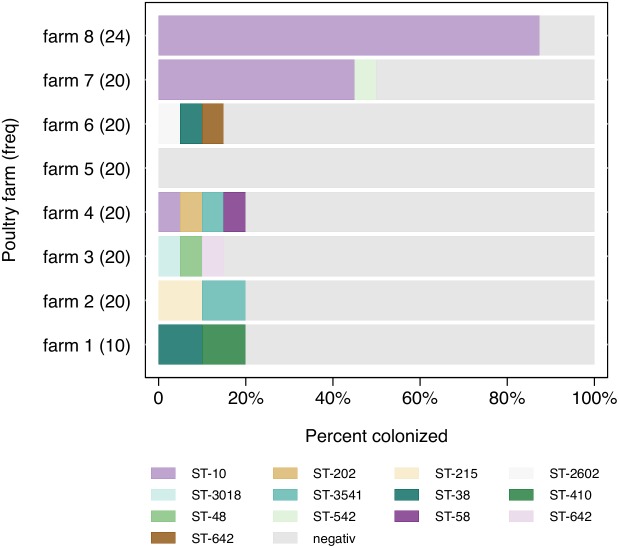
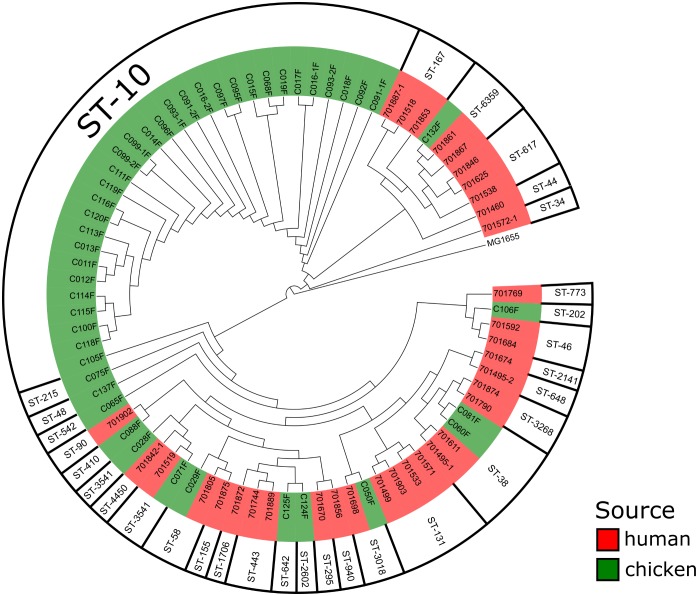
The increasing incidence of infections caused by extended-spectrum beta-lactamase (ESBL)-producing in sub-Saharan Africa is of serious concern. Studies from countries with a highly industrialized poultry industry suggest the poultry production-food-consumer chain as a potential transmission route. In Africa, integrated studies at this human-animal interface are still missing. To determine the molecular epidemiology of ESBL-producing from the intestinal tract of humans and poultry in rural Ghana. During a 6-month period, fecal samples from all children admitted to the Agogo Hospital (Ghana) and broilers at eight poultry farms located within the hospital catchment area were collected. After screening on selective ESBL agar, whole genome sequencing (WGS) was performed on all ESBL isolates. The genomes were analyzed using multilocus sequence typing (MLST), ESBL genotyping and genome-based phylogenetic analyses. Of 140 broilers and 54 children, 41 (29%) and 33 (61%) harbored ESBL , respectively, with prevalences on farms ranging between 0 and 85%. No predominant sequence type (ST) was detected among humans. ST10 was most prevalent among broilers ( = 31, 69%). The ESBL gene was predominant among broilers ( = 43, 96%) and humans ( = 32, 97%). Whole-genome-based phylogenetic analysis revealed three very closely related broiler/human isolate clusters (10% of ESBL isolates) with chromosomal and plasmid-mediated ESBL genes. The findings demonstrate a high frequency of intestinal ESBL-producing in rural Ghana. Considering that animal and human samples are independent specimens from the same geographic location, the number of closely related ESBL isolates circulating across these two reservoirs is substantial. Hence, poultry farms or meat products might be an important source for ESBL-producing bacteria in rural Ghana leading to difficult-to-treat infections in humans.
在撒哈拉以南非洲,产超广谱β-内酰胺酶(ESBL)细菌引起的感染发病率不断上升,这令人严重关切。来自家禽产业高度工业化国家的研究表明,家禽生产-食品-消费者链是一条潜在的传播途径。在非洲,仍缺乏在这个人与动物界面的综合研究。为了确定加纳农村地区人和家禽肠道中产ESBL细菌的分子流行病学。在6个月期间,收集了阿戈戈医院(加纳)收治的所有儿童以及医院集水区内8个家禽养殖场的肉鸡的粪便样本。在选择性ESBL琼脂上进行筛选后,对所有ESBL分离株进行全基因组测序(WGS)。使用多位点序列分型(MLST)、ESBL基因分型和基于基因组的系统发育分析对基因组进行分析。在140只肉鸡和54名儿童中,分别有41只(29%)和33名(61%)携带ESBL细菌,各农场的患病率在0至85%之间。在人类中未检测到主要的序列类型(ST)。ST10在肉鸡中最为普遍(n = 31,69%)。ESBL基因blaCTX-M在肉鸡(n = 43,96%)和人类(n = 32,97%)中占主导地位。基于全基因组的系统发育分析揭示了三个密切相关的肉鸡/人类分离株簇(占ESBL分离株的10%),它们带有染色体和质粒介导的ESBL基因。研究结果表明,加纳农村地区肠道中产ESBL细菌的频率很高。考虑到家畜和人类样本是来自同一地理位置的独立标本,在这两个宿主中传播的密切相关的ESBL分离株数量相当可观。因此,家禽养殖场或肉类产品可能是加纳农村地区产ESBL细菌的重要来源,导致人类出现难以治疗的感染。