Department of Gastroenterology, West China Hospital, Sichuan University, Chengdu, China.
Centre for Inflammatory Bowel Disease, West China Hospital, Sichuan University, Chengdu, China.
Front Immunol. 2020 Feb 20;11:180. doi: 10.3389/fimmu.2020.00180. eCollection 2020.
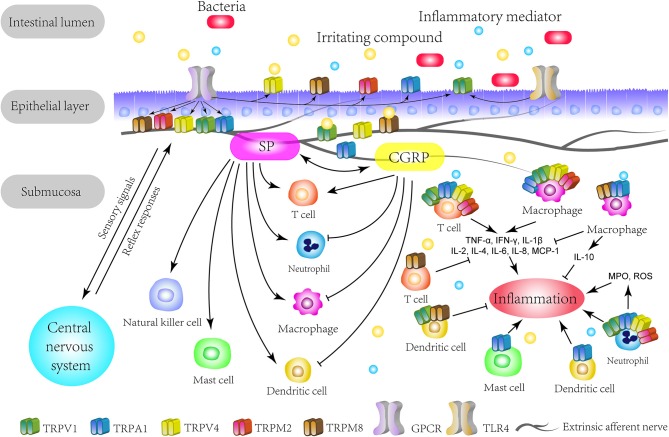
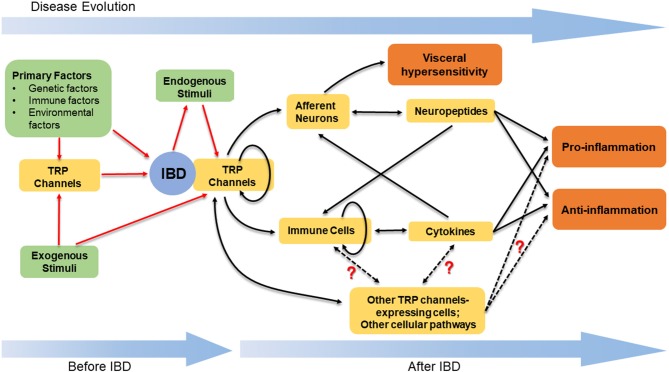
The transient receptor potential (TRP) cation channels are present in abundance across the gastrointestinal (GI) tract, serving as detectors for a variety of stimuli and secondary transducers for G-protein coupled receptors. The activation of TRP channels triggers neurogenic inflammation with related neuropeptides and initiates immune reactions by extra-neuronally regulating immune cells, contributing to the GI homeostasis. However, under pathological conditions, such as inflammatory bowel disease (IBD), TRP channels are involved in intestinal inflammation. An increasing number of human and animal studies have indicated that TRP channels are correlated to the visceral hypersensitivity (VHS) and immune pathogenesis in IBD, leading to an exacerbation or amelioration of the VHS or intestinal inflammation. Thus, TRP channels are a promising target for novel therapeutic methods for IBD. In this review, we comprehensively summarize the functions of TRP channels, especially their potential roles in immunity and IBD. Additionally, we discuss the contradictory findings of prior studies and offer new insights with regard to future research.
瞬时受体电位 (TRP) 阳离子通道在胃肠道 (GI) 中大量存在,作为各种刺激的探测器,并作为 G 蛋白偶联受体的次级转导器。TRP 通道的激活引发具有相关神经肽的神经源性炎症,并通过神经元外调节免疫细胞引发免疫反应,有助于胃肠道稳态。然而,在炎症性肠病 (IBD) 等病理条件下,TRP 通道参与肠道炎症。越来越多的人和动物研究表明,TRP 通道与 IBD 中的内脏高敏性 (VHS) 和免疫发病机制相关,导致 VHS 或肠道炎症的恶化或减轻。因此,TRP 通道是治疗 IBD 的新方法的有希望的靶点。在这篇综述中,我们全面总结了 TRP 通道的功能,特别是它们在免疫和 IBD 中的潜在作用。此外,我们还讨论了先前研究中相互矛盾的发现,并为未来的研究提供了新的见解。