Program in MPE Molecular Pathological Epidemiology, Department of Pathology, Brigham and Women's Hospital and Harvard Medical School, Boston, MA, USA.
Department of Clinical Laboratory, The Second Hospital of Shandong University, Jinan, China.
Br J Cancer. 2020 Apr;122(9):1367-1377. doi: 10.1038/s41416-020-0780-3. Epub 2020 Mar 11.
Histological lymphocytic reaction is regarded as an independent prognostic marker in colorectal cancer. Considering the lack of adequate statistical power, adjustment for selection bias and comprehensive tumour molecular data in most previous studies, we investigated the strengths of the prognostic associations of lymphocytic reaction in colorectal carcinoma by utilising an integrative database of two prospective cohort studies.
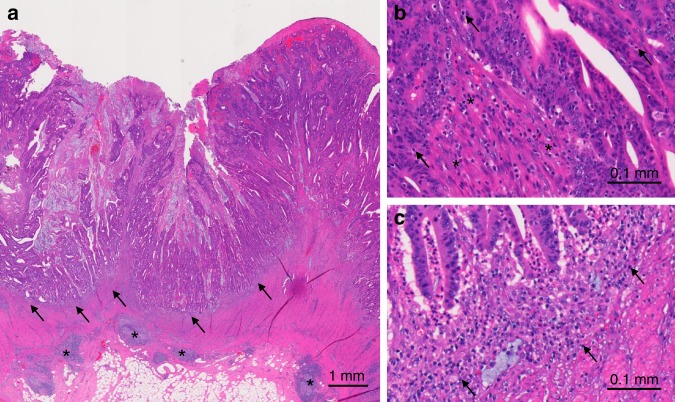
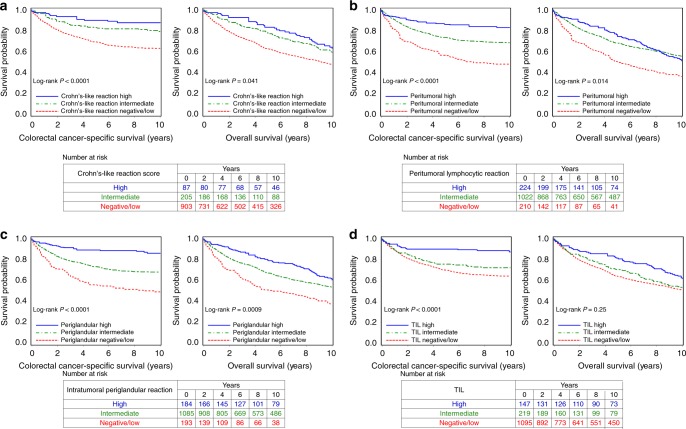
We examined Crohn's-like reaction, intratumoural periglandular reaction, peritumoural reaction and tumour-infiltrating lymphocytes in 1465 colorectal carcinoma cases. Using covariate data of 4420 colorectal cancer cases in total, inverse probability-weighted Cox proportional hazard regression model was used to control for selection bias (due to tissue availability) and potential confounders, including stage, MSI status, LINE-1 methylation, PTGS2 and CTNNB1 expression, KRAS, BRAF and PIK3CA mutations, and tumour neoantigen load.
Higher levels of each lymphocytic reaction component were associated with better colorectal cancer-specific survival (P < 0.002). Compared with cases with negative/low intratumoural periglandular reaction, multivariable-adjusted HRs were 0.55 (95% CI, 0.42-0.71) in cases with intermediate reaction and 0.20 (95% CI, 0.12-0.35) in cases with high reaction. These relationships were consistent in strata of MSI status or neoantigen loads (P > 0.2).
The four lymphocytic reaction components are prognostic biomarkers in colorectal carcinoma.
组织学淋巴细胞反应被认为是结直肠癌的独立预后标志物。考虑到大多数先前研究中缺乏足够的统计效力、选择偏差的调整以及全面的肿瘤分子数据,我们利用两个前瞻性队列研究的综合数据库,研究了结直肠癌中淋巴细胞反应的预后相关性的强度。
我们检查了 1465 例结直肠癌病例中的克罗恩样反应、肿瘤内腺体周围反应、肿瘤周围反应和肿瘤浸润淋巴细胞。使用总共 4420 例结直肠癌病例的协变量数据,使用逆概率加权 Cox 比例风险回归模型来控制选择偏差(由于组织可用性)和潜在混杂因素,包括分期、MSI 状态、LINE-1 甲基化、PTGS2 和 CTNNB1 表达、KRAS、BRAF 和 PIK3CA 突变以及肿瘤新抗原负荷。
每种淋巴细胞反应成分水平较高与结直肠癌特异性生存更好相关(P<0.002)。与肿瘤内腺体周围反应阴性/低水平的病例相比,多变量调整的 HR 分别为 0.55(95%CI,0.42-0.71)和 0.20(95%CI,0.12-0.35)。在 MSI 状态或新抗原负荷的分层中,这些关系是一致的(P>0.2)。
四种淋巴细胞反应成分是结直肠癌的预后生物标志物。