Yang Yu, Sun Xiaoyu, Wang Jinwei, Yang Chao, Zhang Luxia
National Institute of Health Data Science, Peking University, Beijing, People's Republic of China.
Center for Data Science in Health and Medicine, Peking University, Beijing, People's Republic of China.
Clin Epidemiol. 2020 Feb 24;12:215-222. doi: 10.2147/CLEP.S238804. eCollection 2020.
The spread of non-communicable chronic diseases (NCDs) is a global crisis. Understanding the dynamics of NCDs at the population level is crucial to develop prevention strategies as well as to evaluate the effectiveness of intervention. However, studies investigating the incidence rate of NCDs among the general population are limited, especially for developing countries like China. We aim to evaluate the incidence rates of four major NCDs from 2007 to 2016, based on a national commercial claims database in China.
Cancer, stroke, coronary heart disease (CHD) and end-stage kidney disease (ESKD) accounted for over 90% of claims data were included as major NCDs. The definition of the above diseases followed the guideline of disease definitions of critical illness insurance released by the Insurance Association of China. Age-standardized incidence rates (ASRs) of those major NCDs among subgroups of sex, demographic regions, and China city tiers were reported. The trends of incidence rates were described as annual percent change (APC) as well as average annual percent change (AAPC) and were then examined by joinpoint models.
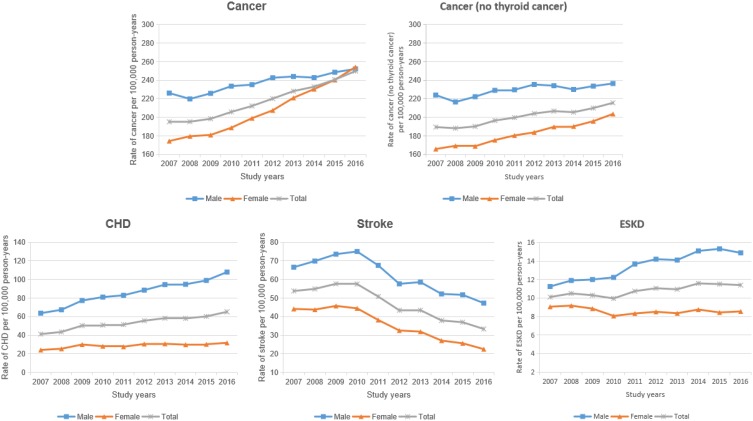
For the population insured in 2007, the average 10-year ASRs of cancer, CHD, stroke, and ESKD were 221.0, 55.5, 43.5, 11.0 per 100,000 person-years, respectively. For males, the ASRs of cancer, CHD, ESKD continuously increase in the past decade with AAPC of 1.4%, 5.2%, and 3.3%; while the ASRs of stroke were decreased with APC of 3.7% after 2009. For females, the increased ASRs of cancer with AAPC of 4.2% and CHD with AAPC of 2.0%; while decreased trends of ASRs were observed for stroke and ESKD. Patterns of ASRs changing varied between different demographic regions and city tiers.
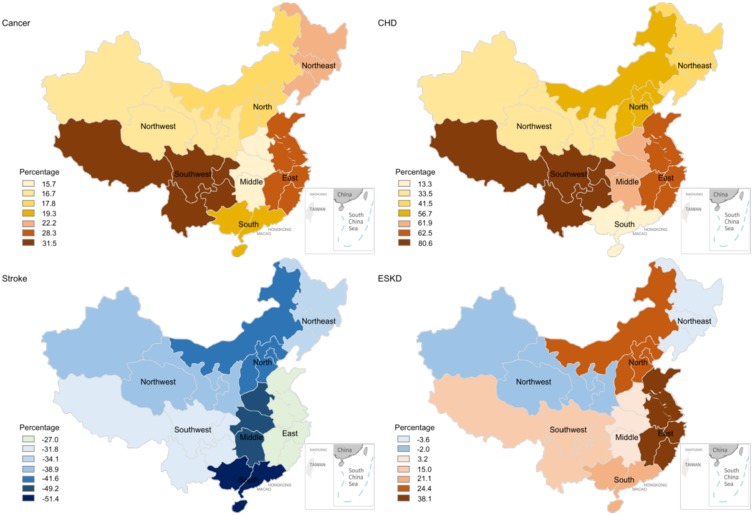
Commercial claims data could be a valuable data source to evaluate the disease burden for major NCDs in China. The disease burden of severe stroke was decreasing while cancer, CHD and ESKD were still increasing in China. More efforts should be put into control of CHD, especially in the northern part of China.
非传染性慢性病(NCDs)的传播是一场全球危机。了解人群层面非传染性慢性病的动态对于制定预防策略以及评估干预效果至关重要。然而,针对普通人群中非传染性慢性病发病率的研究有限,尤其是在中国这样的发展中国家。我们旨在基于中国的一个全国性商业理赔数据库,评估2007年至2016年四种主要非传染性慢性病的发病率。
癌症、中风、冠心病(CHD)和终末期肾病(ESKD)占理赔数据的90%以上,被列为主要非传染性慢性病。上述疾病的定义遵循中国保险行业协会发布的重大疾病保险疾病定义指南。报告了这些主要非传染性慢性病在性别、人口统计学区域和中国城市层级亚组中的年龄标准化发病率(ASRs)。发病率趋势用年度百分比变化(APC)以及平均年度百分比变化(AAPC)来描述,然后通过连接点模型进行检验。
对于2007年参保的人群,癌症、冠心病、中风和终末期肾病的平均10年年龄标准化发病率分别为每10万人年221.0、55.5、43.5、11.0。对于男性,在过去十年中,癌症、冠心病、终末期肾病的年龄标准化发病率持续上升,平均年度百分比变化分别为1.4%、5.2%和3.3%;而2009年后中风的年龄标准化发病率下降,年度百分比变化为3.7%。对于女性,癌症的年龄标准化发病率平均年度百分比变化为4.2%,冠心病为2.0%;而中风和终末期肾病的年龄标准化发病率呈下降趋势。年龄标准化发病率变化模式在不同人口统计学区域和城市层级之间有所不同。
商业理赔数据可能是评估中国主要非传染性慢性病疾病负担的宝贵数据来源。中国严重中风的疾病负担在下降,而癌症、冠心病和终末期肾病仍在上升。应加大对冠心病的控制力度,尤其是在中国北方地区。