Department of Applied Chemistry, Graduate School of Engineering, Osaka Prefecture University, Sakai 599-8570, Japan.
Research Institute for Light-induced Acceleration System, Osaka Prefecture University, Sakai 599-8570, Japan.
Sci Adv. 2020 Feb 28;6(9):eaaz5757. doi: 10.1126/sciadv.aaz5757. eCollection 2020 Feb.
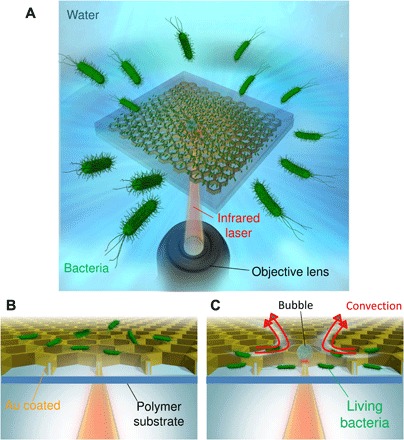
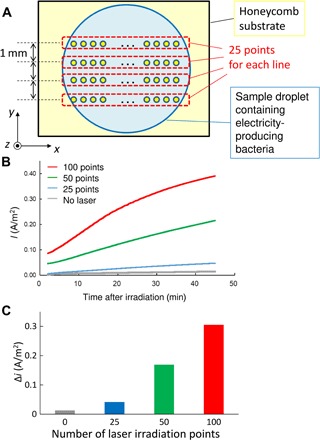
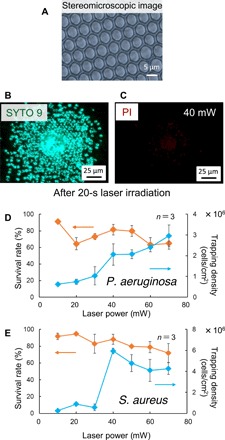
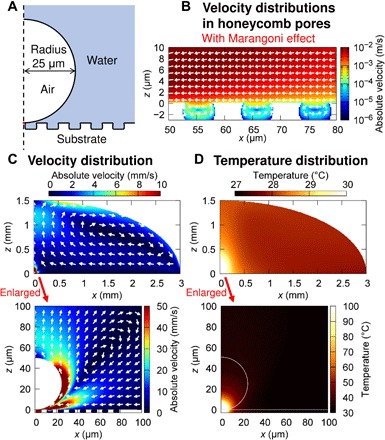
Some bacteria are recognized to produce useful substances and electric currents, offering a promising solution to environmental and energy problems. However, applications of high-performance microbial devices require a method to accumulate living bacteria into a higher-density condition in larger substrates. Here, we propose a method for the high-density assembly of bacteria (10 to 10 cells/cm) with a high survival rate of 80 to 90% using laser-induced convection onto a self-organized honeycomb-like photothermal film. Furthermore, the electricity-producing bacteria can be optically assembled, and the electrical current can be increased by one to two orders of magnitude simply by increasing the number of laser irradiations. This concept can facilitate the development of high-density microbial energy conversion devices and provide new platforms for unconventional environmental technology.
一些细菌被认为可以产生有用的物质和电流,为环境和能源问题提供了有前途的解决方案。然而,高性能微生物器件的应用需要一种方法将活细菌在更大的基质中积累到更高的密度。在这里,我们提出了一种使用激光诱导对流到自组织的蜂窝状光热膜上的方法,将细菌(10 到 10 个细胞/cm)以 80%到 90%的高存活率高密度组装。此外,通过增加激光辐照的次数,可以将发电细菌进行光学组装,并且电流可以简单地增加一个到两个数量级。这个概念可以促进高密度微生物能量转换器件的发展,并为非常规环境技术提供新的平台。