Greenfield D I, Gooch Moore J, Stewart J R, Hilborn E D, George B J, Li Q, Dickerson J, Keppler C K, Sandifer P A
Now at Advanced Science Research Center City University of New York New York City NY USA.
Belle W. Baruch Institute for Marine and Coastal Sciences University of South Carolina Charleston SC USA.
Geohealth. 2017 Nov 28;1(9):306-317. doi: 10.1002/2017GH000094. eCollection 2017 Nov.
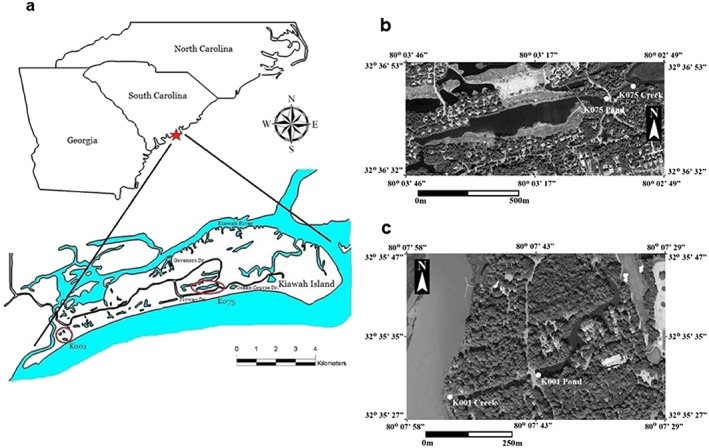
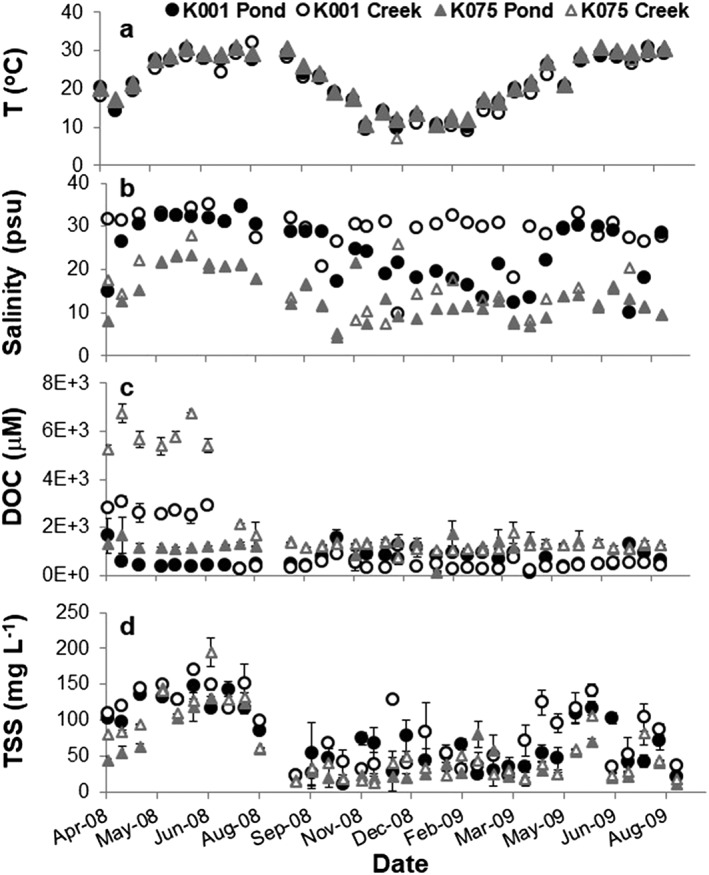
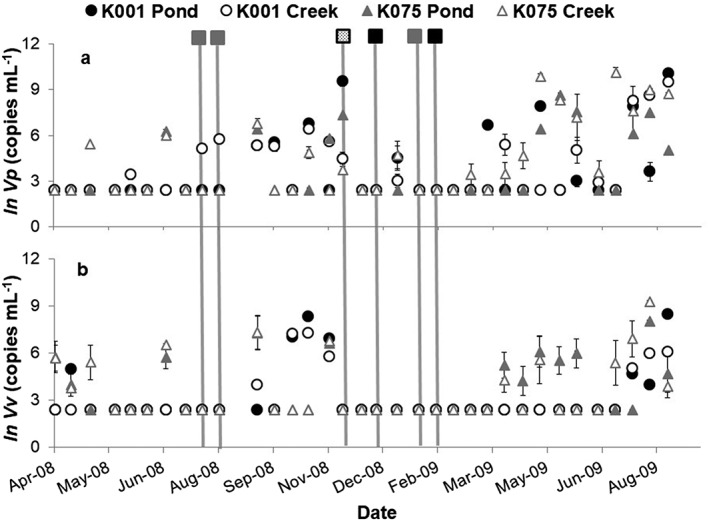
Incidences of harmful algal blooms (HABs) and infections have increased over recent decades. Numerous studies have tried to identify environmental factors driving HABs and pathogenic populations separately. Few have considered the two simultaneously, though emerging evidence suggests that algal blooms enhance growth and survival. This study examined various physical, nutrient, and temporal factors associated with incidences of HABs, , and in South Carolina coastal stormwater detention ponds, managed systems where HABs often proliferate, and their receiving tidal creek waters. Five blooms occurred during the study (2008-2009): two during relatively warmer months (an August 2008 cyanobacteria bloom and a November 2008 dinoflagellate bloom) followed by increases in both species and , respectively, and three during cooler months (December 2008 through February 2009) caused by dinoflagellates and euglenophytes that were not associated with marked changes in abundances. concentrations were positively and significantly associated with temperature and dissolved organic matter, dinoflagellate blooms, negatively and significantly associated with suspended solids, but not significantly correlated with chlorophyll or nitrogen. While more research involving longer time series is needed to increase robustness, findings herein suggest that certain HAB species may augment occurrences during warmer months.
近几十年来,有害藻华(HABs)和感染的发生率有所增加。许多研究试图分别确定驱动有害藻华和致病种群的环境因素。尽管新出现的证据表明藻华会促进生长和生存,但很少有研究同时考虑这两者。本研究调查了南卡罗来纳州沿海雨水滞留池塘、有害藻华经常滋生的管理系统及其接纳的潮汐溪流水体中与有害藻华、感染和疾病发生相关的各种物理、营养和时间因素。在研究期间(2008 - 2009年)出现了五次藻华:两次发生在相对较温暖的月份(2008年8月的蓝藻藻华和2008年11月的甲藻藻华),随后感染物种和疾病分别增加,还有三次发生在较凉爽的月份(2008年12月至2009年2月),由甲藻和裸藻引起,与感染丰度的显著变化无关。疾病浓度与温度和溶解有机物呈正相关且显著相关,与甲藻藻华呈负相关且显著相关,与悬浮固体呈负相关,但与叶绿素或氮无显著相关性。虽然需要更多涉及更长时间序列的研究来提高稳健性,但本文的研究结果表明,某些有害藻华物种可能会在温暖月份增加疾病的发生。