Centre for Big Data Research in Health, University of New South Wales, Sydney, NSW 2052, Australia.
Wellbeing and Preventable Chronic Diseases Division, Menzies School of Health Research, Tiwi, NT 0812, Australia.
Int J Environ Res Public Health. 2021 Sep 30;18(19):10318. doi: 10.3390/ijerph181910318.
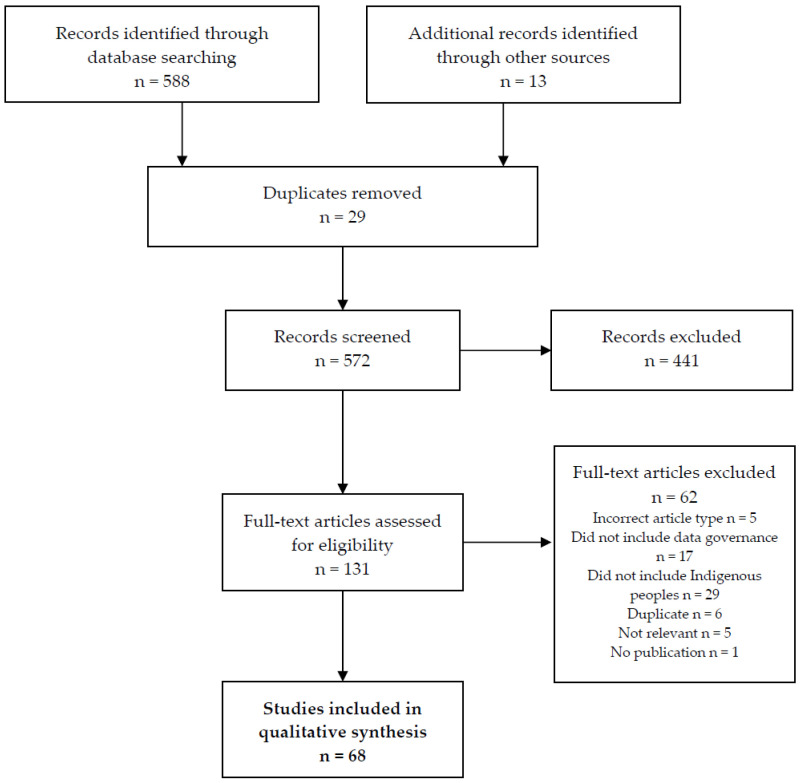
There is increasing potential to improve the research and reporting on the health and wellbeing of Indigenous and Tribal peoples through the collection and (re)use of population-level data. As the data economy grows and the value of data increases, the optimization of data pertaining to Indigenous peoples requires governance that defines who makes decisions on behalf of whom and how these data can and should be used. An international a priori PROSPERO (#CRD42020170033) systematic review was undertaken to examine the health research literature to (1) identify, describe, and synthesize definitions and principles; (2) identify and describe data governance frameworks; and (3) identify, describe, and synthesize processes, policies and practices used in Indigenous Data Governance (ID-GOV). Sixty-eight articles were included in the review that found five components that require consideration in the governance of health research data pertaining to Indigenous people. This included (1) Indigenous governance; (2) institutional ethics; (3) socio-political dynamics; (4) data management and data stewardship; and (5) overarching influences. This review provides the first systematic international review of ID-GOV that could potentially be used in a range of governance strategies moving forward in health research.
通过收集和(重新)使用人群水平数据,提高对土著和部落人民健康和福利的研究和报告水平的潜力越来越大。随着数据经济的增长和数据价值的增加,优化与土著人民有关的数据需要对谁代表谁做出决策以及如何使用这些数据进行定义和管理。进行了一项国际事先 PROSPERO(#CRD42020170033)系统评价,以审查健康研究文献,以(1)确定、描述和综合定义和原则;(2)确定和描述数据治理框架;以及(3)确定、描述和综合用于土著数据治理(ID-GOV)的流程、政策和实践。本评价纳入了 68 篇文章,发现了与土著人民健康研究数据治理相关的五个需要考虑的组成部分。这包括(1)土著治理;(2)机构伦理;(3)社会政治动态;(4)数据管理和数据托管;以及(5)总体影响。这一评价首次对 ID-GOV 进行了系统的国际评价,这可能在未来的健康研究中用于一系列治理策略。