Yatish R, B K Ashok Kumar, Suvarna Abhinav A, Channappa T S, Jayaram Manju, Shivakumar H B
Orthopedics, Kempegowda Institute of Medical Sciences and Research Center, Bangalore, IND.
Pain Management, Kempegowda Institute of Medical Sciences and Research Center, Bangalore, IND.
Cureus. 2025 Aug 3;17(8):e89307. doi: 10.7759/cureus.89307. eCollection 2025 Aug.
Subacromial bursitis is a common cause of shoulder pain and functional limitation, due to inflammation of the subacromial bursa. Corticosteroid injections are widely used in cases unresponsive to conservative treatments. However, the optimal dose for achieving sustained symptom relief with minimal adverse effects, especially when administered under ultrasound guidance, remains a topic of clinical interest. This study evaluates the efficacy of different corticosteroid doses delivered via ultrasound-guided subacromial bursa injection.
This retrospective study was conducted at a tertiary care center between May 2018 and June 2023. Patients aged 30-60 years with MRI-confirmed subacromial bursitis who failed conservative treatment for at least three months were included. Subjects were divided into two groups: a low-dose group receiving 10 mg triamcinolone with 1% lignocaine and a high-dose group receiving 20 mg triamcinolone with 1% lignocaine. Injections were administered under ultrasound guidance using a linear probe. Pain was assessed using the Numerical Rating Scale (NRS) at baseline, and at one week, one month, three months, and six months post-intervention. Data were analyzed using t-tests and chi-square tests.
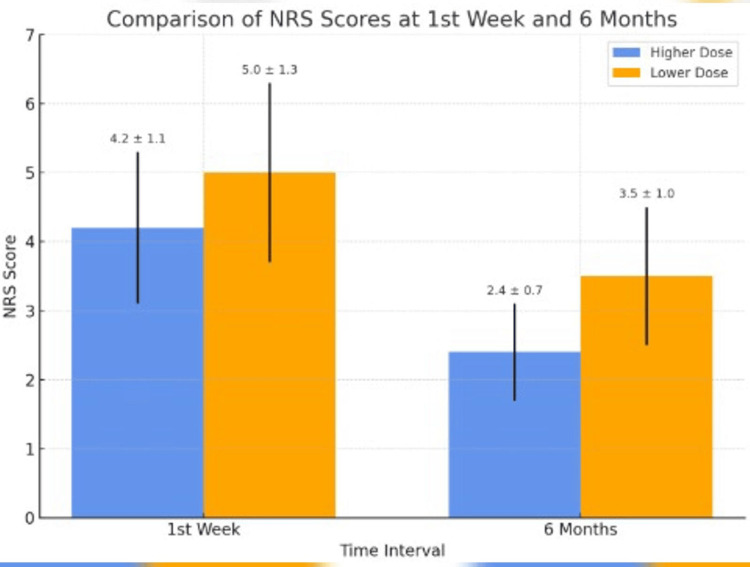
Both groups showed significant reductions in pain scores at all post-injection time points ( < 0.05). The high-dose group demonstrated more substantial and sustained improvement in pain relief, with mean NRS scores decreasing from 8.1 at baseline to 2.4 at six months, compared to a decline from 7.9 to 3.5 in the low-dose group. Adverse events were minimal and similar across both groups.
Ultrasound-guided corticosteroid injections represent a safe and effective treatment for subacromial bursitis, with higher doses of triamcinolone offering longer-lasting pain relief. The technique improves precision and minimizes risk, making it a valuable tool in managing refractory shoulder pain. Further prospective studies are recommended to validate these findings and develop standardized dosing protocols.
肩峰下滑囊炎是肩部疼痛和功能受限的常见原因,是由肩峰下滑囊炎症引起的。皮质类固醇注射广泛应用于对保守治疗无反应的病例。然而,以最小的不良反应实现持续症状缓解的最佳剂量,尤其是在超声引导下给药时,仍然是临床关注的话题。本研究评估了通过超声引导肩峰下滑囊注射给予不同皮质类固醇剂量的疗效。
本回顾性研究于2018年5月至2023年6月在一家三级医疗中心进行。纳入年龄在30至60岁之间、MRI确诊为肩峰下滑囊炎且保守治疗失败至少三个月的患者。受试者分为两组:低剂量组接受10毫克曲安奈德加1%利多卡因,高剂量组接受20毫克曲安奈德加1%利多卡因。使用线性探头在超声引导下进行注射。在基线时以及干预后1周、1个月、3个月和6个月使用数字评分量表(NRS)评估疼痛。使用t检验和卡方检验分析数据。
两组在所有注射后时间点的疼痛评分均显著降低(<0.05)。高剂量组在疼痛缓解方面表现出更显著和持续的改善,平均NRS评分从基线时的8.1降至6个月时的2.4,而低剂量组从7.9降至3.5。两组的不良事件均极少且相似。
超声引导下皮质类固醇注射是肩峰下滑囊炎的一种安全有效的治疗方法,较高剂量的曲安奈德可提供更持久的疼痛缓解。该技术提高了精准度并将风险降至最低,使其成为治疗难治性肩部疼痛的宝贵工具。建议进一步进行前瞻性研究以验证这些发现并制定标准化给药方案。