Spaan Kyra M, van Noordenburg Carmen, Plassmann Merle M, Schultes Lara, Shaw Susan, Berger Michelle, Heide-Jørgensen Mads Peter, Rosing-Asvid Aqqalu, Granquist Sandra M, Dietz Rune, Sonne Christian, Rigét Frank, Roos Anna, Benskin Jonathan P
Department of Environmental Science, Stockholm University, Svante Arrhenius Väg 8, 106 91 Stockholm, Sweden.
Shaw Institute, P.O. Box 1652, Blue Hill, Maine 04614 United States.
Environ Sci Technol. 2020 Apr 7;54(7):4046-4058. doi: 10.1021/acs.est.9b06773. Epub 2020 Mar 24.
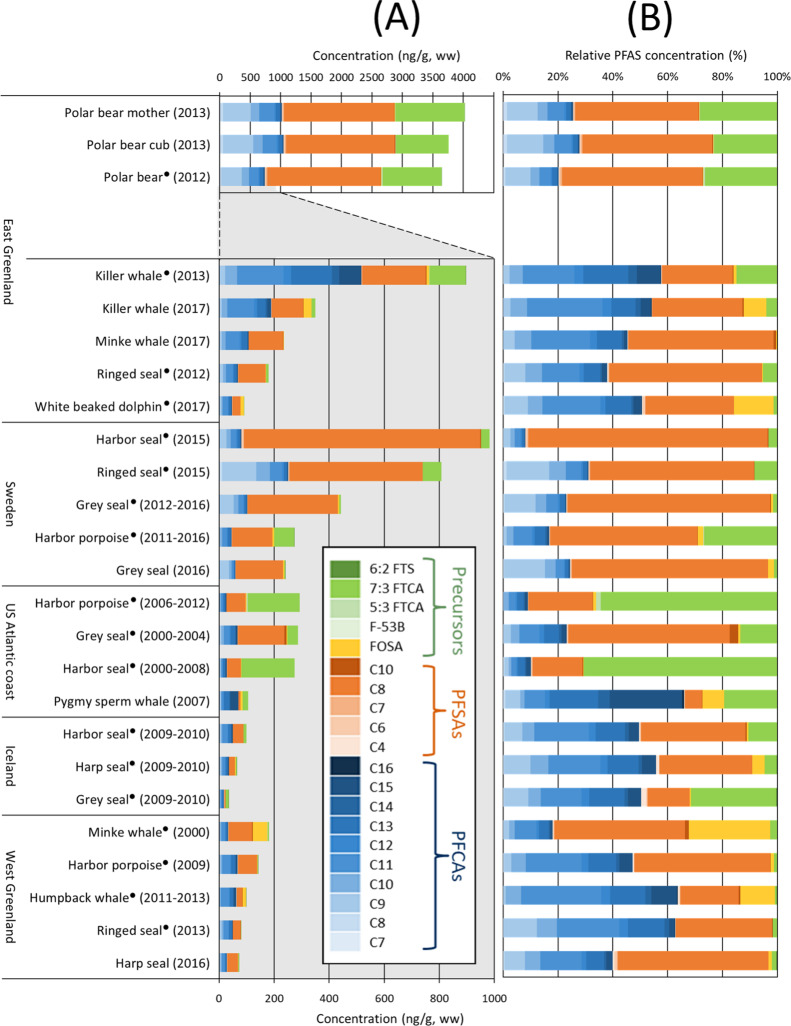
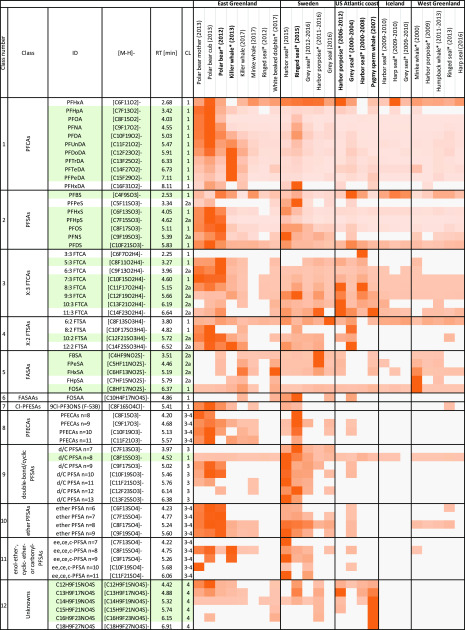
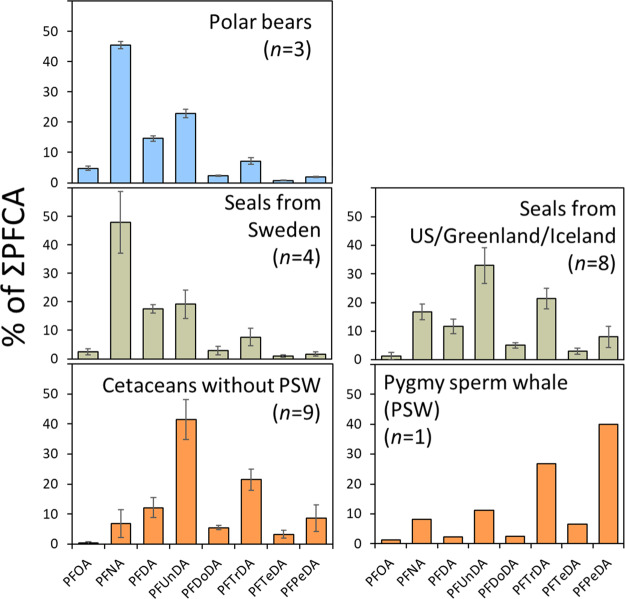
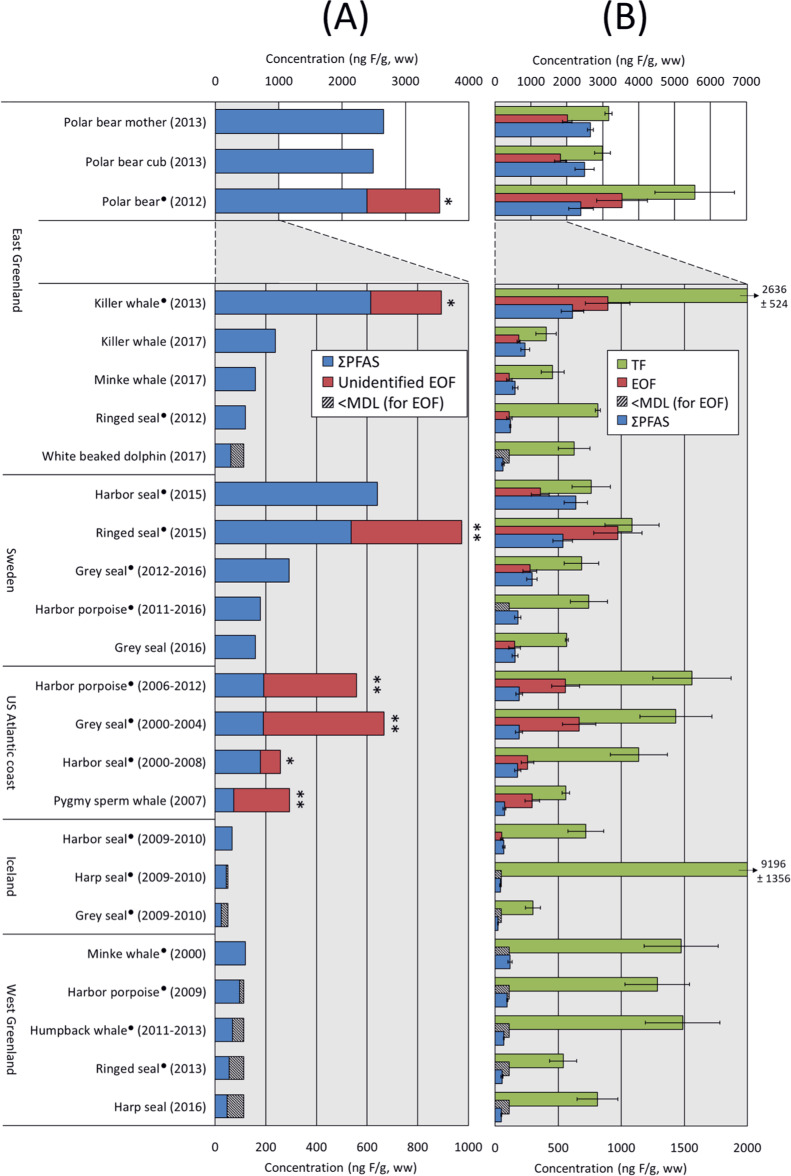
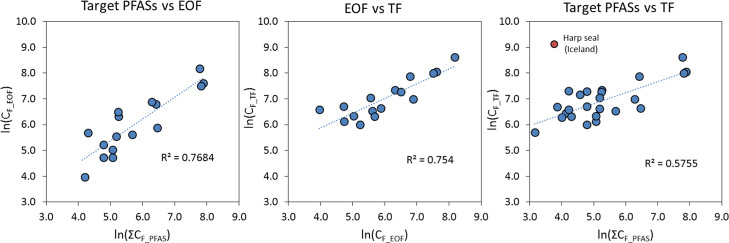
There is increasing evidence that the ∼20 routinely monitored perfluoroalkyl and polyfluoroalkyl substances (PFASs) account for only a fraction of extractable organofluorine (EOF) occurring in the environment. To assess whether PFAS exposure is being underestimated in marine mammals from the Northern Hemisphere, we performed a fluorine mass balance on liver tissues from 11 different species using a combination of targeted PFAS analysis, EOF and total fluorine determination, and suspect screening. Samples were obtained from the east coast United States (US), west and east coast of Greenland, Iceland, and Sweden from 2000 to 2017. Of the 36 target PFASs, perfluorooctane sulfonate (PFOS) dominated in all but one Icelandic and three US samples, where the 7:3 fluorotelomer carboxylic acid (7:3 FTCA) was prevalent. This is the first report of 7:3 FTCA in polar bears (∼1000 ng/g, ww) and cetaceans (<6-190 ng/g, ww). In 18 out of 25 samples, EOF was not significantly greater than fluorine concentrations derived from sum target PFASs. For the remaining 7 samples (mostly from the US east coast), 30-75% of the EOF was unidentified. Suspect screening revealed an additional 37 PFASs (not included in the targeted analysis) bringing the total to 63 detected PFASs from 12 different classes. Overall, these results highlight the importance of a multiplatform approach for accurately characterizing PFAS exposure in marine mammals.
越来越多的证据表明,约20种常规监测的全氟烷基和多氟烷基物质(PFASs)仅占环境中可提取有机氟(EOF)的一小部分。为了评估北半球海洋哺乳动物中PFAS暴露是否被低估,我们结合靶向PFAS分析、EOF和总氟测定以及可疑物筛查,对11个不同物种的肝脏组织进行了氟质量平衡分析。样本于2000年至2017年从美国东海岸、格陵兰岛西海岸和东海岸、冰岛以及瑞典采集。在36种目标PFASs中,除了一份冰岛样本和三份美国样本外,全氟辛烷磺酸(PFOS)在所有样本中占主导地位,在这几份样本中,7:3氟调聚物羧酸(7:3 FTCA)占优势。这是北极熊(约1000 ng/g,湿重)和鲸类动物(<6 - 190 ng/g,湿重)中7:3 FTCA的首次报道。在25个样本中的18个样本中,EOF并不显著高于目标PFASs总和得出的氟浓度。对于其余7个样本(大多来自美国东海岸),30 - 75%的EOF未被识别。可疑物筛查又发现了另外37种PFASs(未包含在靶向分析中),使检测到的PFASs总数达到来自12个不同类别的63种。总体而言,这些结果凸显了采用多平台方法准确表征海洋哺乳动物中PFAS暴露的重要性。