Rutgers University, The State University of New Jersey, Newark, New Jersey, USA.
Cell Commun Signal. 2020 Mar 11;18(1):41. doi: 10.1186/s12964-020-00543-8.
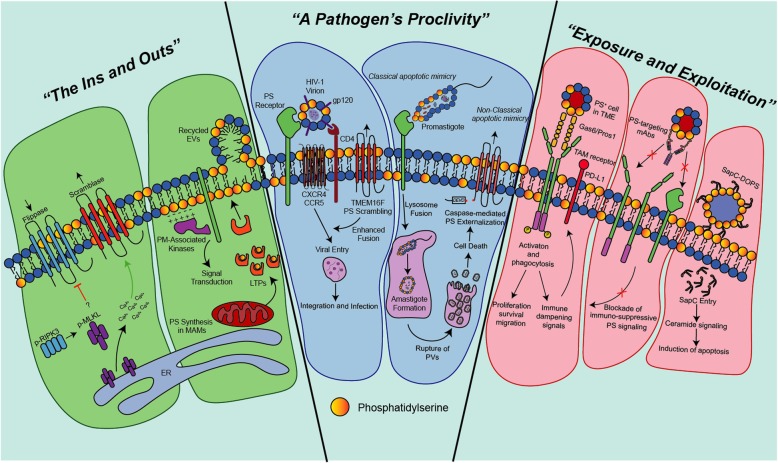
Phosphatidylserine (PS) is an anionic phospholipid found on the membranes of a variety of organelles throughout the cell, most notably the plasma membrane. Under homeostatic conditions, PS is typically restricted to the inner leaflet of the plasma membrane. However, during cellular activation and/or induction of cell death, PS is externalized on the outer surface via the activation of phospholipid scramblases. Externalized PS not only changes the biochemical and biophysical properties of the plasma membrane but also initiates a series of interactions between endogenous extracellular proteins as well as receptors on neighboring cells to stimulate engulfment (efferocytosis) that influence the surrounding immune milieu. In this thematic series published in Cell Communication and Signaling, we feature review articles that highlight recent work in the field of PS biology, including the biochemistry and physiological significance of PS externalization, therapeutic applications and efforts to target PS, as well as posit open questions that remain in the field.
磷脂酰丝氨酸(PS)是一种阴离子磷脂,存在于细胞内各种细胞器的膜上,尤其是质膜。在生理条件下,PS 通常局限于质膜的内小叶。然而,在细胞激活和/或诱导细胞死亡时,通过磷脂 scramblase 的激活,PS 会在外层表面外化。外化的 PS 不仅改变质膜的生化和生物物理特性,还启动一系列内源性细胞外蛋白与邻近细胞上受体之间的相互作用,以刺激吞噬作用(胞噬作用),从而影响周围的免疫环境。在细胞通讯与信号转导这一专题系列中,我们刊登了综述文章,重点介绍 PS 生物学领域的最新工作,包括 PS 外化的生物化学和生理意义、治疗应用和靶向 PS 的努力,以及提出该领域仍然存在的未解决问题。