Shen Yuxiu, Han Zaigang, Liu Shuang, Jiao Yang, Li Ying, Yuan Hongyan
Department of Pharmacology, Affiliated Hospital of Beihua University, Jilin City, Jilin Province 132000, People's Republic of China.
Cancer Manag Res. 2020 Feb 27;12:1493-1502. doi: 10.2147/CMAR.S246691. eCollection 2020.
This study was aimed to explore the anti-tumor effect of curcumin on breast cancer (BC) and the underlying mechanism involving Tafazzin (TAZ)/Yes-associated protein (YAP) axis.
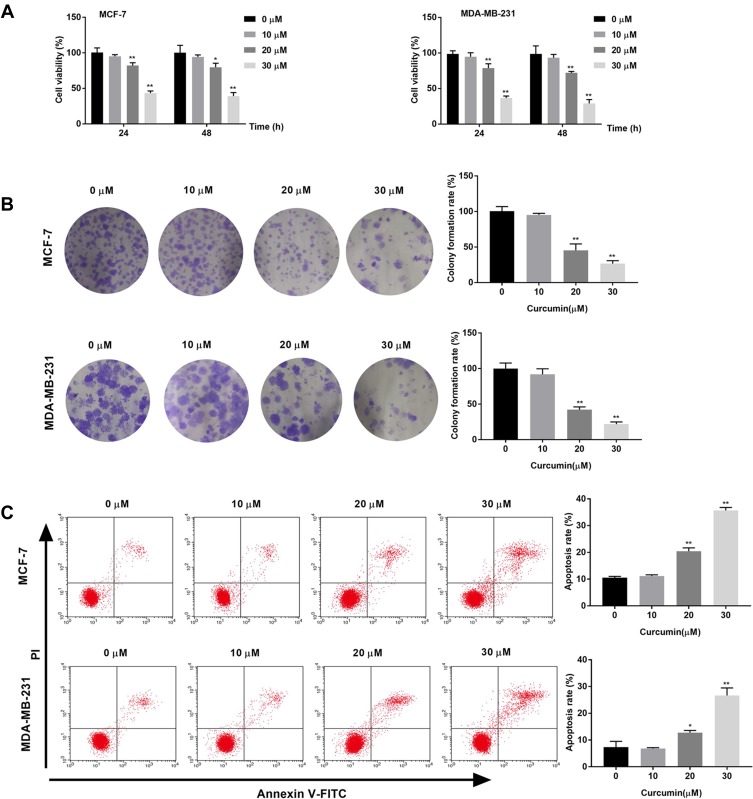
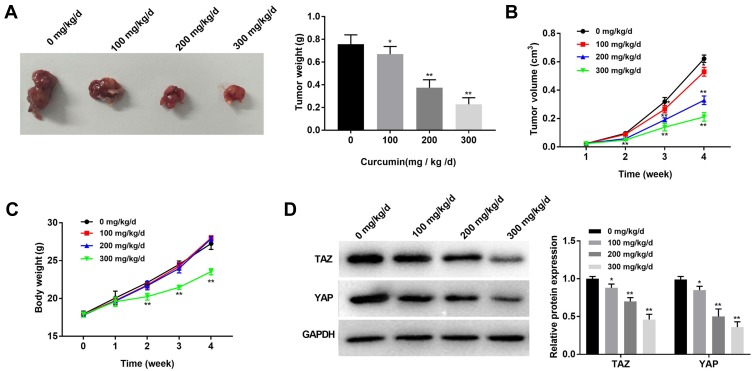
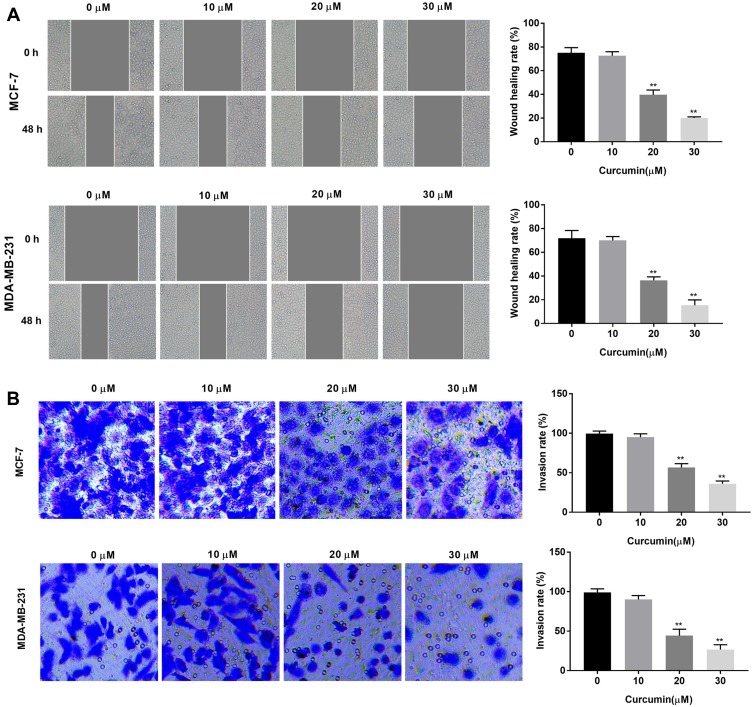
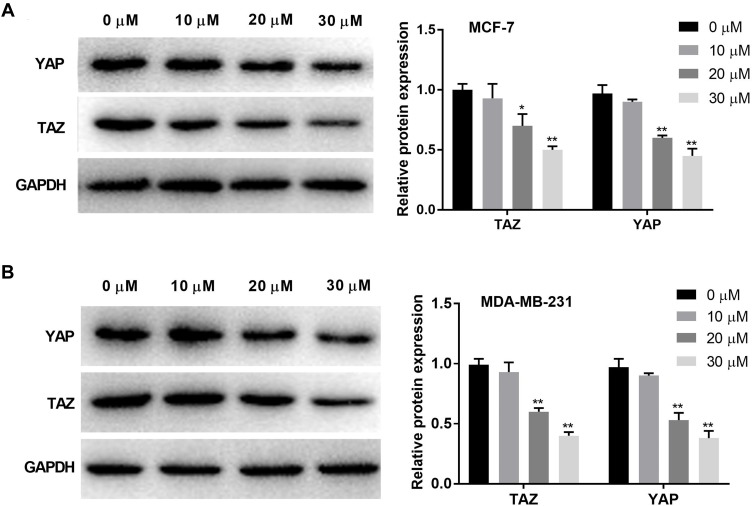
Different concentrations of curcumin (0, 10, 20 and 30 μM) were used to treat BC cells (MCF-7 and MDA-MB-231 cells). The viability, colony formation, apoptosis, migration, and invasion of BC cells were detected by MTT, colony formation, flow cytometry, wound-healing and transwell assay, respectively. The protein expression of TAZ and YAP (effectors of Hippo signaling pathway) was detected by Western blot. MDA-MB-231 cells were injected into mice to verify the anti-tumor effect of curcumin in vivo.
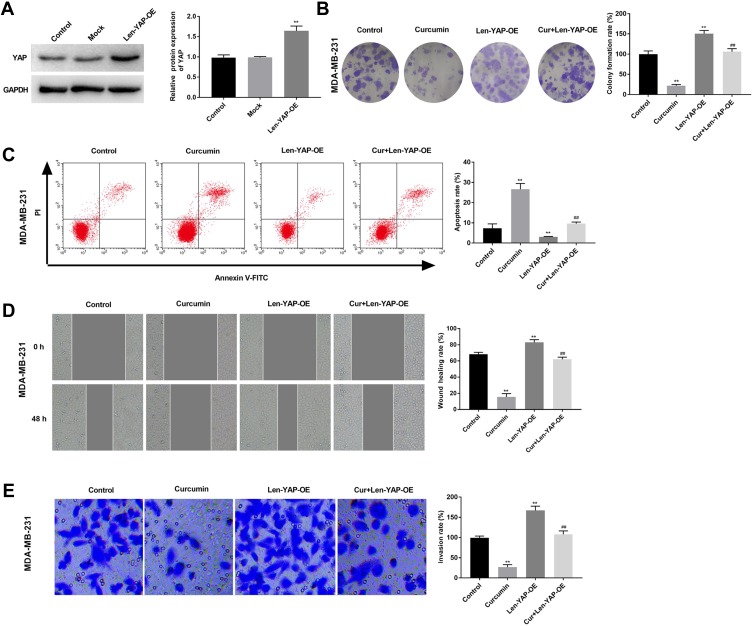
Curcumin (20 and 30 μM) inhibited the proliferation, migration and invasion, and promoted the apoptosis of MCF-7 and MDA-MB-231 cells. Curcumin decreased the protein expression of TAZ and YAP in MCF-7 and MDA-MB-231 cells. Overexpression of YAP reversed the anti-tumor effect of curcumin on MDA-MB-231 cells. In addition, curcumin (100, 200 and 300 mg/kg/d) inhibited the growth of tumor xenografts in mice, and down-regulated the protein expression of TAZ and YAP in tumor xenografts. However, curcumin at a concentration of 300 mg/kg/d slowed the increasing of body weight in mice.
Curcumin inhibited the tumorigenesis of BC by blocking TAZ/YAP axis.
本研究旨在探讨姜黄素对乳腺癌(BC)的抗肿瘤作用及其涉及塔法辛(TAZ)/Yes相关蛋白(YAP)轴的潜在机制。
使用不同浓度的姜黄素(0、10、20和30μM)处理BC细胞(MCF-7和MDA-MB-231细胞)。分别通过MTT法、集落形成实验、流式细胞术、伤口愈合实验和Transwell实验检测BC细胞的活力、集落形成、凋亡、迁移和侵袭能力。通过蛋白质免疫印迹法检测TAZ和YAP(Hippo信号通路的效应分子)的蛋白表达。将MDA-MB-231细胞注射到小鼠体内以验证姜黄素在体内的抗肿瘤作用。
姜黄素(20和30μM)抑制MCF-7和MDA-MB-231细胞的增殖、迁移和侵袭,并促进其凋亡。姜黄素降低了MCF-7和MDA-MB-231细胞中TAZ和YAP的蛋白表达。YAP的过表达逆转了姜黄素对MDA-MB-231细胞的抗肿瘤作用。此外,姜黄素(100、200和300mg/kg/d)抑制了小鼠肿瘤异种移植瘤的生长,并下调了肿瘤异种移植瘤中TAZ和YAP的蛋白表达。然而,300mg/kg/d浓度的姜黄素减缓了小鼠体重的增加。
姜黄素通过阻断TAZ/YAP轴抑制BC的肿瘤发生。