Gelkopf Maxwell J, Avramov Iva, Baddeliyanage Richelle, Ristevski Ivana, Johnson Sarah A, Flegg Kaitlyn, Dimaras Helen
1Department of Ophthalmology & Vision Sciences, The Hospital for Sick Children, 555 University Ave, Toronto, ON M5G 1X8 Canada.
2Child Health Evaluative Sciences Program, SickKids Research Institute, Toronto, Canada.
Res Involv Engagem. 2020 Feb 28;6:7. doi: 10.1186/s40900-020-0177-8. eCollection 2020.
Retinoblastoma is a rare eye cancer that occurs in one or both eyes of infants and young children as a result of errors in the gene. There are approximately 2000 retinoblastoma survivors in Canada. Those with the heritable form of the disease are at risk of passing the gene to the next generation and developing a second cancer. Many retinoblastoma survivors and families therefore interact with the healthcare system throughout their lives.The retinoblastoma community has a longstanding history of engaging patients in research, however without any formal process. The literature establishes benefits to patient engagement such as research results which are more applicable, credible, and transparent. Building on the established interest among stakeholders, the Canadian Retinoblastoma Research Advisory Board (CRRAB) was established in 2016 to foster sustainable and meaningful collaboration between patients (survivors and family members), advocacy groups, healthcare professionals, and researchers in the retinoblastoma community.The aim of this study was to evaluate the utility of CRRAB in fostering patient engagement in research. Members of CRRAB were surveyed to uncover their attitudes towards and experience with patient engagement in research. Participants perceived CRRAB to provide diverse and accessible opportunities for patient engagement in research and perceived their participation to have a meaningful impact. The results suggest that CRRAB promotes patient engagement in retinoblastoma research, and provides direction to sustain and enhance future patient engagement.
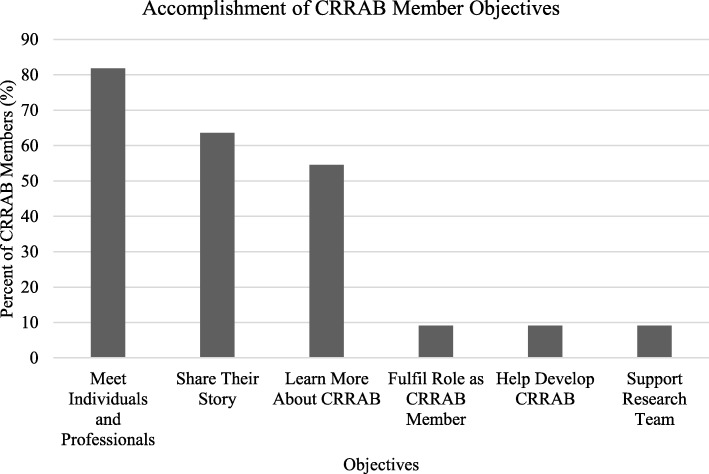
The Canadian Retinoblastoma Research Advisory Board (CRRAB) is a multidisciplinary group, including patients (survivors and family members), advocacy groups, healthcare professionals, and researchers, which aims to establish and sustain patient engagement in retinoblastoma research. The purpose of this study was to describe the development of CRRAB and to uncover members' understanding of and attitudes towards patient engagement in research. As well, to determine their level of engagement. Retinoblastoma patients, healthcare professionals, and researchers provided leadership to co-develop CRRAB. CRRAB members were surveyed by pre- and post-test questionnaire at the 2016 Annual General Meeting to assess experience with, understanding of, and attitudes towards patient engagement in research. A second questionnaire was administered before the 2017 CRRAB meeting to assess awareness and perceived impact of CRRAB activities, and individual engagement in research. Data were analyzed by descriptive statistics and paired t-test (for pre/post-test). Thematic analysis of chart board discussions at both meetings revealed the joint goals of CRRAB and reasons for and barriers to patient engagement. In 2016, 21 individuals participated and self-identified as patients (11, 52%), healthcare professionals (6, 29%), and/or researchers (7, 33%) (participants could overlap stakeholder groups). Overall, participants believed that research is relevant to all stakeholders and that patients can have meaningful impact on research. In 2017, 35 individuals participated and identified as patients (21, 60%), healthcare professionals (9, 26%), and/or researchers (8, 23%). 94% of participants were aware of CRRAB initiatives and 67% had participated in at least one over the previous year. Participants perceived that CRRAB provides diverse opportunities and increases accessibility for patient engagement in research, and perceived patient engagement to have meaningful impact on retinoblastoma research. Chart board discussions revealed that participants wanted to be part of CRRAB to increase knowledge, support innovation and patient engagement, and be part of a community. Members most commonly faced barriers including time and cost restraints. The results of this study suggest that CRRAB has supported the engagement needs of patients affected by retinoblastoma, and has provided an opportunity for engaging patients in retinoblastoma research. CRRAB will continue to be used as a framework for patient engagement, with improvements based on participant feedback.
视网膜母细胞瘤是一种罕见的眼癌,由于基因错误,发生在婴幼儿的一只或两只眼睛中。加拿大大约有2000名视网膜母细胞瘤幸存者。患有遗传性视网膜母细胞瘤的人有将基因传给下一代并患上第二种癌症的风险。因此,许多视网膜母细胞瘤幸存者及其家庭一生都与医疗系统有互动。视网膜母细胞瘤患者群体长期以来一直让患者参与研究,但没有任何正式流程。文献表明患者参与研究有诸多益处,比如研究结果更具适用性、可信度和透明度。基于利益相关者已有的兴趣,加拿大视网膜母细胞瘤研究咨询委员会(CRRAB)于2016年成立,以促进患者(幸存者和家庭成员)、倡导团体、医疗专业人员和视网膜母细胞瘤患者群体中的研究人员之间进行可持续且有意义的合作。本研究的目的是评估CRRAB在促进患者参与研究方面的效用。对CRRAB成员进行了调查,以了解他们对患者参与研究的态度和经验。参与者认为CRRAB为患者参与研究提供了多样且可及的机会,并认为他们的参与产生了有意义的影响。结果表明,CRRAB促进了视网膜母细胞瘤研究中的患者参与,并为维持和加强未来的患者参与提供了方向。
加拿大视网膜母细胞瘤研究咨询委员会(CRRAB)是一个多学科团体,包括患者(幸存者和家庭成员)、倡导团体、医疗专业人员和研究人员,其目标是建立并维持患者参与视网膜母细胞瘤研究。本研究的目的是描述CRRAB的发展情况,并了解成员对患者参与研究的理解和态度。此外,确定他们的参与程度。视网膜母细胞瘤患者、医疗专业人员和研究人员共同发挥领导作用,共同创建了CRRAB。在2016年年度股东大会上,通过会前和会后问卷调查对CRRAB成员进行了调查,以评估他们在患者参与研究方面的经验、理解和态度。在2017年CRRAB会议前发放了第二份问卷,以评估对CRRAB活动的知晓度和感知影响,以及个人在研究中的参与情况。通过描述性统计和配对t检验(用于会前/会后测试)对数据进行了分析。对两次会议上图表板讨论的主题分析揭示了CRRAB的共同目标以及患者参与的原因和障碍。2016年,21人参与并自我认定为患者(11人,52%)、医疗专业人员(6人,29%)和/或研究人员(7人,33%)(参与者可能归属多个利益相关者群体)。总体而言,参与者认为研究与所有利益相关者都相关,并且患者可以对研究产生有意义的影响。2017年,35人参与并认定为患者(21人,60%)、医疗专业人员(9人,26%)和/或研究人员(8人,23%)。去年,94%的参与者知晓CRRAB的倡议,67%的人至少参与了一项。参与者认为CRRAB为患者参与研究提供了多样的机会,并增加了可及性,且认为患者参与对视网膜母细胞瘤研究有有意义的影响。图表板讨论表明,参与者希望成为CRRAB的一员,以增加知识、支持创新和患者参与,并成为一个群体的一部分。成员最常面临的障碍包括时间和成本限制。本研究结果表明,CRRAB满足了受视网膜母细胞瘤影响患者的参与需求,并为患者参与视网膜母细胞瘤研究提供了机会。CRRAB将继续用作患者参与的框架,并根据参与者的反馈进行改进。