Health Services Research and Development Service, VA Puget Sound Health Care System, Seattle Division, Seattle, WA, USA.
Mental Health Service, VA Puget Sound Health Care System, Seattle Division, Seattle, WA, USA.
Am J Health Promot. 2020 Jul;34(6):587-598. doi: 10.1177/0890117120908505. Epub 2020 Mar 12.
Veterans with post-traumatic stress disorder (PTSD) lose less weight in the Veterans Affairs (VA) weight management program (MOVE!), so we developed MOVE!+UP.
Single-arm pre-post pilot to iteratively develop MOVE!+UP (2015-2018).
Veterans Affairs Medical Center.
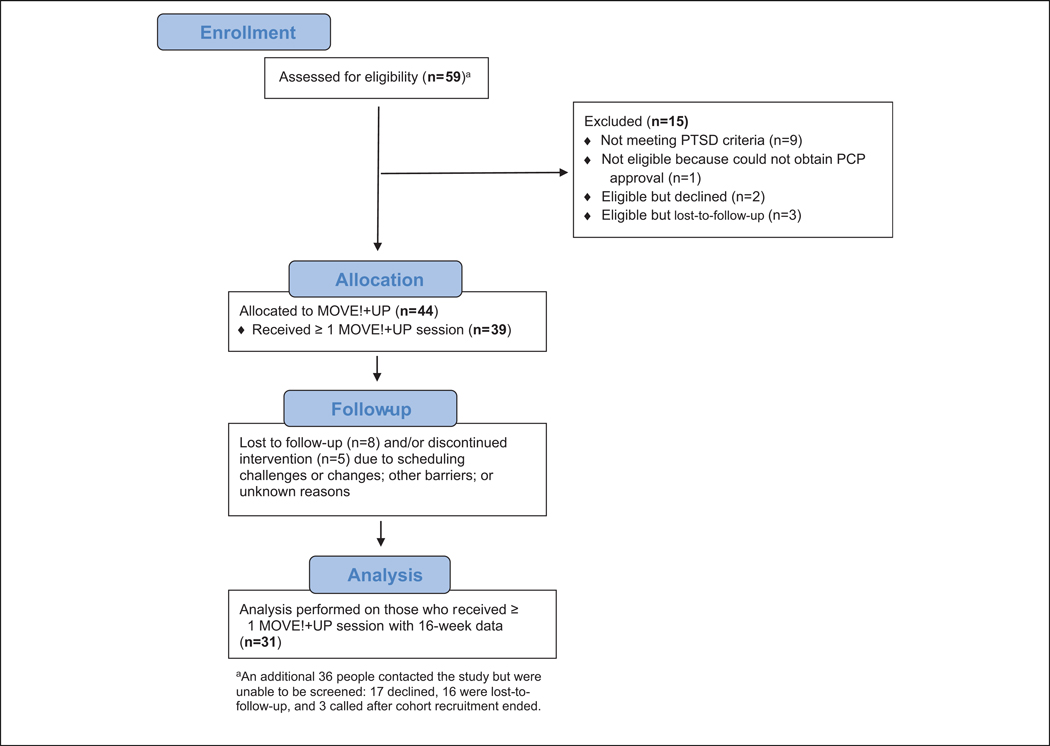
Overweight Veterans with PTSD (5 cohorts of n = 5-11 [N = 44]; n = 39 received ≥1 MOVE+UP session, with cohorts 1-4 [n = 31] = "Development" and cohort 5 [n = 8] = "Final" MOVE!+UP).
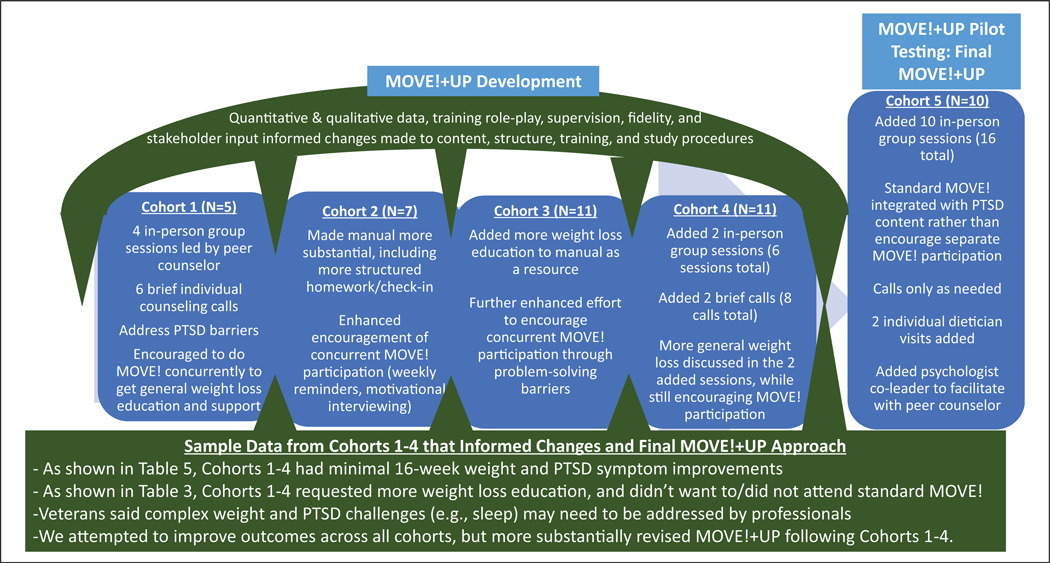
MOVE!+UP weight management for Veterans with PTSD modified after each cohort. Final MOVE!+UP was coled by a licensed clinical psychologist and Veteran peer counselor in 16 two-hour in-person group sessions and 2 individual dietician visits. Sessions included general weight loss support (eg, behavioral monitoring with facilitator feedback, weekly weighing), cognitive-behavioral skills to address PTSD-specific barriers, and a 30-minute walk to a nearby park.
To inform post-cohort modifications, we assessed weight, PTSD, and treatment targets (eg, physical activity, diet), and conducted qualitative interviews.
Baseline to 16-week paired tests and template analysis.
Development cohorts suggested improvements (eg, additional sessions and weight loss information, professional involvement) and did not lose weight (mean [] = 1.8 lbs (standard deviation [SD] = 8.2); = .29. Conversely, the final cohort reported high satisfaction and showed meaningful weight ( = -14 pounds [SD = 3.7] and 71% lost ≥5% baseline weight) and PTSD ( = -17.9 [SD = 12.2]) improvements, < .05.
The comprehensive, 16-week, in-person, cofacilitated Final MOVE!+UP was acceptable and may improve the health of people with PTSD. Iterative development likely produced a patient-centered intervention, needing further testing.
患有创伤后应激障碍(PTSD)的退伍军人在退伍军人事务部(VA)体重管理计划(MOVE!)中减重效果较差,因此我们开发了 MOVE!+UP。
单臂前后试点研究,用于迭代开发 MOVE!+UP(2015-2018 年)。
退伍军人事务医疗中心。
超重 PTSD 退伍军人(5 个队列,每组 5-11 人[共 44 人];39 人接受了≥1 次 MOVE+UP 治疗,队列 1-4[31 人]为“发展”队列,队列 5[8 人]为“最终”MOVE!+UP)。
根据每个队列对 PTSD 退伍军人的 MOVE!+UP 体重管理进行修改。最终的 MOVE!+UP 由一名持照临床心理学家和退伍军人同行顾问在 16 次两小时的小组会议和 2 次个人营养师访问中共同主持。课程包括一般减肥支持(例如,促进者反馈的行为监测、每周称重)、解决 PTSD 特定障碍的认知行为技能,以及到附近公园进行 30 分钟的步行。
为了为后续队列修改提供信息,我们评估了体重、创伤后应激障碍和治疗目标(例如,身体活动、饮食),并进行了定性访谈。
从基线到 16 周的配对 t 检验和模板分析。
发展队列提出了改进建议(例如,增加课程和减肥信息,专业参与),但没有减轻体重(平均[ ]=1.8 磅(标准差[SD]=8.2);=.29. 相反,最终队列报告了很高的满意度,并显示出有意义的体重(=-14 磅[SD=3.7]和 71%的人减去≥5%的基线体重)和 PTSD(=-17.9[SD=12.2])改善,<.05。
全面的、16 周的、面对面的、共同主持的最终 MOVE!+UP 是可以接受的,可能会改善 PTSD 患者的健康状况。迭代开发可能产生了以患者为中心的干预措施,需要进一步测试。