Department of Cell and Molecular Biology, Faculty of Biotechnology and Biomolecular Sciences, Universiti Putra Malaysia , Serdang , Malaysia.
Halal Products Research Institute, University Putra Malaysia , Serdang , Malaysia.
Pol J Microbiol. 2020;69(1):1-6. doi: 10.33073/pjm-2020-007.
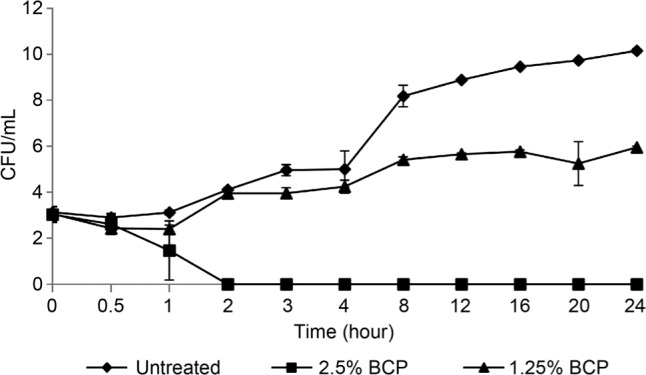
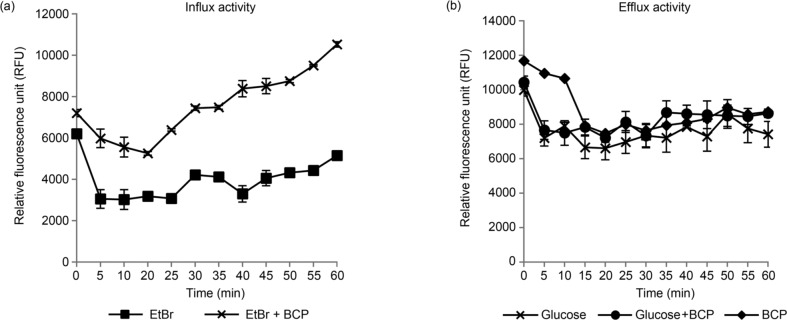
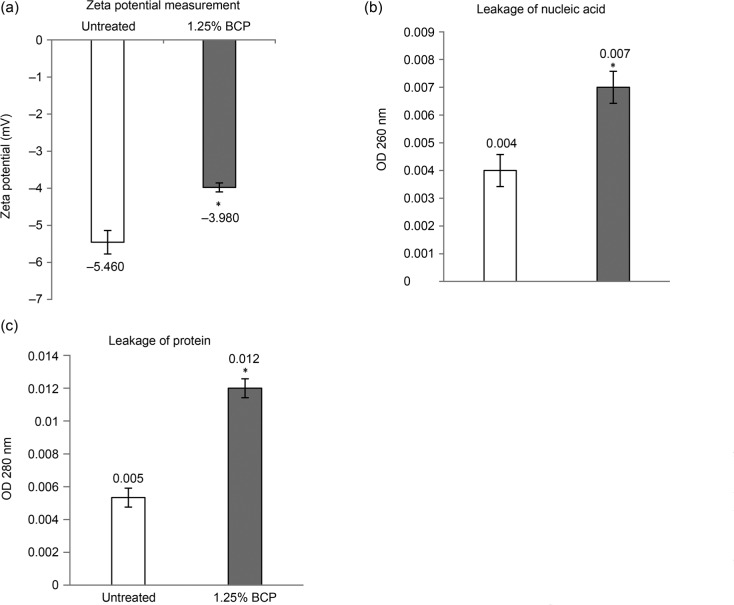
Natural products such as essential oils (EOs) are secondary metabolites that can be obtained from either plant or animal sources or produced by microorganisms. Much attention has been given to exploring the use of secondary metabolites as natural antibacterial agents. This study investigates the antibacterial activity and mechanism of β-caryophyllene, a compound that can be found in various EOs, against . The minimum inhibitory concentration of β-caryophyllene against was 2.5% (v/v), whereas killing kinetics of β-caryophyllene at minimum inhibitory concentration recorded complete bactericidal activity within 2 hours. Zeta-potential measurement in the cells treated with half the minimum inhibitory concentration of β-caryophyllene at 1.25% (v/v) showed an increase in the membrane permeability surface charge to -3.98 mV, compared to untreated cells (-5.46 mV). Intracellular contents leakage of UV-absorbing materials was detected in the cells treated with β-caryophyllene. Additionally, β-caryophyllene does not interfere with the efflux activity of via the ethidium bromide influx/efflux activity. The results revealed that β-caryophyllene was able to alter membrane permeability and integrity of , leading to membrane damage and intracellular content leakage, which eventually caused cell death. Natural products such as essential oils (EOs) are secondary metabolites that can be obtained from either plant or animal sources or produced by microorganisms. Much attention has been given to exploring the use of secondary metabolites as natural antibacterial agents. This study investigates the antibacterial activity and mechanism of β-caryophyllene, a compound that can be found in various EOs, against . The minimum inhibitory concentration of β-caryophyllene against was 2.5% (v/v), whereas killing kinetics of β-caryophyllene at minimum inhibitory concentration recorded complete bactericidal activity within 2 hours. Zeta-potential measurement in the cells treated with half the minimum inhibitory concentration of β-caryophyllene at 1.25% (v/v) showed an increase in the membrane permeability surface charge to –3.98 mV, compared to untreated cells (–5.46 mV). Intracellular contents leakage of UV-absorbing materials was detected in the cells treated with β-caryophyllene. Additionally, β-caryophyllene does not interfere with the efflux activity of via the ethidium bromide influx/efflux activity. The results revealed that β-caryophyllene was able to alter membrane permeability and integrity of , leading to membrane damage and intracellular content leakage, which eventually caused cell death.
天然产物,如精油(EOs),是可以从植物或动物来源或微生物中获得的次生代谢产物。人们非常关注探索次生代谢产物作为天然抗菌剂的用途。本研究调查了 β-石竹烯的抗菌活性和机制,β-石竹烯是一种存在于各种精油中的化合物,针对 。β-石竹烯对 的最小抑菌浓度为 2.5%(v/v),而在最低抑菌浓度下,β-石竹烯的杀菌动力学在 2 小时内记录了完全杀菌活性。在细胞中用 β-石竹烯的一半最小抑菌浓度(1.25%(v/v))处理后的 ζ-电位测量显示,细胞膜通透性表面电荷增加到-3.98 mV,而未处理的细胞为-5.46 mV。用 β-石竹烯处理的细胞中检测到紫外吸收物质的细胞内内容物泄漏。此外,β-石竹烯不干扰 通过溴化乙锭流入/流出活性的流出活性。结果表明,β-石竹烯能够改变 的膜通透性和完整性,导致膜损伤和细胞内内容物泄漏,最终导致细胞死亡。