Metcalfe Richard S, Atef Hady, Mackintosh Kelly, McNarry Melitta, Ryde Gemma, Hill Denise M, Vollaard Niels B J
Applied Sports Science, Technology, Exercise and Medicine Research Centre (A-STEM), Swansea University, Swansea, SA1 8EN, UK.
Department of Physical Therapy for Internal Medicine, Faculty of Physical Therapy, Cairo University, Giza, Egypt.
BMC Public Health. 2020 Mar 12;20(1):313. doi: 10.1186/s12889-020-8444-z.
The efficacy of high-intensity interval training (HIT) as a time-efficient exercise strategy for beneficially modifying risk factors for cardiovascular disease has repeatedly been demonstrated in controlled laboratory settings. However, the effectiveness of HIT in an unsupervised workplace setting has not been investigated. The objective of this study was to use mixed methods to investigate the feasibility, acceptability and effectiveness of a short-duration, high-intensity exercise intervention (REHIT) when applied unsupervised in a workplace setting.
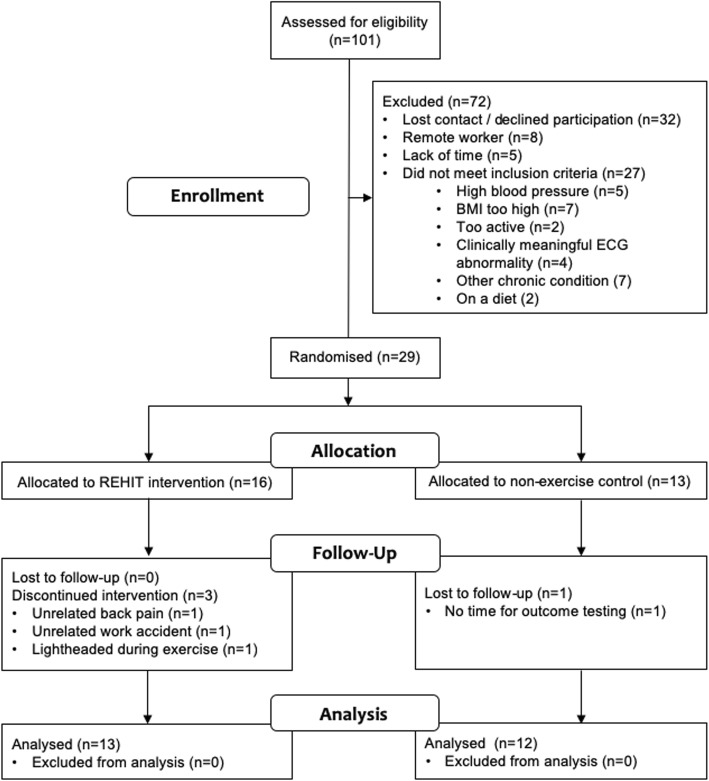
Twenty-five office-workers (mean ± SD age: 47 ± 9 y, BMI: 27.5 ± 4.4 kg·m, V̇Omax: 28 ± 7 mL·kg·min) completed a 6-week REHIT intervention unsupervised in their workplace (n = 13, 6 men), or acted as a no-intervention control (n = 12, 6 men). The intervention consisted of 2 sessions/week of low-intensity (~ 25 W) cycling interspersed with 2 'all-out' sprints, increasing in duration from 10 to 20 s per sprint over the 6 weeks (total time-commitment: 8:40 min per session). V̇Omax was assessed pre- and post-training, whilst questionnaire-based measures of exercise enjoyment, self-efficacy, and acceptability were completed post-training. Eight participants also completed post-intervention semi-structured interviews.
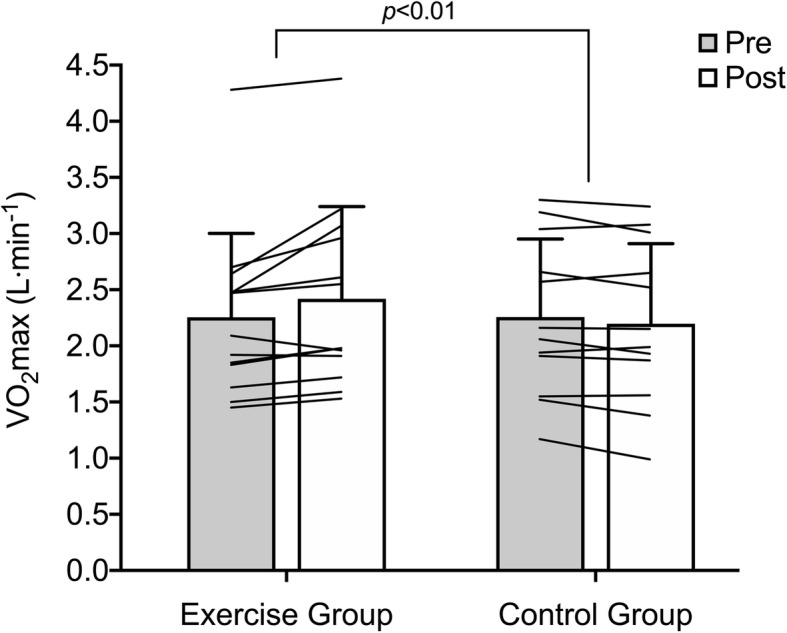
V̇Omax significantly improved in the exercise group (2.25 ± 0.75 L·min vs. 2.42 ± 0.82 L·min; + 7.4%) compared to the control group (2.22 ± 0.72 L·min vs. 2.17 ± 0.74 L·min; - 2.3%; time*intervention interaction effect: p < 0.01). Participants considered the REHIT intervention acceptable and enjoyable (PACES: 89 ± 17 out of 119) and were confident in their ability to continue to perform REHIT (7.8 ± 1.2 out of 9). Qualitative data revealed that REHIT offered a time-efficient opportunity to exercise, that was perceived as achievable, and which encouraged highly valued post-exercise outcomes (e.g. progress towards health/fitness benefits).
REHIT could be implemented as a feasible, effective and acceptable exercise intervention in a workplace setting, with a total time-commitment of < 20 min/week. Consideration of certain psycho-social factors and behaviour-change techniques may ensure adherence to the REHIT programme in the long term.
The study was registered on ClinicalTrials.gov on 07/05/2019 (registration: NCT03941145).
高强度间歇训练(HIT)作为一种能有效改善心血管疾病风险因素的高效运动策略,已在受控实验室环境中得到反复验证。然而,HIT在无监督的工作场所环境中的有效性尚未得到研究。本研究的目的是采用混合方法,调查在工作场所无监督情况下应用的短期高强度运动干预(REHIT)的可行性、可接受性和有效性。
25名办公室职员(平均±标准差年龄:47±9岁,体重指数:27.5±4.4kg·m²,最大摄氧量:28±7mL·kg⁻¹·min⁻¹)在其工作场所无监督地完成了为期6周的REHIT干预(n = 13,6名男性),或作为无干预对照组(n = 12,6名男性)。干预包括每周2次低强度(约25W)骑行,其间穿插2次“全力”冲刺,在6周内每次冲刺的持续时间从10秒增加到20秒(每次训练总时长:8分40秒)。在训练前和训练后评估最大摄氧量,同时在训练后通过问卷调查测量运动乐趣、自我效能感和可接受性。8名参与者还在干预后完成了半结构化访谈。
与对照组相比,运动组的最大摄氧量显著提高(2.25±0.75L·min⁻¹对2.42±0.82L·min⁻¹;+7.4%),而对照组为(2.22±0.72L·min⁻¹对2.1