Norwegian Trauma Registry, Division of Orthopedic Surgery, Oslo University Hospital, Oslo, Norway.
Faculty of Health Science, University of Stavanger, Stavanger, Norway.
Scand J Trauma Resusc Emerg Med. 2020 Mar 12;28(1):20. doi: 10.1186/s13049-020-0703-6.
Trauma is a major cause of mortality and reduced quality of life. Most trauma-related research originates from trauma centres, and there are limited available data regarding the treatment of trauma patients throughout the Nordic countries. These countries differ from economically similar countries due to their cold climate, mix of rural and urban areas, and the long distances separating many residents from a trauma centre. Research funders and the general public expect trauma research to focus on all links in the treatment chain. Here we conducted a systematic review to assess the amount of trauma-related research from the Nordic countries between January 1995 and April 2018, and the distribution of this research among different countries and different parts of the trauma treatment chain.
A systematic literature search was conducted in Medline, Embase, the Cochrane Library, Web of Science, and Scopus. We included studies concerning the trauma population from Nordic countries, and published between January 1995 and April 2018. Two independent reviewers screened titles and abstracts, and performed data extraction from full-text articles.
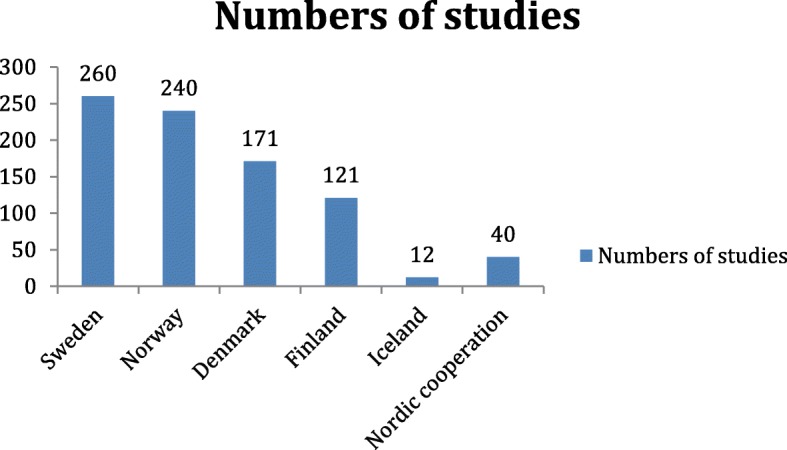
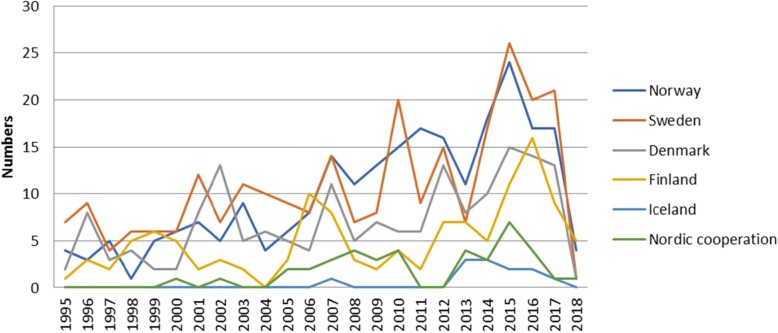
The literature search yielded 5117 titles and abstracts, of which 844 full-text articles were included in our analysis. During this period, the annual number of publications increased. Publications were equally distributed among Norway, Sweden, and Denmark in terms of numbers; however, Norway had more publications relative to inhabitants. There were fewer overall publications from Finland and Iceland. We identified mostly cohort studies and very few randomized controlled trials. Studies focused on the level of care were predominantly epidemiological studies. Research at the pre-hospital level was three-fold more frequent than research on other elements of the trauma treatment chain.
The rate of publications in the field of trauma care in the Nordic countries has increased over recent years. However, several parts of the trauma treatment chain are still unexplored and most of the available studies are observational studies with low research evidence.
创伤是导致死亡率和生活质量下降的主要原因。大多数与创伤相关的研究都源于创伤中心,而关于北欧国家创伤患者治疗的可用数据有限。由于寒冷的气候、城乡混合以及许多居民与创伤中心之间的距离遥远,这些国家与经济相似的国家有所不同。研究资助者和公众期望创伤研究关注治疗链中的所有环节。在这里,我们进行了一项系统评价,以评估 1995 年 1 月至 2018 年 4 月期间来自北欧国家的创伤相关研究数量,以及这些研究在不同国家和创伤治疗链的不同部分的分布情况。
在 Medline、Embase、Cochrane 图书馆、Web of Science 和 Scopus 中进行了系统文献检索。我们纳入了来自北欧国家的创伤人群的研究,并于 1995 年 1 月至 2018 年 4 月期间发表。两名独立评审员筛选标题和摘要,并从全文文章中提取数据。
文献检索产生了 5117 个标题和摘要,其中 844 篇全文文章纳入我们的分析。在此期间,每年发表的文章数量都在增加。从数量上看,挪威、瑞典和丹麦的出版物数量相当;然而,挪威的出版物与居民的比例更高。芬兰和冰岛的出版物总体上较少。我们发现大多数是队列研究,很少有随机对照试验。关注护理水平的研究主要是流行病学研究。与创伤治疗链的其他部分相比,院前水平的研究频率是其三倍。
近年来,北欧国家创伤护理领域的出版物数量有所增加。然而,创伤治疗链的几个部分仍未得到探索,并且大部分可用研究都是观察性研究,研究证据水平较低。