Department of Clinical Pharmacy, College of Pharmacy, University of Michigan, 428 Church Street, Ann Arbor, MI, 48109, USA.
Department of Biostatistics, University of Michigan School of Public Health, Ann Arbor, USA.
Breast Cancer Res Treat. 2020 Apr;180(3):707-714. doi: 10.1007/s10549-020-05584-8. Epub 2020 Mar 12.
Approximately 25% of patients receiving weekly paclitaxel for breast cancer require treatment disruptions to avoid severe, irreversible peripheral neuropathy (PN). Vitamin insufficiencies are PN risk factors in many diseases, but their relevance to chemotherapy-induced PN is unknown.
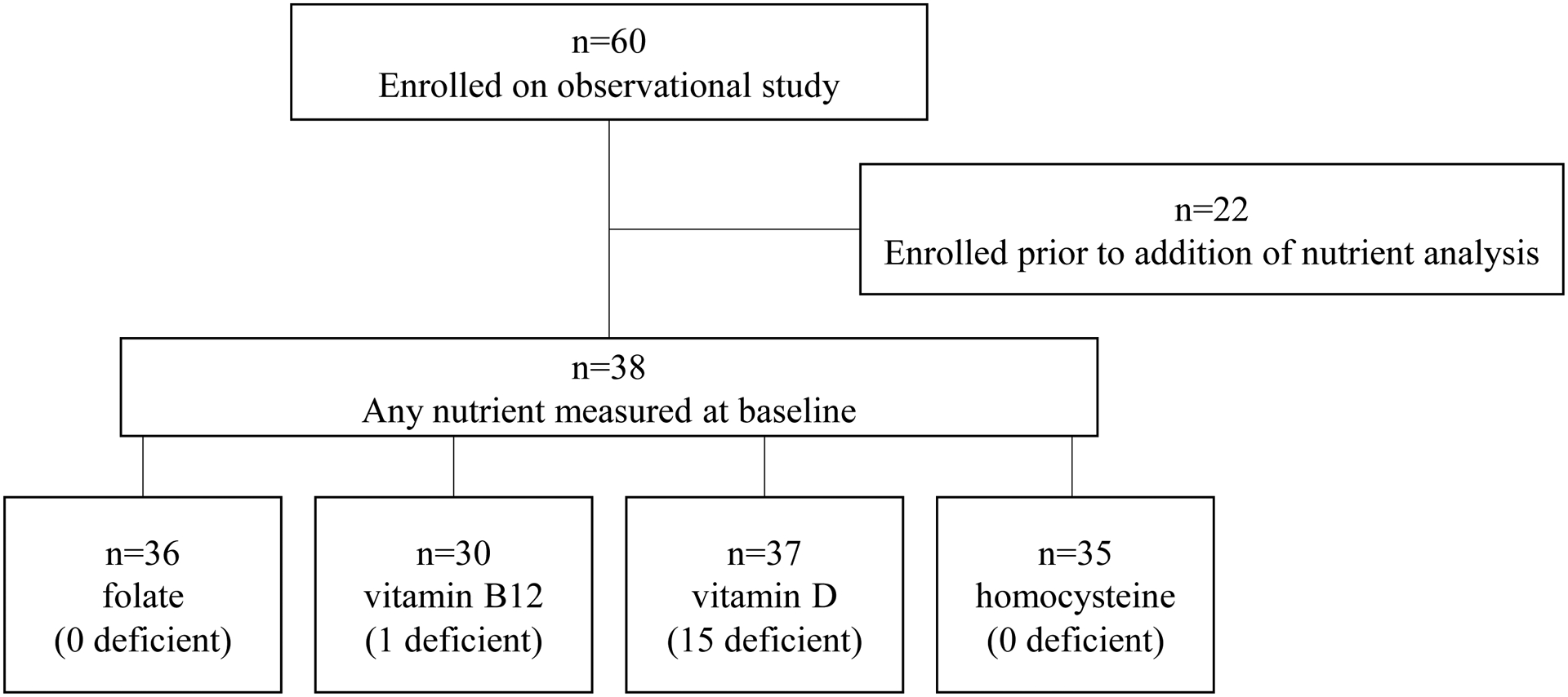
We investigated whether baseline insufficiency of vitamin D, vitamin B12, folate, or homocysteine increased PN in patients with breast cancer receiving weekly paclitaxel in a retrospective analysis of a prospective observational study. Patient-reported PN was collected at baseline and during treatment on the Quality of Life Questionnaire Chemotherapy-Induced Peripheral Neuropathy (CIPN20). The primary analysis tested associations between vitamin deficiency and the maximum increase from baseline in the CIPN20 sensory subscale (ΔCIPN8). Secondary analyses tested for association with PN-induced treatment disruptions and adjusted associations for treatment and clinical variables.
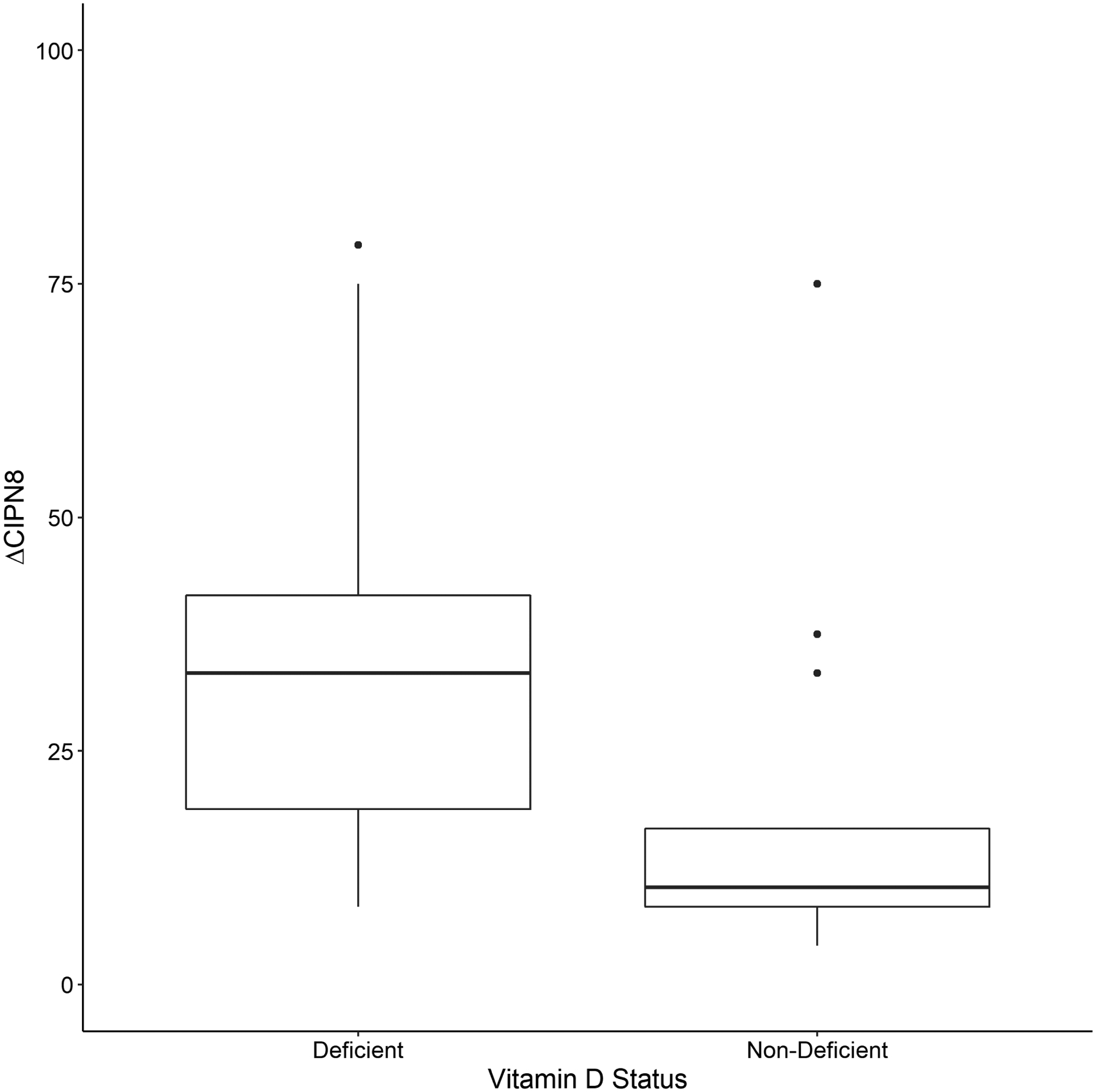
25-hydroxy-vitamin D was the only nutrient with sufficient deficiency (< 20 ng/mL) for analysis (15/37 = 41%). Vitamin D-deficient patients had a greater mean PN increase than non-deficient patients (ΔCIPN8 ± SD, 36 ± 23 vs. 16 ± 16, p = 0.003) and a non-significant, approximately threefold increase in risk of treatment disruption (OR 2.98, 95% CI [0.72, 12.34], p = 0.16). In multivariable models adjusted for clinical and treatment variables, baseline vitamin D level was inversely associated with PN (β = - 0.04, p = 0.02).
Pre-treatment vitamin D deficiency was associated with PN in women receiving weekly paclitaxel for breast cancer. Vitamin D deficiency may be an easily detected PN risk factor that could be resolved prior to treatment to prevent PN, avoid treatment disruptions, and improve treatment outcomes.
约 25%接受每周紫杉醇治疗乳腺癌的患者需要中断治疗,以避免严重、不可逆的周围神经病变(PN)。维生素缺乏是许多疾病发生 PN 的危险因素,但它们与化疗引起的 PN 的相关性尚不清楚。
我们通过对一项前瞻性观察研究的回顾性分析,调查了乳腺癌患者每周接受紫杉醇治疗时,基线时维生素 D、维生素 B12、叶酸或同型半胱氨酸缺乏是否会增加 PN。患者报告的 PN 在基线时和治疗期间使用化疗诱导的周围神经病变问卷(CIPN20)进行收集。主要分析测试了维生素缺乏与 CIPN20 感觉子量表的最大基线增加(ΔCIPN8)之间的关联。次要分析测试了与 PN 引起的治疗中断的关联,并调整了治疗和临床变量的关联。
只有 25-羟维生素 D 有足够的缺乏(<20ng/mL)进行分析(15/37=41%)。维生素 D 缺乏的患者与非缺乏的患者相比,PN 增加的平均值更大(ΔCIPN8±SD,36±23 vs. 16±16,p=0.003),并且治疗中断的风险增加了约三倍(OR 2.98,95%CI[0.72,12.34],p=0.16)。在调整了临床和治疗变量的多变量模型中,基线维生素 D 水平与 PN 呈负相关(β=−0.04,p=0.02)。
在接受每周紫杉醇治疗乳腺癌的女性中,治疗前维生素 D 缺乏与 PN 相关。维生素 D 缺乏可能是一种易于检测的 PN 危险因素,可以在治疗前解决,以预防 PN、避免治疗中断并改善治疗结局。