Faculty of Computer Science, Otto von Guericke University Magdeburg, Universitätsplatz 2, Magdeburg, 39106, Germany.
Tinnitus Center, Charité Universitaetsmedizin Berlin, Charitéplatz 1, Berlin, 10117, Germany.
Sci Rep. 2020 Mar 13;10(1):4664. doi: 10.1038/s41598-020-61593-z.
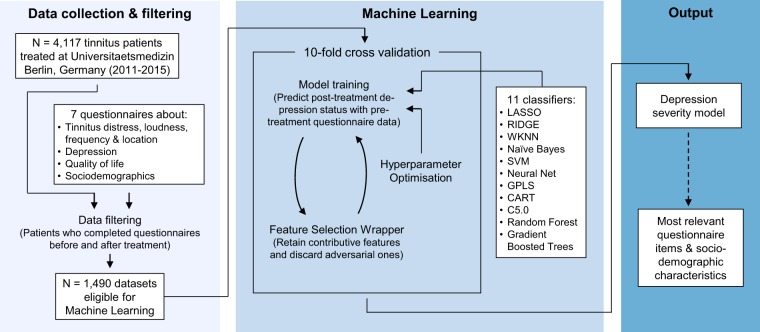
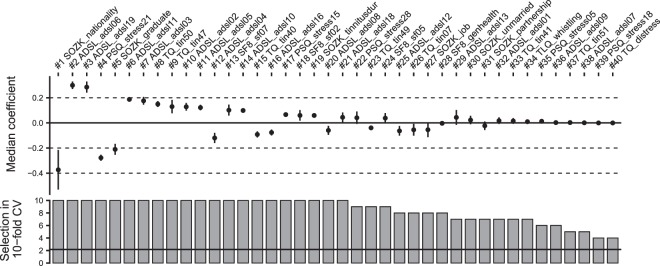
Tinnitus is a complex condition that is associated with major psychological and economic impairments - partly through various comorbidities such as depression. Understanding the interaction between tinnitus and depression may thus improve either symptom cluster's prevention, diagnosis and treatment. In this study, we developed and validated a machine learning model to predict depression severity after outpatient therapy (T1) based on variables obtained before therapy (T0). 1,490 patients with chronic tinnitus (comorbid major depressive disorder: 52.2%) who completed a 7-day multimodal treatment encompassing tinnitus-specific components, cognitive behavioural therapy, physiotherapy and informational counselling were included. 185 variables were extracted from self-report questionnaires and socio-demographic data acquired at T0. We used 11 classification methods to train models that reliably separate between subclinical and clinical depression at T1 as measured by the general depression questionnaire. To ensure highly predictive and robust classifiers, we tuned algorithm hyperparameters in a 10-fold cross-validation scheme. To reduce model complexity and improve interpretability, we wrapped model training around an incremental feature selection mechanism that retained features that contributed to model prediction. We identified a LASSO model that included all 185 features to yield highest predictive performance (AUC = 0.87 ± 0.04). Through our feature selection wrapper, we identified a LASSO model with good trade-off between predictive performance and interpretability that used only 6 features (AUC = 0.85 ± 0.05). Thus, predictive machine learning models can lead to a better understanding of depression in tinnitus patients, and contribute to the selection of suitable therapeutic strategies and concise and valid questionnaire design for patients with chronic tinnitus with or without comorbid major depressive disorder.
耳鸣是一种复杂的病症,与重大的心理和经济障碍有关——部分原因是存在各种共病,如抑郁症。因此,了解耳鸣与抑郁症之间的相互作用可能会改善这两个症状群的预防、诊断和治疗。在这项研究中,我们开发并验证了一个机器学习模型,以根据治疗前(T0)获得的变量预测门诊治疗(T1)后抑郁症的严重程度。共有 1490 名慢性耳鸣患者(合并有重度抑郁症:52.2%)完成了为期 7 天的多模态治疗,包括耳鸣特异性成分、认知行为疗法、物理疗法和信息咨询。从 T0 获得的自我报告问卷和社会人口统计学数据中提取了 185 个变量。我们使用了 11 种分类方法来训练模型,这些模型可以可靠地区分 T1 时使用一般抑郁问卷测量的亚临床和临床抑郁症。为了确保高度预测性和稳健的分类器,我们在 10 倍交叉验证方案中调整了算法超参数。为了降低模型复杂性并提高可解释性,我们将模型训练包装在一个增量特征选择机制中,该机制保留了有助于模型预测的特征。我们确定了一个包含所有 185 个特征的 LASSO 模型,以获得最高的预测性能(AUC = 0.87±0.04)。通过我们的特征选择包装器,我们确定了一个具有良好预测性能和可解释性之间折衷的 LASSO 模型,该模型仅使用 6 个特征(AUC = 0.85±0.05)。因此,预测性机器学习模型可以帮助更好地理解耳鸣患者的抑郁症,并有助于为伴有或不伴有合并重度抑郁症的慢性耳鸣患者选择合适的治疗策略和简洁有效的问卷设计。