Department of Neurosurgery, Center for Neuroregeneration, Houston Methodist Research Institute, Houston, TX, USA.
Mayo Clinic Graduate School of Biomedical Sciences, Mayo Clinic, Rochester, MN, USA.
Physiol Rep. 2020 Mar;8(5):e14397. doi: 10.14814/phy2.14397.
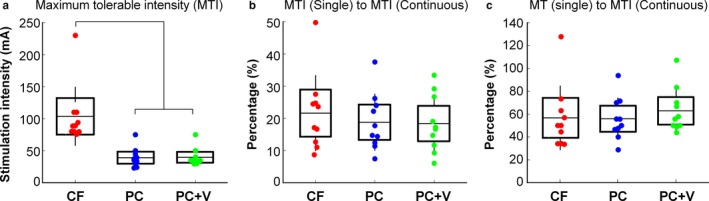
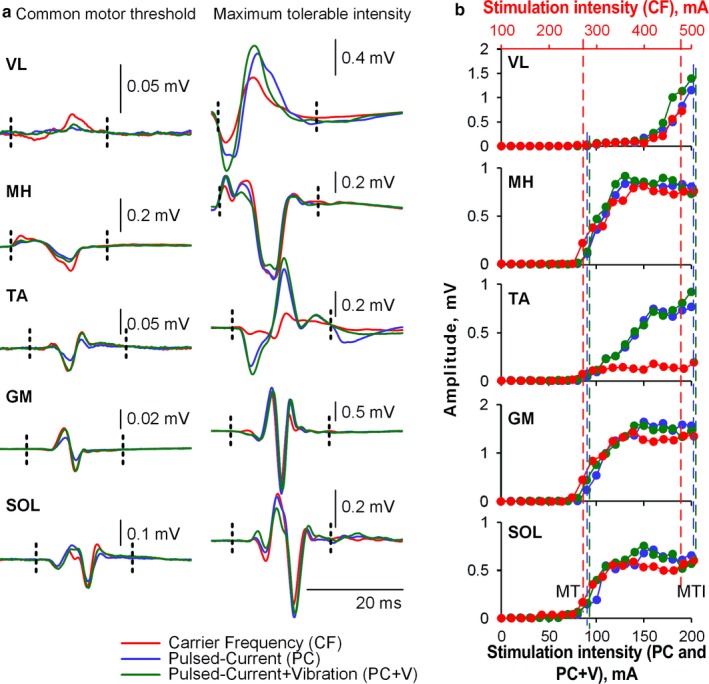
Transcutaneous spinal stimulation (TSS) is a useful tool to modulate spinal sensorimotor circuits and has emerged as a potential treatment for motor disorders in neurologically impaired populations. One major limitation of TSS is the discomfort associated with high levels of stimulation during the experimental procedure. The objective of this study was to examine if the discomfort caused by TSS can be alleviated using different stimulation paradigms in a neurologically intact population. Tolerance to TSS delivered using conventional biphasic balanced rectangular pulses was compared to two alternative stimulation paradigms: a 5 kHz carrier frequency and biphasic balanced rectangular pulses combined with vibrotactile stimulation. In ten healthy participants, tolerance to TSS was examined using both single-pulse (0.2 Hz) and continuous (30 Hz) stimulation protocols. In both the single-pulse and continuous stimulation protocols, participants tolerated significantly higher levels of stimulation with the carrier frequency paradigm compared to the other stimulation paradigms. However, when the maximum tolerable stimulation intensity of each stimulation paradigm was normalized to the intensity required to evoke a lower limb muscle response, there were no statistical differences between the stimulation paradigms. Our results suggest that, when considering the intensity of stimulation required to obtain spinally evoked motor potentials, neither alternative stimulation paradigm is more effective at reducing discomfort than the conventional, unmodulated pulse configuration.
经皮脊髓刺激(TSS)是调节脊髓感觉运动回路的有用工具,已成为神经损伤人群运动障碍的潜在治疗方法。TSS 的一个主要限制是在实验过程中高刺激水平引起的不适。本研究的目的是检查在神经完整人群中使用不同的刺激模式是否可以减轻 TSS 引起的不适。使用传统双相平衡矩形脉冲的 TSS 引起的不适与两种替代刺激模式进行了比较:5 kHz 载波频率和双相平衡矩形脉冲与振动刺激相结合。在 10 名健康参与者中,使用单脉冲(0.2 Hz)和连续(30 Hz)刺激方案检查了 TSS 的耐受性。在单脉冲和连续刺激方案中,与其他刺激方案相比,参与者对载波频率方案的刺激水平耐受性更高。然而,当将每个刺激方案的最大可耐受刺激强度归一化为引起下肢肌肉反应所需的强度时,刺激方案之间没有统计学差异。我们的结果表明,当考虑获得脊髓诱发运动电位所需的刺激强度时,与传统的未调制脉冲配置相比,替代刺激方案都不能更有效地减轻不适。