Department of Infectious Diseases and Immunology, Shanghai Public Health Clinical Center, Shanghai 201508, China.
Department of Infectious Diseases, Shanghai Public Health Clinical Center, 2901 Caolang Road, Shanghai 201508, China.
J Infect. 2020 May;80(5):e1-e6. doi: 10.1016/j.jinf.2020.03.004. Epub 2020 Mar 19.
Studies on the 2019 novel coronavirus disease (COVID-19) have generally been limited to the description of the epidemiology and initial clinical characteristics. We investigated the temporal progression in patients with COVID-19.
In this retrospective, single-center study, we included confirmed cases of COVID-19 from Jan 20 to Feb 6, 2020 in Shanghai. Final date of follow-up was February 25, 2020.
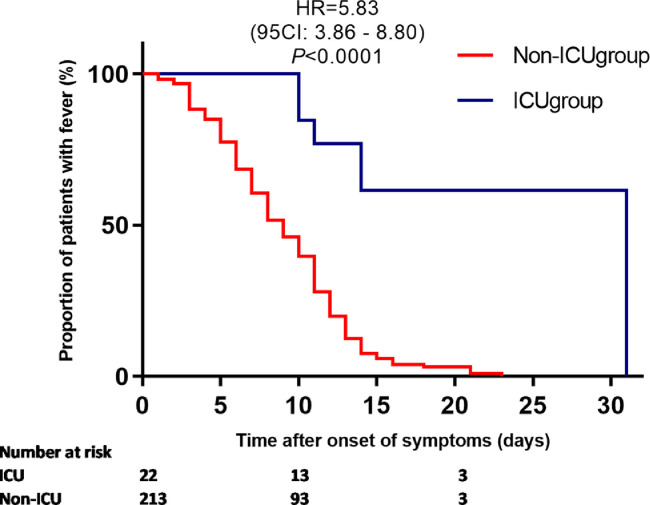
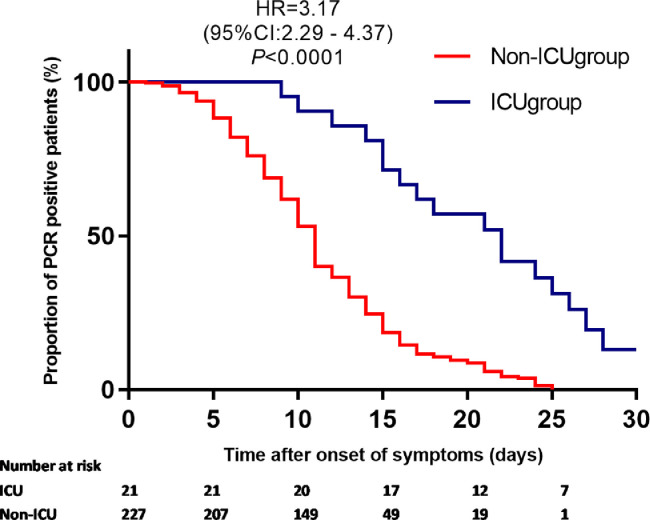
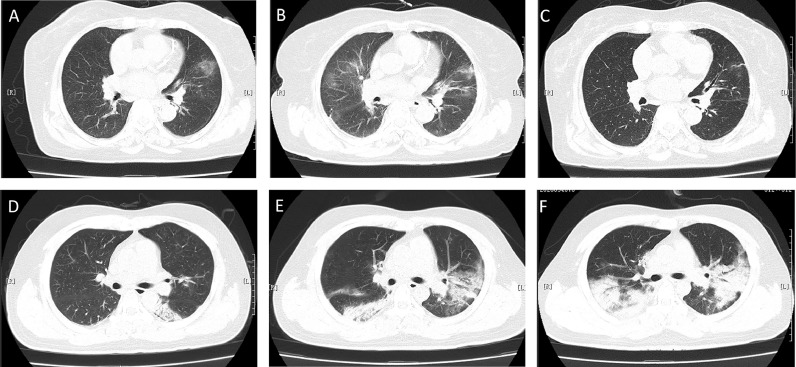
Of the 249 patients enrolled, the median age was 51 years old, and 126 (50.6%) were male. The duration from onset of symptoms to hospitalization was 4(2-7) days in symptomatic patients. Fever was occurred in 235(94.3%) patients. A total of 215 (86.3%) patients had been discharged after 16(12-20) days hospitalization. The estimated median duration of fever in all the patients with fever was 10 days (95 confidential intervals [CIs]: 8-11 days) after onset of symptoms. Patients who were transferred to intensive care units (ICU) had significantly longer duration of fever as compared to those not in ICU (31 days v.s. 9 days after onset of symptoms, respectively, P <0.0001). Radiological aggravation of initial image was observed in 163 (65.7%) patients on day 7 after onset of symptoms. 154(94.5%) of these patients showed radiological improvement on day 14. The median duration to negative reverse-transcriptase PCR tests of upper respiratory tract samples was 11 days (95 CIs: 10-12 days). Viral clearance was more likely to be delayed in patients in ICU than those not in ICU (P <0.0001). In multivariate logistical analysis, age (Odds ratio [OR] = 1.06) and CD4 T cell count (OR = 0.55 per 100 cells/ul increase) were independently associated with ICU admission.
The majority of COVID-19 cases are mild. The clinical progression pattern suggests that early control of viral replication and application of host-directed therapy in later stage is essential to improve the prognosis of CVOID-19.
关于 2019 年新型冠状病毒病(COVID-19)的研究通常仅限于描述其流行病学和初始临床特征。我们调查了 COVID-19 患者的时间进展情况。
在这项回顾性的单中心研究中,我们纳入了 2020 年 1 月 20 日至 2 月 6 日上海确诊的 COVID-19 病例。最终随访日期为 2020 年 2 月 25 日。
在纳入的 249 例患者中,中位年龄为 51 岁,126 例(50.6%)为男性。有症状患者从出现症状到住院的时间为 4(2-7)天。235 例(94.3%)患者发热。16(12-20)天后,215 例(86.3%)患者出院。所有发热患者的发热中位持续时间为症状出现后 10 天(95%置信区间:8-11 天)。与未转入重症监护病房(ICU)的患者相比,转入 ICU 的患者发热时间明显延长(分别为症状出现后 31 天和 9 天,P<0.0001)。在症状出现后第 7 天,163 例(65.7%)患者的初始图像出现影像学加重。其中 154 例(94.5%)患者在第 14 天出现影像学改善。上呼吸道样本逆转录酶聚合酶链反应检测结果阴性的中位时间为 11 天(95%置信区间:10-12 天)。与未转入 ICU 的患者相比,转入 ICU 的患者病毒清除时间更可能延迟(P<0.0001)。在多变量逻辑分析中,年龄(优势比[OR] = 1.06)和 CD4 T 细胞计数(OR = 每增加 100 个细胞/μl 降低 0.55)与 ICU 入院独立相关。
大多数 COVID-19 病例为轻症。临床进展模式表明,早期控制病毒复制和后期应用宿主定向治疗对于改善 COVID-19 预后至关重要。