Ngoula Ferdinand, Lontio Fulbert Aime, Tchoffo Herve, Manfo Tsague Faustin Pascal, Djeunang Roméo-Marcial, Vemo Bertin Narcisse, Moffo Frederic, Djuissi Motchewo Nadege
Animal Physiology and Health Research Unit, Faculty of Agronomy and Agricultural Sciences, University of Dschang, Dschang, Cameroon.
Department of Biochemistry and Molecular Biology, Faculty of Sciences, University of Buea Buea, Cameroon.
Front Vet Sci. 2020 Feb 26;7:37. doi: 10.3389/fvets.2020.00037. eCollection 2020.
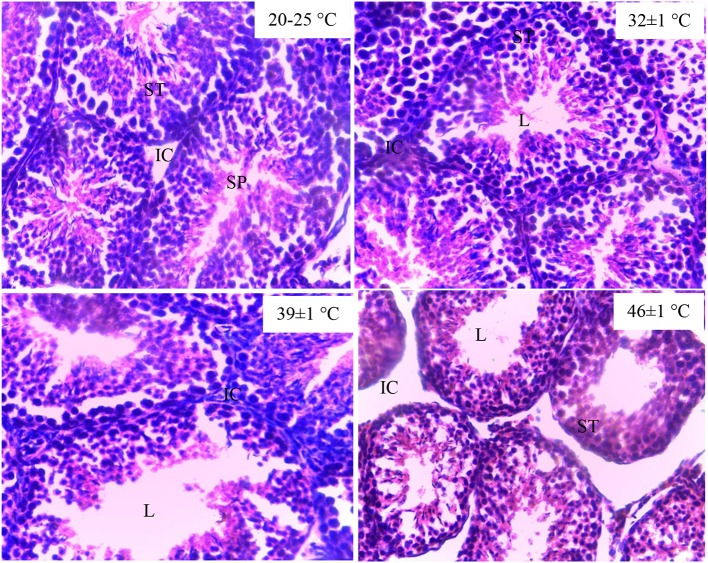
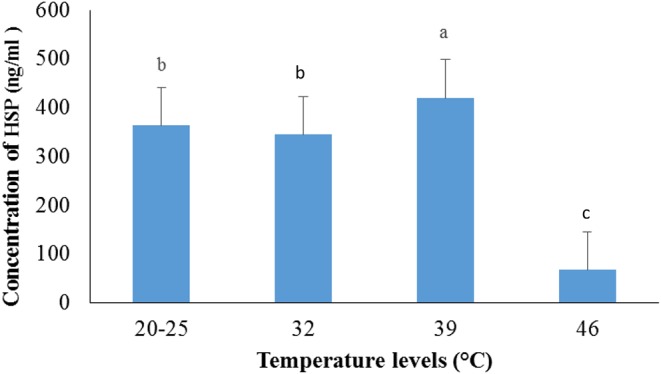
The present study was designed to evaluate the effects of heat that induces oxidative stress on reproduction organ weight and serum biochemical, testes structure, and function in male guinea pig (). Forty-eight male guinea pigs with an average weight of 330.56 ± 23.62 g, aged 3-4 months, were distributed into four groups of 12 animals each. One group (control) was maintained to ambient temperature (20-25°C), while other groups (Groups 2-4) were exposed daily for 6 h, to 32 ± 1°C, 39±1°C, and 46 ± 1°C, respectively. All animals were sacrificed after 60 days' exposure and their reproductive characteristics values were determined. Results revealed a significant decrease ( < 0.05) of the weight of testes, epididymis, vas deferens, and accessory glands in cavies exposed to the highest temperature investigated (46 ± 1°C), compared to the control animals. There was a significant ( < 0.05) reduction of serum testosterone and LH levels in all heat stress-exposed groups (≥46 ± 1°C) when compared to the control group. Heat stress significantly ( < 0.05) decreased sperm mobility, sperm count, and testicular antioxidant enzymes, while increasing testicular malondialdehyde content. However, the serum level of HSP-40 increased in the animals exposed to 39 ± 1°C and decreased when the cavies were exposed to 46 ± 1°C. In conclusion, exposure to heat-induced oxidative stress results in impairment of reproduction organ weight and serum biochemical, testes structure, and function in male cavies.
本研究旨在评估诱导氧化应激的热对雄性豚鼠生殖器官重量、血清生化指标、睾丸结构及功能的影响。48只平均体重为330.56±23.62克、年龄为3 - 4个月的雄性豚鼠被分为四组,每组12只。一组(对照组)维持在环境温度(20 - 25°C),而其他组(第2 - 4组)每天分别暴露于32±1°C、39±1°C和46±1°C的环境中6小时。暴露60天后,处死所有动物并测定其生殖特征值。结果显示,与对照动物相比,暴露于所研究的最高温度(46±1°C)的豚鼠,其睾丸、附睾、输精管和附属腺体的重量显著降低(<0.05)。与对照组相比,所有热应激暴露组(≥46±1°C)的血清睾酮和促黄体生成素水平均显著降低(<0.05)。热应激显著降低了精子活力、精子数量和睾丸抗氧化酶,同时增加了睾丸丙二醛含量。然而,暴露于39±1°C的动物血清HSP - 40水平升高,而暴露于46±1°C的豚鼠血清HSP - 40水平降低。总之,暴露于热诱导的氧化应激会导致雄性豚鼠生殖器官重量、血清生化指标、睾丸结构及功能受损。