Darios Frédéric, Mochel Fanny, Stevanin Giovanni
Sorbonne Université, Paris, France.
Inserm, U1127, Paris, France.
Front Neurosci. 2020 Feb 28;14:74. doi: 10.3389/fnins.2020.00074. eCollection 2020.
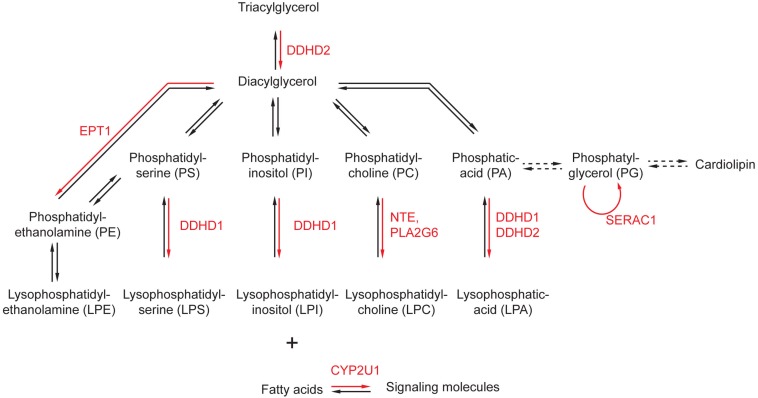
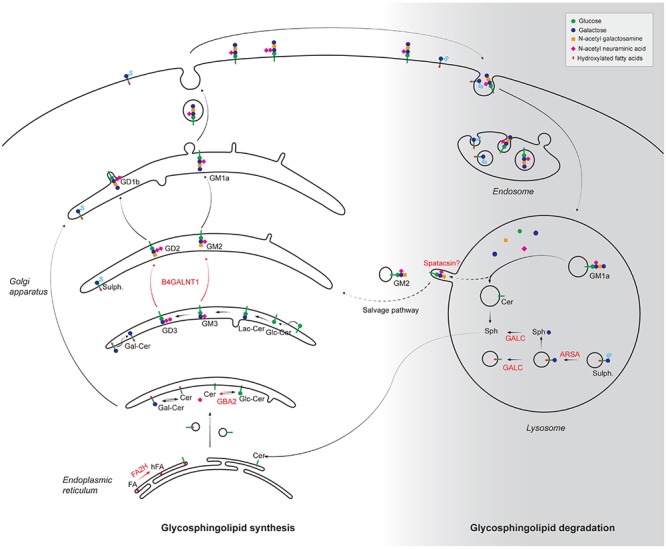
Hereditary spastic paraplegias (HSP) are a group of neurodegenerative diseases sharing spasticity in lower limbs as common symptom. There is a large clinical variability in the presentation of patients, partly underlined by the large genetic heterogeneity, with more than 60 genes responsible for HSP. Despite this large heterogeneity, the proteins with known function are supposed to be involved in a limited number of cellular compartments such as shaping of the endoplasmic reticulum or endolysosomal function. Yet, it is difficult to understand why alteration of such different cellular compartments can lead to degeneration of the axons of cortical motor neurons. A common feature that has emerged over the last decade is the alteration of lipid metabolism in this group of pathologies. This was first revealed by the identification of mutations in genes encoding proteins that have or are supposed to have enzymatic activities on lipid substrates. However, it also appears that mutations in genes affecting endoplasmic reticulum, mitochondria, or endolysosome function can lead to changes in lipid distribution or metabolism. The aim of this review is to discuss the role of lipid metabolism alterations in the physiopathology of HSP, to evaluate how such alterations contribute to neurodegenerative phenotypes, and to understand how this knowledge can help develop therapeutic strategy for HSP.
遗传性痉挛性截瘫(HSP)是一组以双下肢痉挛为共同症状的神经退行性疾病。患者临床表现存在很大差异,部分原因是基因高度异质性,有60多个基因与HSP相关。尽管存在这种高度异质性,但已知功能的蛋白质被认为仅涉及有限的细胞区室,如内质网的塑形或内溶酶体功能。然而,很难理解为何这些不同细胞区室的改变会导致皮质运动神经元轴突退化。在过去十年中出现的一个共同特征是,在这组疾病中脂质代谢发生了改变。这首先是通过鉴定编码对脂质底物具有或被认为具有酶活性的蛋白质的基因突变而揭示的。然而,似乎影响内质网、线粒体或内溶酶体功能的基因突变也会导致脂质分布或代谢的变化。本综述的目的是讨论脂质代谢改变在HSP病理生理学中的作用,评估这些改变如何导致神经退行性表型,并了解这些知识如何有助于制定HSP的治疗策略。