Srivastava Rakesh K, Singh Ram B, Pujarula Vijaya Lakshmi, Bollam Srikanth, Pusuluri Madhu, Chellapilla Tara Satyavathi, Yadav Rattan S, Gupta Rajeev
International Crops Research Institute for the Semi-Arid Tropics (ICRISAT), Hyderabad, India.
All India Coordinated Research Project on Pearl Millet (AICRP-PM), Indian Council of Agricultural Research (ICAR), Jodhpur, India.
Front Genet. 2020 Feb 28;10:1389. doi: 10.3389/fgene.2019.01389. eCollection 2019.
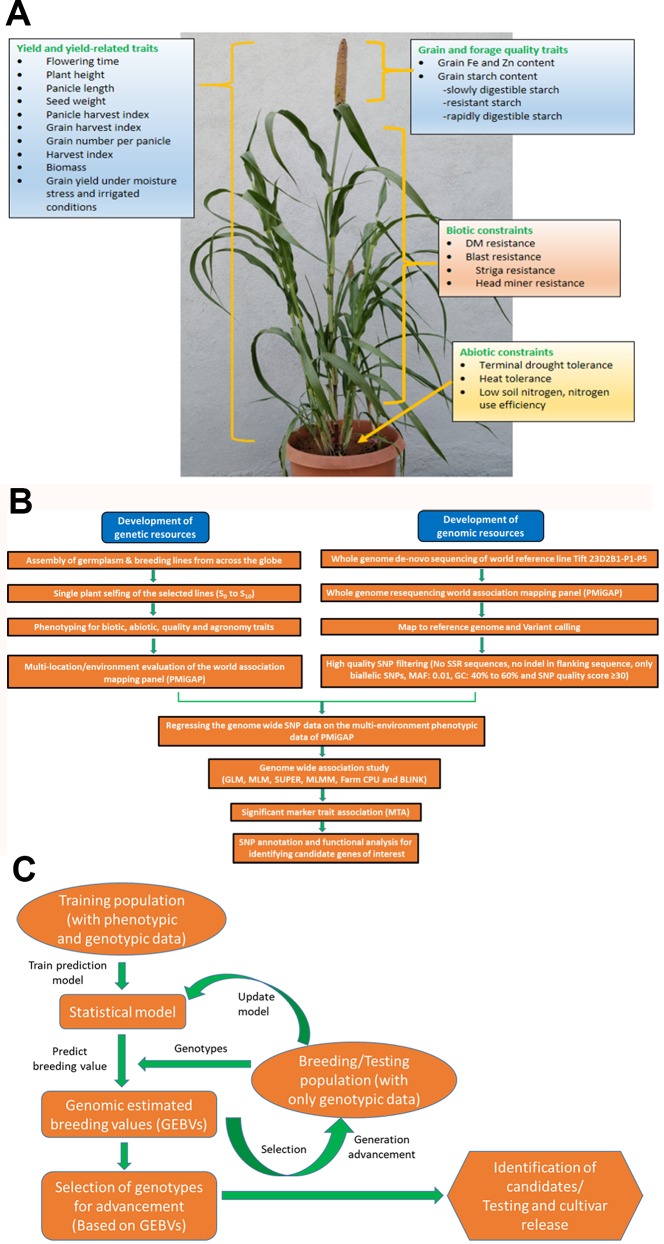
Pearl millet is a climate-resilient, drought-tolerant crop capable of growing in marginal environments of arid and semi-arid regions globally. Pearl millet is a staple food for more than 90 million people living in poverty and can address the triple burden of malnutrition substantially. It remained a neglected crop until the turn of the 21st century, and much emphasis has been placed since then on the development of various genetic and genomic resources for whole-genome scan studies, such as the genome-wide association studies (GWAS) and genomic selection (GS). This was facilitated by the advent of sequencing-based genotyping, such as genotyping-by-sequencing (GBS), RAD-sequencing, and whole-genome re-sequencing (WGRS) in pearl millet. To carry out GWAS and GS, a world association mapping panel called the Pearl Millet inbred Germplasm Association Panel (PMiGAP) was developed at ICRISAT in partnership with Aberystwyth University. This panel consisted of germplasm lines, landraces, and breeding lines from 27 countries and was re-sequenced using the WGRS approach. It has a repository of circa 29 million genome-wide SNPs. PMiGAP has been used to map traits related to drought tolerance, grain Fe and Zn content, nitrogen use efficiency, components of endosperm starch, grain yield, etc. Genomic selection in pearl millet was jump-started recently by WGRS, RAD, and tGBS (tunable genotyping-by-sequencing) approaches for the PMiGAP and hybrid parental lines. Using multi-environment phenotyping of various training populations, initial attempts have been made to develop genomic selection models. This mini review discusses advances and prospects in GWAS and GS for pearl millet.
珍珠粟是一种适应气候变化、耐旱的作物,能够在全球干旱和半干旱地区的边缘环境中生长。珍珠粟是9000多万贫困人口的主食,能在很大程度上应对营养不良的三重负担。在21世纪之交之前,它一直是一种被忽视的作物,从那时起,人们就非常重视开发各种遗传和基因组资源用于全基因组扫描研究,如全基因组关联研究(GWAS)和基因组选择(GS)。珍珠粟中基于测序的基因分型技术的出现,如简化基因组测序(GBS)、RAD测序和全基因组重测序(WGRS),推动了这一进程。为了开展GWAS和GS,国际半干旱热带作物研究所(ICRISAT)与阿伯里斯特威斯大学合作,开发了一个名为珍珠粟自交系种质关联面板(PMiGAP)的全球关联作图面板。该面板由来自27个国家的种质系、地方品种和育种系组成,并采用WGRS方法进行了重测序。它拥有约2900万个全基因组单核苷酸多态性(SNP)的储存库。PMiGAP已被用于定位与耐旱性、籽粒铁和锌含量、氮利用效率、胚乳淀粉成分、籽粒产量等相关的性状。最近,通过对PMiGAP和杂交亲本系采用WGRS、RAD和可调GBS(tGBS,可调简化基因组测序)方法,珍珠粟的基因组选择工作得以启动。利用各种训练群体的多环境表型分析,已经初步尝试开发基因组选择模型。这篇小型综述讨论了珍珠粟GWAS和GS的进展与前景。